AI Overview
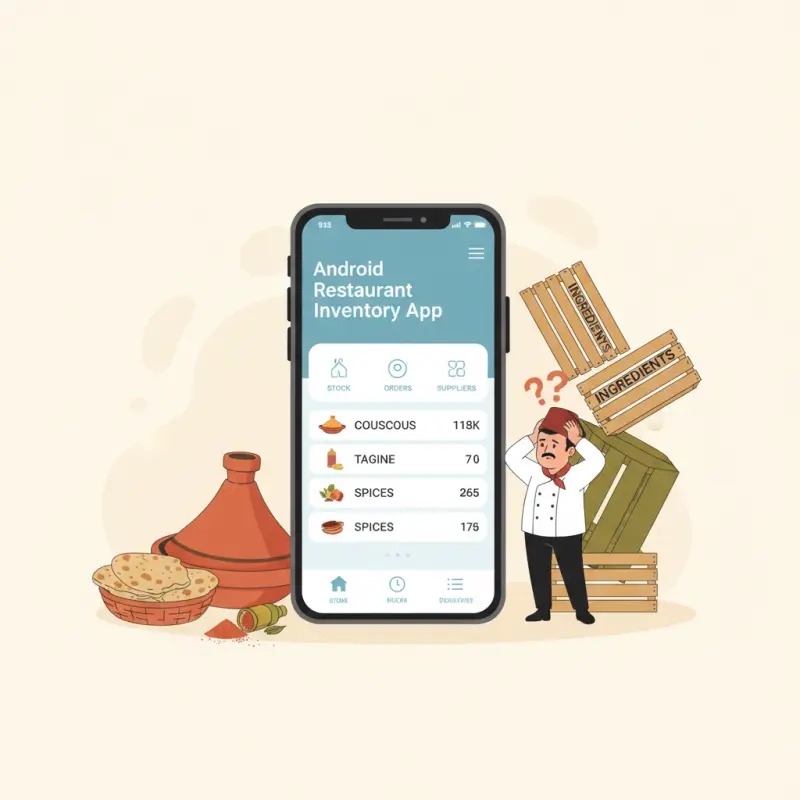
Most android restaurant inventory app solutions fail because they treat symptoms instead of causes, creating more work rather than solving core inventory problems. Moroccan restaurants lose an average of 12,000 MAD monthly to inventory mismanagement, with costs climbing to 18,000 MAD when factoring in staff time spent on manual tracking. Standalone apps that don't integrate with POS systems create data gaps where sales aren't reflected in inventory counts, leading to blind ordering decisions. The fundamental issue isn't tracking what's currently in stock — it's predicting future needs based on sales patterns and seasonal demand. Restaurant owners in Morocco need integrated solutions that connect inventory management directly to their point-of-sale systems. The most effective approach combines real-time stock tracking with automated ordering based on historical consumption patterns and upcoming demand forecasts.
Table of Contents
The Real Cost of Manual Inventory in Moroccan Restaurants
A mid-sized restaurant in Casablanca loses 12,000 MAD every month to inventory mismanagement. That's not a typo — it's the average cost of manual stock tracking across Morocco's restaurant industry. When you factor in the four hours daily that staff spend counting items, reconciling spreadsheets, and chasing supplier discrepancies, the real cost climbs to 18,000 MAD monthly.
The hidden costs cut deeper than most restaurant owners realize. Each pricing error from outdated ingredient costs shaves 2-3% off profit margins. Spoilage from over-ordering hits another 5%. But the worst damage happens in supplier relationships — when you can't track what you ordered versus what arrived, vendors learn they can short-change deliveries without consequence.
Restaurant owners search for an Android restaurant inventory app thinking technology will solve these problems. Most discover that disconnected apps create new headaches instead of fixing old ones.
Stack audit
What do you currently use?
Tick what you have. We’ll show what OCHI replaces or connects to.
Why Most Android Restaurant Inventory Apps Miss the Mark
The fundamental flaw with standalone inventory apps is simple: they treat symptoms instead of causes. These apps excel at telling you what's in your freezer right now. They fail at predicting what should be there tomorrow based on your Tuesday lunch patterns or upcoming holiday weekend.
Here's the contrarian truth no app developer wants to admit — most restaurant stock management software creates more work, not less. Staff now juggle paper counts, Excel sheets, AND a mobile app. Triple the data entry means triple the errors.
The Integration Problem Nobody Talks About
When your inventory app doesn't connect to your POS system, every sale creates a data gap. Your restaurant software inventory shows 50 chicken breasts in stock. Your POS processed 30 chicken tagines today. But nobody updated the inventory count because the systems don't talk. By week's end, you're ordering blind.
The accuracy gap compounds daily. Kitchen staff estimate portions instead of weighing them. Servers forget to log wasted items. Your "smart" inventory system becomes dumber than the paper it replaced because at least paper forced a daily reconciliation.
The Training Trap
Complex interfaces kill adoption faster than any technical limitation. Watch a line cook try to update inventory counts on a cluttered app interface during dinner rush. They'll abandon the system within days and return to mental notes. When your restaurant inventory program requires a training manual, it's already failed.
The average kitchen worker in Agadir changes jobs every eight months. If your inventory system takes two weeks to master, you're constantly training new staff on a tool they'll barely use before leaving.
What Restaurant Stock Management Software Actually Needs to Do
Forget the feature lists in app store descriptions. Real restaurant inventory management software must match how kitchens actually operate. Morning deliveries need quick receiving workflows. Prep teams need simple portion tracking. Service staff need instant low-stock alerts. End-of-day counts must reconcile automatically with sales data.
The core workflow looks like this: scan delivery invoices, prep ingredients by recipe requirements, track depletion through POS integration, and generate next-day orders based on predictive modeling. Any system that adds steps to this flow creates friction that kills adoption.
Gram-Level Precision vs. Unit Counting
Recipe costing demands ingredient-level tracking at gram precision. "Five tomatoes left" tells you nothing about portion costs when tomatoes range from 150g to 300g each. Professional restaurant inventory management software weighs ingredients, not units.
Consider a basic margherita pizza. Proper costing requires: 250g dough (2.50 MAD), 80g tomato sauce (1.20 MAD), 120g mozzarella (7.80 MAD), 5g basil (0.50 MAD). Unit counting gives you "1 pizza" — useless for pricing decisions or waste tracking.
Predictive Ordering Based on Sales Patterns
Smart restaurant software inventory analyzes your sales history to forecast needs. If you sell 40% more tagines on Fridays, the system adjusts Thursday's chicken order automatically. If tourist season starts in two weeks, ingredient orders ramp up based on last year's patterns.
This predictive approach transforms inventory from reactive counting to proactive planning. You order what you'll need, not what you've run out of.
OCHI's Inventory System: A Real-World Test Case
Restaurant Zahra in Marrakech's medina struggled with 35% food costs — well above the 28% target for Moroccan casual dining. After implementing OCHI's integrated inventory system, they cut waste by 25% in three months through gram-level tracking and automated supplier ordering.
| Metric | Before OCHI | After 3 Months | Improvement |
|---|---|---|---|
| Food Cost % | 35% | 27% | 8 points |
| Weekly Orders | 14 orders | 6 orders | 57% reduction |
| Monthly Spoilage | 8,500 MAD | 2,100 MAD | 75% reduction |
| Inventory Hours/Week | 28 hours | 8 hours | 20 hours saved |
The transformation started with connecting every system — when a customer orders through the OCHI platform, inventory depletes automatically based on recipe specifications. No manual updates. No guesswork.
How Integration Changes Everything
OCHI's approach differs because inventory isn't a separate module — it's woven into every operation. When servers punch orders into the POS, ingredients deduct immediately. When chefs mark items as prepared on the Kitchen Display System, portion sizes verify against recipes. When delivery drivers return, credits process automatically for returned items.
This integration eliminates the data gaps that plague standalone apps. Your Tuesday lunch rush automatically adjusts Wednesday's prep list. Your weekend specials trigger Monday supplier orders. The system thinks like a chef, not an accountant.
The 25% Waste Reduction Breakdown
Restaurant Zahra's waste dropped through three specific changes. First, gram-level tracking revealed portion inconsistencies — their "250g" steaks averaged 310g, costing an extra 4,200 MAD monthly. Second, automated low-stock alerts prevented over-ordering perishables by 40%. Third, connecting recipes to inventory exposed ingredient substitutions that inflated costs without improving quality.
The real breakthrough came from predictive ordering. Instead of guessing Friday's needs on Wednesday, the system analyzed six months of sales patterns, weather data, and local events to forecast with 91% accuracy.
Choosing Your Restaurant Inventory Program: The Decision Framework
Skip the feature comparisons. Evaluate inventory systems based on three criteria that actually matter: integration depth, adoption simplicity, and total operational cost.
Integration depth means your Android restaurant inventory app connects to POS, recipes, suppliers, and accounting without manual bridges. Adoption simplicity means your newest prep cook masters it in one shift. Total operational cost includes software, training, errors from disconnected systems, and time spent on workarounds.
A standalone inventory app might cost 500 MAD monthly. Add 2,000 MAD for integration headaches, 3,000 MAD for accuracy gaps, and 4,000 MAD in staff time managing disconnected systems. That "affordable" app now costs 9,500 MAD monthly. Compare that to unified platforms where inventory flows naturally through existing workflows.
The math becomes clear when you stop viewing inventory as an isolated function. Your restaurant doesn't need another app to manage — it needs restaurant stock management software that thinks like your kitchen operates.
Ready to see how integrated inventory management works? Set up your restaurant at votrenom.ochi.ma and track every gram from day one. Visit ochi.ma/partners to explore the complete platform.
Frequently Asked Questions
What makes a good android restaurant inventory app for Moroccan restaurants?
A good android restaurant inventory app must integrate with your POS system to automatically update stock levels with each sale. It should predict future inventory needs based on sales patterns, not just track current stock levels.
Why do standalone inventory apps fail in restaurants?
Standalone apps create data gaps because they don't connect to POS systems. Staff end up managing paper counts, Excel sheets, and the mobile app separately, tripling data entry and errors.
How much do Moroccan restaurants lose to poor inventory management?
Mid-sized restaurants in Morocco lose an average of 12,000 MAD monthly to inventory mismanagement. Including staff time costs, total losses reach 18,000 MAD per month.
What should I look for in restaurant inventory software in Morocco?
Look for software that integrates inventory with POS, predicts ordering needs based on sales patterns, and tracks supplier performance. Avoid apps that require duplicate data entry across multiple systems.
Can mobile inventory apps reduce food waste in restaurants?
Mobile apps alone don't reduce waste effectively. Integrated systems that track sales patterns and predict demand prevent over-ordering, which causes 5% of profit margin losses from spoilage.
Restaurant owners · Weekly
The guide to running a restaurant in 2026.
One article per week. No commission advice. Just honest operational insight for Moroccan restaurants.

Blog Manager
Comments
No comments yet. Be the first to share your thoughts.