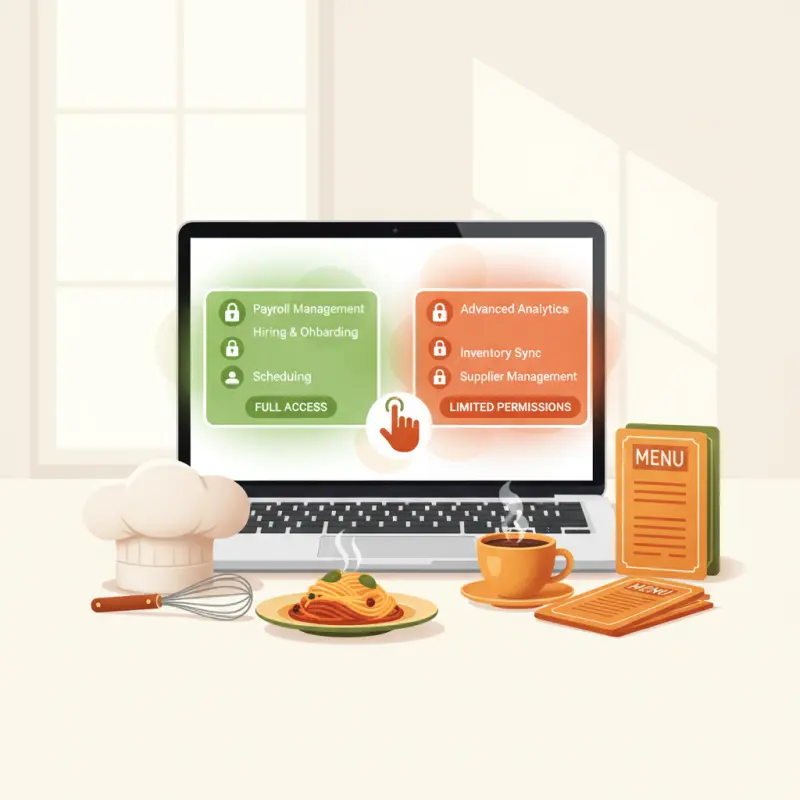
Best HR Software for Restaurants: Permission Control Over Feature Lists
Blog Manager
··6 min read
AI Overview
The best hr software for restaurants isn't about scheduling or time tracking — it's about controlling permissions to prevent revenue loss. Most Moroccan restaurants lose 2-3% of revenue to staff-related theft because generic HR software treats permission control as yes/no toggles instead of detailed role matrices. Real restaurant operations need morning shift managers with different permissions than evening cashiers, servers who can void orders with proper approval chains, and audit trails that track every transaction modification. Systems like Square for Restaurants and Toast offer basic employee management, but they can't match integrated platforms that combine POS permissions with staff scheduling in one dashboard. Choose software that lets you define exactly who can approve overtime, void orders after payment, edit time sheets, and access cash drawers — with full audit trails showing when and why each action happened.
Table of Contents
For restaurant owners
Start your restaurant in 60 minutes.
From signup to your first real order — no commission, no setup fee, no sales call.
Your head chef just approved their own overtime for the third month straight. Your cashier's daily reports show perfect balance, but revenue keeps dropping. These aren't HR software problems — they're permission problems that cost Moroccan restaurants thousands of dirhams monthly.
Most restaurant owners searching for the best HR software for restaurants get sold feature lists: scheduling, time tracking, payroll integration. But after helping over 1,000 restaurants across Morocco digitize their operations, we've learned the real issue isn't tracking hours. It's controlling who can approve what, when, and why.
Why Restaurant HR Software Fails (And What Actually Matters)
Walk into any restaurant in Casablanca's Maarif district and ask about their biggest staff challenge. You won't hear about scheduling conflicts. You'll hear about the waiter who voids orders after customers pay cash. The shift manager who edits time sheets retroactively. The cashier whose drawer mysteriously balances despite missing receipts.
Generic restaurant HR software treats these as separate issues — time tracking here, POS permissions there, scheduling somewhere else. But they're all the same problem: accountability gaps that basic employee management tools can't close.
The Permission Problem Most Restaurants Ignore
Traditional restaurant workforce management software gives you two options: everyone can do everything, or nobody can do anything. Neither works in real restaurant operations where your morning shift manager needs different permissions than your evening cashier.
Consider this common scenario: A server needs to void an incorrect order. Simple enough. But who approved that void? Can they void orders after payment? What about partial voids? Most systems treat this as a yes/no toggle when it needs to be a detailed permission matrix tied to specific roles and audit trails.
When "Employee Management" Becomes Employee Theft
The average restaurant in Morocco loses 2-3% of revenue to internal theft — that's MAD 30,000 annually for a mid-sized operation. Not from elaborate schemes, but from simple permission gaps: managers approving their own changes, servers processing their own refunds, cashiers closing their own shifts without oversight.
The 8-Role Framework: Building Bulletproof Restaurant Operations
After analyzing thousands of operational failures across Moroccan restaurants, patterns emerge. The same eight roles appear in every successful operation, each with distinct permissions that prevent overlap and abuse.
Role
Core Permissions
Cannot Do
Reports To
Admin
All system access, role assignment
Direct cash handling
Owner
Branch Manager
Staff scheduling, reports, voids
Edit own timesheet
Admin
POS Operator
Order entry, payment processing
Void after payment
Branch Manager
Waiter
Table orders, order status
Process payments
POS Operator
Chef
Kitchen display, order timing
Void orders
Branch Manager
Delivery Boy
Order pickup, status updates
Edit order details
POS Operator
Cashier
Cash handling, shift reports
Approve own report
Branch Manager
Staff
Clock in/out, view schedule
All transactional access
All roles above
Admin vs Manager vs Server: Who Can Do What (And Why It Matters)
OCHI's implementation of this framework goes beyond simple role assignment. Each action creates an audit trail linking the employee, their role at that moment, and the supervising authority. A waiter can request a void, but only their assigned POS Operator can approve it. That operator's actions are logged and reviewed by the Branch Manager during shift close.
This cascade of accountability stops the most common theft patterns. When every action requires appropriate authority and creates permanent records, the opportunities for abuse shrink dramatically.
The Audit Trail That Catches Problems Before They Cost You
The best restaurant scheduling software helps you plan shifts. But it's the per-employee activity history that saves your business. Every order modification, every refund, every clock-in adjustment — tracked by employee, timestamp, and authorizing manager.
Smart restaurant owners in Marrakech's Guéliz district learned this after implementing OCHI's system: the threat of an audit trail prevents more theft than catching it after the fact. When employees know every action links back to them personally, behavior changes overnight.
The MAD 120,000 Question: What Restaurant Workforce Management Software Actually Costs
Restaurant owners get sticker shock seeing HR software prices: MAD 500-2,000 per month for basic features. But they're comparing the wrong numbers. The real equation isn't software cost versus no cost — it's software cost versus operational loss.
Hidden Costs of "Free" Restaurant Scheduling Software
That free scheduling app seems perfect until you calculate the real cost. No audit trails mean you can't prove who changed what. No role separation means your closing manager can edit the entire day's records. No integration means manual entry errors compound daily.
A typical 30-seat restaurant in Agadir loses MAD 8,000-12,000 monthly to these gaps: phantom refunds, buddy punching, inventory "mistakes" that follow patterns. Suddenly MAD 1,000 for proper restaurant HR software looks like a bargain.
Cost Per Employee: The Math That Changes Everything
Break down the numbers per employee and the decision becomes obvious. MAD 50 per employee monthly for comprehensive workforce management versus MAD 400 in average monthly loss per employee without it. The ROI hits positive in the first week — if you choose software that actually addresses restaurant realities.
Case Study: How Café Atlas in Marrakech Caught a 15,000 MAD Refund Scam
Three months of declining revenue despite steady customer traffic. That was the puzzle facing Café Atlas until they implemented OCHI's granular permission system. Within 48 hours, the per-employee activity logs revealed the truth.
The Red Flag: Unusual Refund Patterns
Their senior server — a five-year veteran — showed an unusual pattern. Refunds clustered at shift end, always for cash orders, always approved by the same shift manager. The amounts seemed random: MAD 67 here, MAD 124 there. Small enough to hide in daily variance, large enough to total MAD 15,000 over three months.
Traditional POS systems would show these as legitimate refunds. But OCHI's employee history tracking revealed the pattern: orders placed, food prepared and presumably served, then refunded after cash payment. The shift manager's approval came without ever checking with the kitchen about returned food.
The Solution: Granular Activity Logs and Role-Based Access
The fix was simple: refunds now require kitchen confirmation for prepared orders. Shift managers can't approve refunds for orders during their own shifts — that requires Branch Manager authority. Every refund links to the original order, the authorizing manager, and includes a mandatory reason code.
Result: refunds dropped 75% overnight. Not because legitimate refunds stopped, but because the fake ones became impossible without multiple people colluding — and leaving digital fingerprints.
Your Restaurant's HR Software Decision Tree
Choosing the best HR software for restaurants isn't about features. It's about matching your operational reality to the right permission structure. Here's how to decide:
Single Location vs Multi-Branch Requirements
Single location under 20 employees: Basic scheduling and time tracking might suffice if you personally supervise most operations. But the moment you step away — even for a day off — you need role-based permissions.
Multiple locations or over 20 employees: Non-negotiable RBAC with per-branch permission inheritance. What works in your Casablanca flagship might need adjustment for your Rabat expansion. OCHI's branch-level permission customization handles this automatically while maintaining central oversight.
Integration Requirements That Actually Matter
Forget the marketing speak about "seamless integration." You need three specific connections: POS permissions sync (who can void what), time tracking to payroll (authenticated hours only), and audit logs to your accounting system (for variance analysis).
Every other integration is nice-to-have. These three are business-critical for restaurants serious about controlling labor costs and operational theft.
The best HR software for restaurants isn't the one with the most features. It's the one that understands restaurants lose more money to permission gaps than scheduling conflicts. Once you see your operation through this lens — roles, permissions, and audit trails instead of just shifts and timesheets — the right choice becomes clear.
Ready to see how granular permissions can transform your restaurant's operations? Check out the complete OCHI platform at ochi.ma/partners.
Frequently Asked Questions
What makes the best HR software for restaurants different from regular HR software?
Restaurant HR software must integrate with POS systems to control transaction permissions, handle shift-based scheduling, and provide real-time oversight of cash handling. Generic HR software can't manage who can void orders or approve overtime in restaurant-specific contexts.
How much do restaurants lose from poor staff permission controls?
The average restaurant in Morocco loses 2-3% of revenue from staff-related issues like unauthorized voids, time sheet manipulation, and cash handling problems. This amounts to thousands of dirhams monthly for most establishments.
Should restaurant HR software integrate with POS systems?
Yes, integration is essential. The best systems combine staff scheduling, permission controls, and transaction oversight in one platform, eliminating accountability gaps that cost restaurants money.
What restaurant staff permissions matter most for preventing theft?
Critical permissions include who can void orders after payment, approve their own overtime, edit completed time sheets, and access cash drawers. Each role should have specific limits with full audit trails.
How do I know if my restaurant needs better HR software?
Watch for these signs: staff approving their own overtime, unexplained voids after cash payments, perfect cash drawer balances despite missing receipts, or retroactive time sheet edits. These indicate permission control problems.
Restaurant owners · Weekly
The guide to running a restaurant in 2026.
One article per week. No commission advice.
Just honest operational insight for Moroccan restaurants.
Blog Manager
Comments
No comments yet. Be the first to share your thoughts.