AI Overview
The best online food ordering system eliminates commission fees that drain 15-30% of restaurant revenue monthly. Traditional platforms like Uber Eats and Deliveroo charge combined fees reaching 47% when you factor in commissions, listing fees, and payment processing delays. A Casablanca restaurant owner pays 2,400 MAD monthly in overdraft fees caused by seven-day payment delays. The best online food ordering system provides QR code ordering, real-time kitchen integration, and branded subdomains without hidden costs. Zero-commission platforms like OCHI let restaurants keep 100% of revenue while offering the same ordering features. Essential components include frictionless mobile ordering, inventory sync, and immediate payment processing. Choose systems that eliminate commission fees entirely rather than platforms advertising free setup with hidden monthly costs.
Table of Contents
A restaurant owner in Agadir just discovered their "free" online ordering platform actually costs them 48,000 MAD per month. Here's what the best online food ordering system should actually deliver — and why most platforms fail to mention the real numbers.
Commission-Based Platforms Drain Restaurant Profits
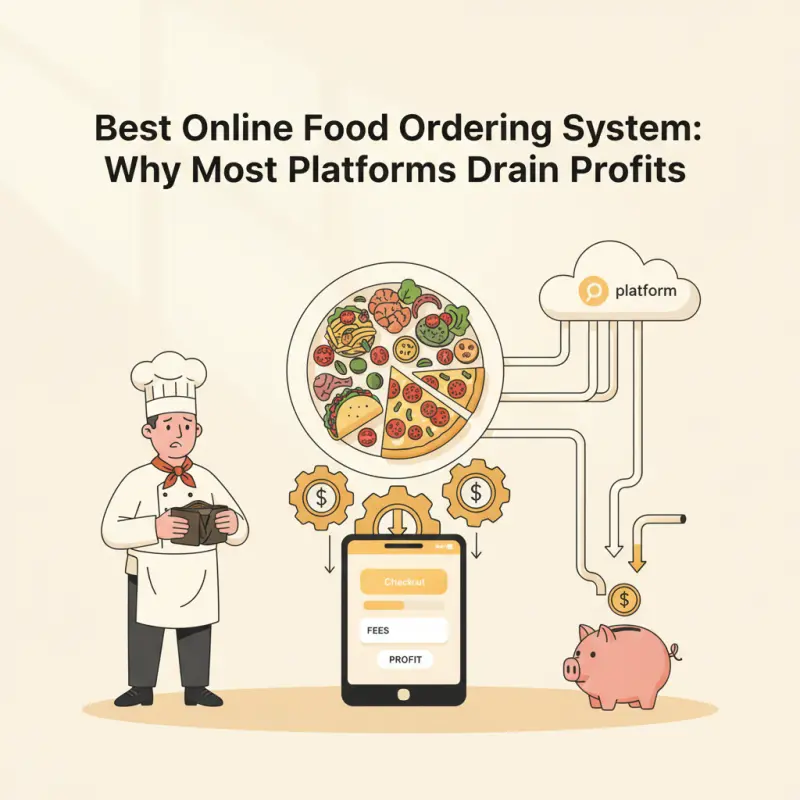
Traditional food ordering platforms charge between 15% and 30% commission on every order. For a restaurant generating 200,000 MAD monthly through online orders, that's 30,000 to 60,000 MAD vanishing before you pay a single supplier or staff member.
The math gets worse when you factor in payment delays. Most platforms hold funds for seven to 14 days, creating cash flow gaps that force restaurants to use credit lines just to buy ingredients. One Casablanca restaurant owner told us they spend 2,400 MAD monthly on overdraft fees — directly caused by platform payment delays.
Why "Free" Setup Isn't Really Free
Platforms advertise free setup, then reveal monthly listing fees (500-2,000 MAD), payment gateway charges (2.9% + 3 MAD per transaction), and menu markup "suggestions" that push prices 10-15% above your actual menu. A restaurant online ordering system that claims zero setup cost often extracts 35% of your revenue through combined fees.
Here's the breakdown most platforms won't show you:
| Fee Type | Traditional Platform | Zero-Commission Model |
|---|---|---|
| Order Commission | 15-30% | 0% |
| Monthly Listing | 500-2,000 MAD | 0 MAD |
| Payment Processing | 2.9% + 3 MAD | Standard gateway rates |
| Menu Price Markup | 10-15% suggested | Your actual prices |
| Total Revenue Loss | 28-47% | ~2.9% |
Food cost calculator
What’s your real margin?
Food cost
29.2%
Gross margin
70.8%
Profit / dish
85 MAD
Healthy · under 30%
Digitize your menu with OCHIWhat Makes a Restaurant Online Ordering System Actually Work
Forget the marketing promises. An online food ordering system for restaurants needs three core components to drive real revenue: frictionless ordering, kitchen integration, and accurate inventory management.
Essential Features That Drive Revenue
QR code ordering beats app downloads every time. Studies show 73% of customers abandon orders when forced to download an app, while QR-to-web ordering sees 89% completion rates. OCHI's QR ordering lets customers scan, browse your full menu, and order within 30 seconds — no app needed.
Guest checkout increases conversions by 23%. Forcing registration before ordering kills impulse purchases. The best systems offer both options: quick guest checkout for new customers, optional accounts for loyalty rewards.
Multilingual support isn't optional in Morocco. Your food ordering system online must handle Arabic (right-to-left), French, and English seamlessly. This includes the menu, checkout process, and order confirmations. One Marrakech restaurant saw orders increase 40% after adding proper Arabic support.
Kitchen Operations Integration
A Kitchen Display System replaces the chaos of printed tickets. Orders appear on dedicated screens with color-coded statuses: red for new, yellow for preparing, green for ready. Chefs update status with one touch, and customers get real-time updates on their phones.
Real-time inventory prevents the worst customer experience: ordering something that's sold out. When your POS deducts stock instantly, your online menu reflects actual availability. No more calling customers to cancel items.
Peak hour controls save your kitchen from meltdown. Set maximum orders per 15-minute window, add prep time buffers between orders, or temporarily pause specific items when overwhelmed. One Rabat pizzeria reduced kitchen errors by 60% using timed order throttling.
The Numbers Behind Successful Online Ordering
Data from 1,000+ Moroccan restaurants reveals patterns that generic food online ordering system providers miss entirely.
Average Order Value Optimization
Properly designed upselling features increase average order value between 15% and 22%. The key: suggest complementary items at the right moment. When someone orders a tagine, suggest fresh bread and olives — not another main dish. When they add a burger, offer to upgrade fries and add a drink for 15 MAD more.
Menu presentation matters more than you think. Restaurants using professional photos see 18% higher AOV than those with text-only menus. Item descriptions that mention specific ingredients ("grilled with rosemary and sea salt") outperform generic descriptions ("delicious grilled chicken") by 2.3x.
Moroccan ordering patterns show clear peaks: 12:30-14:00 for lunch, 19:30-21:30 for dinner, with Friday evenings seeing 2.5x normal volume. Smart restaurants pre-prep for these windows and adjust staffing accordingly.
Customer Behavior Data That Matters
Direct ordering customers return 3x more often than those from commission platforms. Why? They remember your restaurant name (votrenom.ochi.ma), not the platform. They receive your promotions directly. They build loyalty with your brand, not an aggregator.
Geographic patterns within Moroccan cities show distinct preferences. Agadir customers order seafood 40% more than inland cities. Casablanca sees 60% of orders from offices during weekdays. Marrakech tourists prefer English menus and card payments, while locals want Arabic interfaces and cash options.
Mobile ordering dominates at 78%, but desktop users spend 30% more per order. The lesson: optimize for mobile speed, but don't neglect desktop design for high-value customers.
Why Most "Best Of" Lists Miss the Mark
Generic software rankings compare features without understanding local market realities. A platform perfect for New York fails completely in Morocco.
The Morocco-Specific Requirements Gap
Cash on delivery remains king, accounting for 65% of Moroccan food orders. International platforms often lack COD support or charge extra fees for cash handling. Bank transfers matter too — many corporate clients prefer monthly invoicing over card payments.
Delivery zones in Moroccan cities don't follow neat postal codes. You need polygon mapping to define irregular delivery areas, different pricing for medina vs. nouvelle ville zones, and accurate distance calculation through winding streets.
Local compliance requirements include specific invoice formats, tax ID validation, and Arabic receipt options. Platforms built for global markets rarely handle these correctly, leaving restaurants to manage compliance manually.
Why Your Restaurant Needs Its Own Digital Identity
A branded subdomain (votrenom.ochi.ma) builds actual business value. Customers bookmark your site, not a marketplace page. Google indexes your menu directly, bringing organic search traffic. You own the customer relationship and data.
Platform dependency creates invisible risk. When aggregators change terms, increase fees, or shut down (remember when major players left smaller Moroccan cities?), dependent restaurants lose their entire online presence overnight.
Direct customer relationships translate to measurable value. Email open rates for restaurant promotions average 25% versus 3% for platform notifications. SMS campaigns to your own database see 45% redemption rates compared to 8% for generic platform offers.
Implementation Reality Check
Switching from commission-based platforms to your own system takes planning, not just enthusiasm.
Migration Timeline and Costs
Full setup takes 24 to 48 hours with modern platforms. Day one: configure menu, set delivery zones, connect payment methods. Day two: train staff, test orders, go live. Compare this to custom development: 8-12 weeks and 50,000+ MAD.
Staff training varies by role. Cashiers learn the POS in two hours. Waiters master table management in one shift. Kitchen staff adapt to digital displays within three days. The key: start with your tech-savviest employee as an internal champion.
Customer communication during transition requires finesse. Announce your new direct ordering option without badmouthing platforms (they might still send some orders). Offer first-order discounts for direct customers. Add table tents with QR codes before removing platform stickers.
Measuring Success Beyond Order Volume
Profit margins tell the real story. A restaurant doing 100,000 MAD monthly through platforms might keep 70,000 MAD after commissions. The same volume through direct channels keeps 97,000 MAD — that's 324,000 MAD extra annually.
Customer lifetime value jumps when you own the relationship. Platform customers order 4.2 times annually with average order value of 180 MAD (756 MAD total). Direct customers order 13 times annually at 210 MAD average (2,730 MAD total) — nearly 4x higher lifetime value.
Operational efficiency gains compound over time. Digital orders eliminate phone call errors (-8% mistake rate), reduce order-taking time by 3 minutes per order, and free staff to focus on service quality. One Fès restaurant cut phone time by 2 hours daily, allowing their host to greet every dine-in customer personally.
The best online food ordering system isn't about features or promises — it's about keeping more money in your pocket while serving customers better. See what OCHI can do for your restaurant at ochi.ma/partners.
Frequently Asked Questions
What commission do food ordering platforms typically charge restaurants?
Traditional food ordering platforms charge between 15% and 30% commission per order, plus additional fees for payment processing and monthly listings that can total up to 47% of revenue.
How much money do commission-based platforms cost restaurants monthly?
A restaurant generating 200,000 MAD monthly through online orders loses 30,000 to 60,000 MAD to platform commissions alone, before accounting for listing fees and payment delays.
What features should the best restaurant ordering system include?
Essential features include QR code ordering, real-time kitchen display systems, inventory management, branded ordering pages, and immediate payment processing without commission fees.
Why do payment delays from ordering platforms hurt restaurants?
Most platforms hold payments for seven to 14 days, forcing restaurants to use credit lines for daily operations and resulting in overdraft fees of 2,400 MAD or more monthly.
Are zero-commission restaurant ordering platforms really free?
Zero-commission platforms eliminate order commissions and monthly listing fees while maintaining standard payment gateway rates around 2.9%, saving restaurants 25-45% compared to traditional platforms.
Restaurant owners · Weekly
The guide to running a restaurant in 2026.
One article per week. No commission advice. Just honest operational insight for Moroccan restaurants.

Blog Manager
Comments
No comments yet. Be the first to share your thoughts.