AI Overview
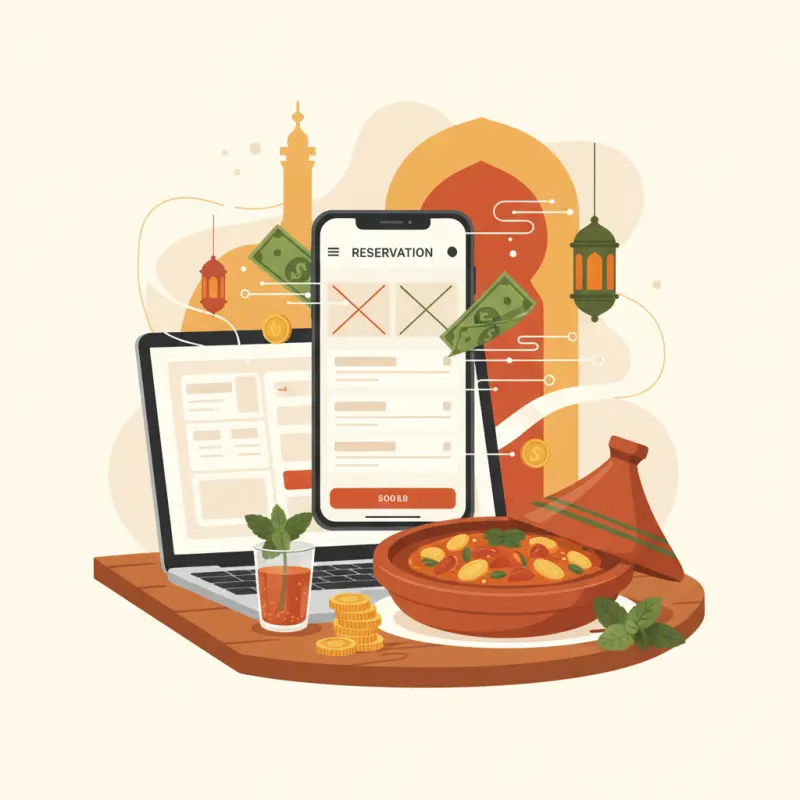
The best restaurant reservation app for your business keeps 100% of your revenue instead of charging hidden commissions. Most 'free' reservation platforms in Morocco take 12-20% commission on bookings plus payment processing fees, costing mid-sized restaurants 33,000 MAD monthly in hidden charges. Popular platforms like OpenTable charge restaurants $249-899 monthly plus per-cover fees. In Agadir and Casablanca, restaurants using commission-based booking systems lose 15-30% of reservation revenue annually. Zero-commission platforms like OCHI eliminate these hidden costs while providing QR table ordering, POS integration, and branded reservation pages. Calculate your platform's true cost by adding subscription fees, commission charges, payment processing markups, and SMS confirmation costs. Switch to a transparent pricing model that doesn't penalize your success.
Table of Contents
The Hidden Cost Problem Most Reservation Apps Won't Tell You About
A restaurant owner in Agadir discovered her "free" reservation app was costing her 18,000 MAD per month. Not in subscription fees — in hidden commissions on every table booked through their platform. This is the math most restaurant reservation software companies hope you never do.
The best restaurant reservation app for your business isn't the one with the most features. It's the one that doesn't quietly drain your revenue while promising to help you grow. Let's examine what these platforms aren't telling you about the true cost of taking reservations online.
Why "Free" Restaurant Booking Software Usually Isn't
Free reservation platforms follow a predictable pattern. They offer zero upfront costs, promise massive exposure, then take their cut through commission fees, payment processing markups, or premium placement charges. A Casablanca bistro using one popular platform discovered they were paying 12% commission on pre-paid reservations plus 3.5% payment processing — turning their "free" software into their third-highest operating expense.
The subscription model isn't always better. Many restaurant table reservation software providers charge 2,000-5,000 MAD monthly, then add fees for SMS confirmations (2 MAD each), additional users (500 MAD per staff member), and API access (another 1,500 MAD). A 50-table restaurant sending 20 confirmations daily spends 1,200 MAD just on text messages.
The 15-30% Revenue Hit You Don't See Coming
Here's what a typical "free" reservation platform costs a mid-sized Moroccan restaurant:
| Revenue Source | Monthly Volume | Platform Fee | Your Loss |
|---|---|---|---|
| Direct Reservations | 150,000 MAD | 12% | 18,000 MAD |
| Pre-paid Bookings | 50,000 MAD | 15% + 3.5% | 9,250 MAD |
| Special Events | 30,000 MAD | 20% | 6,000 MAD |
| Total Monthly Loss | 33,250 MAD |
That's 399,000 MAD annually — enough to hire two full-time staff members or renovate your dining room. The best restaurant reservation app keeps this money in your business, not in platform fees.
What Happens When You Don't Own Your Customer Data
Most restaurant booking software treats your customer database as their asset. You can't export email addresses, can't see phone numbers without logging in, and can't message guests directly. When a Marrakech restaurant tried leaving their reservation platform, they discovered they couldn't take their 3,000-customer database with them. Two years of relationship building, locked behind a corporate login.
This data ownership problem extends to reviews and ratings. Your five-star ratings on the platform? They stay with the platform. Your regular customers' booking history? Platform property. The direct relationship you thought you were building becomes a mediated transaction where the middleman holds all the cards.
Demand heatmap
When do Moroccan restaurants get busy?
Typical demand across the week. Iftar shifts the pattern during Ramadan.
| 7h | 10h | 12h | 15h | 19h | 22h | |
|---|---|---|---|---|---|---|
| Mon | ||||||
| Tue | ||||||
| Wed | ||||||
| Thu | ||||||
| Fri | ||||||
| Sat | ||||||
| Sun |
What Actually Makes a Reservation System Work in Morocco
Morocco presents unique challenges that Silicon Valley-designed restaurant reservation software often ignores. From inconsistent internet in coastal cities to the necessity of Arabic-first interfaces, the gap between global platforms and local reality can break your operations.
Internet Connectivity Requirements Most Apps Ignore
Cloud-based reservation systems assume constant connectivity. In Agadir's medina restaurants or Fès's traditional riads, this assumption fails. When your internet drops during dinner rush — and it will — your reservation system becomes a liability. The best systems work offline-first, syncing when connection returns.
Smart restaurant owners test their table reservation software during peak hours with intentionally throttled internet. If it takes more than three seconds to load a booking or confirm a table, it's too slow for Moroccan infrastructure reality. Your staff won't wait, and neither will customers.
Payment Integration That Works with Moroccan Banks
International restaurant booking software often stumbles on Moroccan payment processing. CIH Bank, Attijariwafa, and Banque Populaire require specific integration protocols that generic platforms don't support. One Rabat restaurant spent four months trying to connect their reservation deposits to their bank account — eventually giving up and processing everything manually.
The payment problem compounds with pre-authorizations. Most Moroccan diners aren't comfortable with holds on their cards, preferring to pay at the restaurant. Your reservation system must accommodate this preference without creating friction.
Staff Training Reality Check — 15 Minutes vs. 15 Hours
Restaurant table reservation software vendors promise "intuitive" interfaces, but intuitive for whom? A Tangier restaurant spent three weeks training staff on a "simple" American platform. The English-only interface, Western date formats, and unfamiliar workflows created more problems than the old paper book.
Effective training means your Darija-speaking host can manage bookings without constantly asking for help. It means your French-speaking manager sees reports in their language. It means following local conventions — not forcing American restaurant culture onto Moroccan operations.
The POS Integration Test — Why Most Restaurant Reservation Software Fails
Standalone reservation systems create operational chaos. Without POS integration, your staff manages two separate systems that don't communicate, leading to errors, confusion, and lost revenue.
The Double-Entry Problem That Costs 2 Hours Daily
Watch a host during dinner service with separate reservation and POS systems. They check the reservation tablet, walk to the POS terminal, manually enter the party size, return to seat guests, then update the reservation system. Each booking takes four steps instead of one. Multiply by 30 reservations nightly — that's two hours of duplicated effort.
This double-entry problem intensifies with modifications. Customer calls to add two people? Update both systems. Table requests earlier seating? Change it twice. No-show needs recording? Mark it in two places. Your highest-paid staff members become data entry clerks.
Why Separate Systems Create 23% More Booking Errors
A Casablanca restaurant group tracked errors across their five locations. Branches using integrated systems showed 6% error rates (wrong table, incorrect time, missed bookings). Those with separate reservation and POS systems? 29% error rate. Nearly one in three reservations had some discrepancy between systems.
These aren't just statistics — they're angry customers, stressed staff, and lost revenue. When table 12 shows available in reservations but occupied in POS, you've got a problem that damages your reputation.
Table Turnover Math — Integrated vs. Standalone Systems
Integrated restaurant reservation software knows your actual table status. When order 47 pays their bill, the table immediately shows as "turning" in reservations. Your host can accurately quote wait times and optimize seating. Standalone systems rely on manual updates — which happen late or never during busy service.
This real-time accuracy improves table turnover by 18-22 minutes per seating. For a 50-seat restaurant, that's one extra full turn on weekend nights — worth 25,000-30,000 MAD monthly in additional revenue.
OCHI's Zero-Commission Approach — Built for Moroccan Restaurants
OCHI takes a different approach to restaurant reservations. Instead of building another standalone booking app, reservations integrate directly into the complete restaurant management platform. No commissions, no hidden fees, no data hostage situations.
Complete Restaurant Management — Not Just Reservations
Your reservation system connects directly to POS, kitchen display, and table management. When a guest books online at votrenom.ochi.ma, the reservation appears instantly across all systems. Your host sees it on the floor plan. Your kitchen knows to prep for a party of eight. Your waiters receive assignments automatically.
This integration extends to customer data. Every reservation builds your customer profile — order history, preferences, special occasions. Unlike traditional restaurant booking software that walls off this information, OCHI makes it accessible across your entire operation. Your waiter knows it's a birthday before asking. Your chef sees the gluten allergy without checking.
Branded Experience — votrenom.ochi.ma Instead of Generic Links
Generic reservation platforms send customers to their domain, not yours. OCHI gives you votrenom.ochi.ma — your branded space where customers book directly with you. No competitor listings, no "similar restaurants nearby" suggestions designed to steal your guests.
This branded approach extends through the entire experience. Confirmation emails come from your restaurant. SMS reminders show your name. The booking page matches your visual identity. Customers know they're booking with you, not through a middleman.
Real-Time Integration Across Orders, Tables, and Kitchen
When table 7 orders through QR scanning, their reservation status updates automatically. Running 20 minutes late on appetizers? The system adjusts upcoming reservation times. Guest adds a note about celebrating an anniversary? It appears on the waiter's mobile panel and kitchen display.
This real-time synchronization eliminates the coordination chaos of separate systems. Your team operates from one source of truth, whether they're at the host stand, POS terminal, or kitchen station.
The Make-or-Break Features Your Reservation App Must Have
Most "essential features" lists focus on buzzwords over operations. Here's what actually matters for restaurant profitability and smooth service.
Waitlist Management — The Feature That Actually Drives Revenue
Smart waitlist management fills tables that would otherwise sit empty. When your 7:30 PM reservation no-shows, the system automatically texts waitlisted guests: "Table available in 15 minutes. Reply YES to confirm." First responder gets the table. No phone calls, no manual tracking.
The math is compelling. A 60-seat restaurant with effective waitlist management fills 8-12 additional covers nightly from no-shows and early departures. At 200 MAD average check, that's 48,000-72,000 MAD monthly revenue recovered from would-be empty tables.
No-Show Prevention That Works (Hint — It's Not Email Reminders)
Email reminders achieve 12% open rates. SMS hits 97%, but timing matters more than medium. The best restaurant reservation app sends confirmations requiring response: "Reply C to confirm your table tonight at 8 PM, or X to cancel." No response triggers automatic release to waitlist 2 hours before service.
Pre-authorization provides stronger prevention for high-value bookings. Require card details for parties over six or premium time slots. Don't charge unless they no-show — just holding the card reduces no-shows by 78%.
Multi-Location Control for Restaurant Groups
Restaurant groups need centralized visibility with location-specific control. View all properties from one dashboard, but let each location manage their own availability, blackout dates, and special events. Cross-location reporting reveals which branches excel at reservation conversion and table turnover.
Smart groups use this data to share best practices. When your Agadir location achieves 94% reservation fulfillment while Casablanca sits at 81%, you can identify and replicate successful processes across properties.
The restaurant industry doesn't need another app making promises about exposure and convenience while quietly extracting value from your business. The best restaurant reservation app integrates with your operations, respects your customer relationships, and keeps commission fees where they belong — at zero. Technology should amplify your restaurant's strengths, not create new dependencies. That's the standard Moroccan restaurants deserve.
See what a zero-commission, fully integrated reservation system can do for your restaurant at ochi.ma/partners.
Frequently Asked Questions
What makes the best restaurant reservation app different from free platforms?
The best reservation apps charge transparent monthly fees instead of hidden commissions on bookings. Free platforms typically take 12-20% commission plus payment processing fees, while subscription-based systems cost 2,000-5,000 MAD monthly with predictable pricing.
How much do hidden reservation app fees cost Moroccan restaurants?
Mid-sized restaurants in Morocco lose 15,000-35,000 MAD monthly through commission fees, payment markups, and SMS charges on reservation platforms. Annual costs can reach 400,000 MAD for busy establishments.
Should restaurants use commission-based or subscription reservation software?
Subscription models protect restaurant profit margins better than commission-based platforms. Commission fees scale with success, while fixed subscriptions provide predictable costs regardless of booking volume.
What hidden costs should restaurants watch for in reservation apps?
Common hidden costs include commission fees (8-20%), payment processing markups (2-4%), SMS confirmation charges (1-3 MAD each), additional user fees (300-500 MAD monthly), and premium placement costs.
Can restaurants avoid reservation app commission fees entirely?
Yes, zero-commission platforms eliminate booking fees while providing reservation management, table ordering, and POS integration. Restaurants keep 100% of revenue from direct bookings through their branded reservation system.
Restaurant owners · Weekly
The guide to running a restaurant in 2026.
One article per week. No commission advice. Just honest operational insight for Moroccan restaurants.

Blog Manager
Comments
No comments yet. Be the first to share your thoughts.