AI Overview
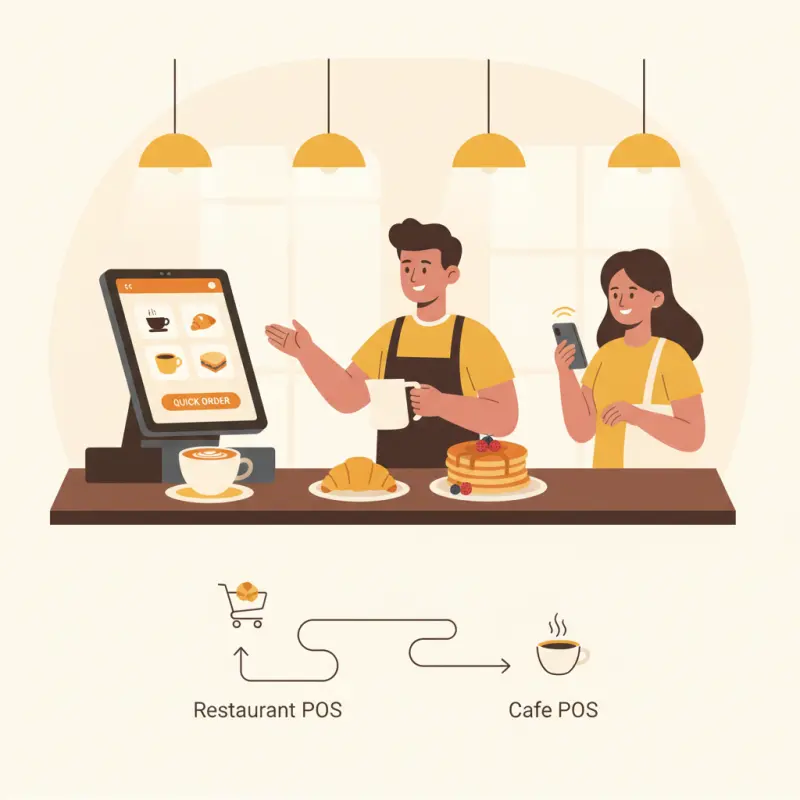
Cafe point of sale systems require fundamentally different design than restaurant POS because counter service operates at a different speed and scale. A cafe point of sale system must prioritize order speed over table management, with popular items and modifiers accessible in one touch. Traditional restaurant systems track finished dishes, while cafes need ingredient-level inventory tracking — measuring milk in liters and coffee beans in kilos across dozens of drink variations. Successful cafes in Morocco like Cafe Amana process 140 orders in 90 minutes during morning rush, requiring screens optimized for rapid ordering rather than table layouts. The operational mismatch between restaurant workflows and cafe reality costs time and customers. Choose a POS system designed specifically for counter service with ingredient tracking, quick modifiers, and speed-optimized interfaces.
Table of Contents
The morning rush at Cafe Amana in Agadir tells you everything about why generic point of sale systems fail cafes. Between 7:30 and 9:00 AM, barista Youssef takes 140 orders — that's one every 45 seconds. Most restaurant POS systems weren't built for this reality.
Your cafe point of sale system shapes every customer interaction, from that first morning cappuccino to the afternoon pastry rush. Yet most systems force you into workflows designed for sit-down restaurants with 90-minute table turns. The mismatch costs you time, money, and customers.
Your Cafe Runs Nothing Like a Restaurant — Why Most POS Systems Miss the Mark
Watch a typical restaurant service: servers greet seated customers, take orders tableside, and manage checks over multiple courses. Now watch your cafe: customers queue at the counter, rattle off complex drink modifications, and expect their order in under three minutes. These aren't the same business.
The operational differences run deeper than service style. Your inventory tracks raw ingredients — how many liters of milk did you use today? How many kilos of coffee beans? Restaurant systems count finished dishes. They can tell you how many tagines you sold, not how much argan oil you consumed across 50 different preparations.
The Counter Service Challenge
Counter service demands speed above all else. Your staff switches between taking orders, operating the espresso machine, and handling payments — often within the same transaction. Traditional table-based layouts waste precious screen space on floor maps you don't need.
The most successful cafes in Morocco optimize their screens for speed. Popular items get prominent placement. Common modifiers — extra shot, oat milk, no foam — become one-touch options. Your cafe pos system should adapt to your menu, not force your menu into rigid categories.
Inventory Reality Check
A restaurant knows it used one chicken to make one chicken tajine. But your double latte uses 240ml of milk, 18g of coffee, and possibly 20ml of vanilla syrup. Multiply that complexity across hundreds of daily orders with varying sizes and customizations.
Tracking waste becomes critical when dealing with perishables. That expired milk represents direct profit loss. Smart inventory systems alert you before products expire, suggest order quantities based on usage patterns, and account for the 3-5% waste that's inevitable with dairy products.
Stack audit
What do you currently use?
Tick what you have. We’ll show what OCHI replaces or connects to.
The 15-Second Rule:
Why Speed Trumps Features for Cafes
Customer psychology research shows that perceived wait time doubles after 90 seconds in a queue. In Casablanca's business district, where office workers grab coffee between meetings, even 60 seconds feels too long. Speed isn't just about efficiency — it's about meeting fundamental customer expectations.
Peak Hour Mathematics
Let's run the numbers for a typical Moroccan cafe during morning rush:
| Metric | Standard POS | Optimized System | Daily Impact |
|---|---|---|---|
| Average order time | 55 seconds | 35 seconds | +36 orders capacity |
| Customer abandonment rate | 12% at 3+ minute wait | 4% at 2 minute wait | 8 saved customers |
| Average ticket value | 45 MAD | 45 MAD | +360 MAD revenue |
| Monthly revenue gain | — | — | +10,800 MAD |
Shaving 20 seconds off each transaction during peak hours translates directly to revenue. Those seconds come from thoughtful design: preset modifier buttons, quick payment processing, and workflows that match how your staff actually works.
Screen Design That Actually Works
Effective cafe interfaces follow predictable patterns. Your top six beverages should be accessible without scrolling. Size selection happens first, then modifications. Payment options appear immediately after order confirmation — no hunting through menus.
The best systems learn from your usage. If 70% of your cappuccinos are large with an extra shot, that combination deserves its own button. Static layouts that treat every item equally slow down your most common transactions.
Why Food Truck POS Systems Fail Cafes (And Vice Versa)
The overlap seems obvious — both serve quick food and beverages to customers on the go. But pos systems for food trucks solve different problems than cafe operations demand. Understanding these differences helps you avoid choosing the wrong tool.
Space and Setup Differences
Food trucks operate in cramped quarters with unreliable power and internet. Their point of sale systems for food trucks prioritize offline functionality and minimal hardware. Your cafe, anchored in one location, can leverage stable connections for real-time inventory updates and integrated loyalty programs.
Customer flow patterns differ completely. Food truck customers order from outside through a service window. Your cafe customers enter, browse pastries while queuing, maybe add items impulsively. The physical space shapes the technology needs.
Operational Complexity Variations
Most food trucks offer 8-12 items with minimal customization. Your cafe menu might list 20 beverages, each available in three sizes with dozens of possible modifications. The permutations multiply quickly — a basic cappuccino spawns 50+ variants once you factor in milk types, flavors, and preparation preferences.
Inventory management complexity scales differently too. Food trucks typically prep ingredients daily in commissary kitchens. Your cafe manages continuous delivery of perishables, precise temperature storage, and real-time depletion across multiple ingredient types.
The Real Cost of "Free" POS Systems:
A Moroccan Cafe Case Study
Cafe Tifawin in Agadir switched to a "free" POS system last year. The hardware came at no cost, setup was included, and monthly fees seemed reasonable. Six months later, owner Khalid discovered the true price hidden in transaction fees.
Hidden Commission Math
Here's how the numbers broke down for Cafe Tifawin:
| Revenue Stream | Monthly Volume | Commission Rate | Monthly Cost |
|---|---|---|---|
| Counter sales | 85,000 MAD | 2.5% | 2,125 MAD |
| Online orders | 15,000 MAD | 3.5% | 525 MAD |
| Processing fees | 100,000 MAD | 0.5% | 500 MAD |
| Total hidden costs | — | — | 3,150 MAD |
Those percentages compound annually. Cafe Tifawin pays 37,800 MAD yearly in hidden fees — enough to hire part-time help or upgrade equipment. The "free" system costs more than premium alternatives.
OCHI's Modular Approach
OCHI takes a different path: zero commission on every order. Your cafe keeps 100% of revenue whether customers order at the counter, through QR codes at tables, or online at yourcafe.ochi.ma. The modular platform lets you activate features as needed — start with basic POS, add QR ordering during expansion, integrate loyalty programs when ready.
The integrated cafe accounting software features eliminate double-entry headaches. Sales data flows directly to your books, inventory adjustments update automatically, and daily reports give you the numbers that matter without manual calculation.
Building Your Cafe Tech Stack:
Start Simple, Scale Smart
The temptation to implement everything at once kills more digital transformations than budget constraints. Successful cafes phase their technology adoption based on immediate needs and staff readiness.
Phase 1: Core Operations
Week one focuses on the basics: menu setup, payment processing, and basic reporting. Your staff needs confidence with core functions before adding complexity. Train one champion who can support others during the transition.
Payment preferences in Morocco vary by neighborhood. University areas see more cash transactions. Business districts prefer cards and mobile payments. Your system should handle all methods seamlessly, with clear daily reconciliation for each type.
Integration Planning
Month two brings integration opportunities. Connect your accounting software first — accurate financial data matters more than fancy marketing features. Once sales data flows smoothly, add inventory management to track ingredient usage and predict ordering needs.
Marketing automation waits until you've collected meaningful customer data. Three months of transaction history reveals patterns: who visits daily, which promotions drive traffic, what products pair naturally. Build campaigns on real behavior, not assumptions.
Ready to see how a cafe point of sale system built for your operations works? Test OCHI's platform with your menu at votrenom.ochi.ma — no commission fees, just the tools your cafe needs.
Frequently Asked Questions
What makes a cafe POS system different from a restaurant POS?
Cafe POS systems prioritize counter service speed over table management, with one-touch modifiers and ingredient-level inventory tracking instead of finished dish counting.
Why do cafes need ingredient-level inventory tracking?
Cafes use raw ingredients across multiple drinks — tracking milk in liters and coffee beans in kilos provides accurate cost control that finished dish tracking cannot match.
How fast should a cafe POS system process orders?
High-volume cafes process one order every 45 seconds during rush periods. Your POS interface must support this speed with prominent popular items and quick modifier access.
What features should I look for in a cafe point of sale system?
Look for counter-optimized screen layouts, ingredient inventory tracking, one-touch modifiers for common requests, and integration with espresso machines and payment processors.
Restaurant owners · Weekly
The guide to running a restaurant in 2026.
One article per week. No commission advice. Just honest operational insight for Moroccan restaurants.

Blog Manager
Comments
No comments yet. Be the first to share your thoughts.