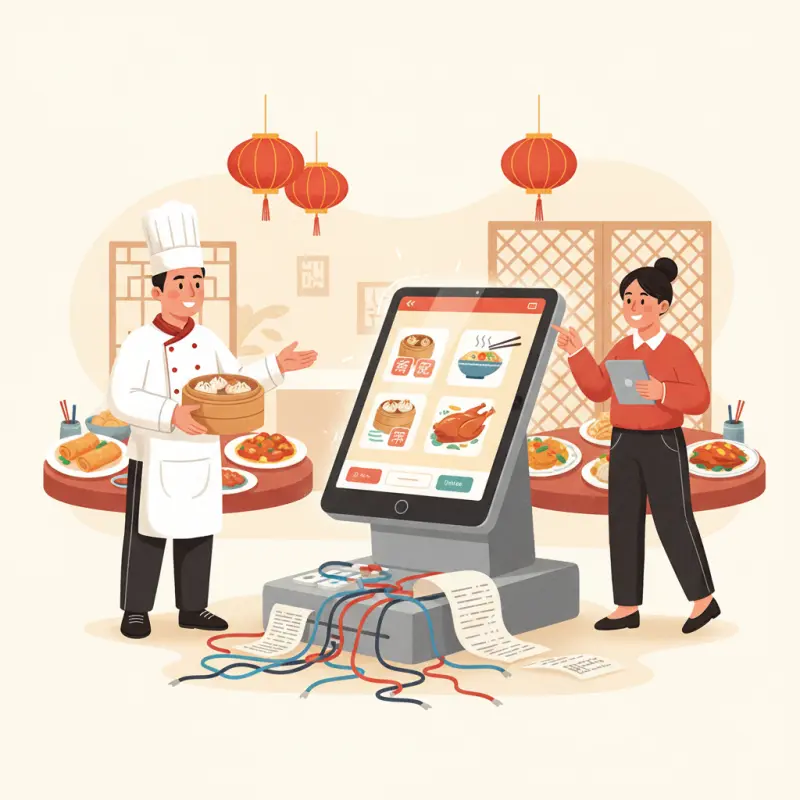
Chinese Restaurant POS Systems: Why Generic Solutions Fall Short
Blog Manager
··4 min read
AI Overview
Chinese restaurant pos systems require specialized features that generic solutions can't deliver. Multi-language menu navigation becomes critical when staff speaks Darija, chefs read simplified Chinese, and tourists order in French. Family-style dining creates unique operational demands — shared dishes with individual billing splits, portion modifications within group orders, and continuous tea service tracking. In Morocco, cash-heavy markets like Fès process 70% of transactions without cards, demanding robust cash management with shift handovers and denomination tracking. Moroccan tax compliance adds another layer of complexity with specific reporting requirements. Choose a restaurant ordering platform that handles cultural dining patterns, language barriers, and local payment preferences instead of forcing your operations into a one-size-fits-all solution.
Table of Contents
For restaurant owners
Start your restaurant in 60 minutes.
From signup to your first real order — no commission, no setup fee, no sales call.
Why Chinese Restaurant POS Requirements Differ From Generic Solutions
A Chinese restaurant in Agadir serves 200 diners on a typical Friday night. Each table orders differently — some want dishes split between two plates, others need modifications for dietary restrictions, and the tea service runs continuously throughout the meal. Generic restaurant POS systems weren't built for this complexity.
The multi-language menu challenge hits first. Your staff needs to navigate between Mandarin kitchen instructions, Arabic customer preferences, and French tourist orders. When your cashier speaks Darija, your chef reads simplified Chinese, and your customer wants their order in French, a restaurant pos point of sale system better handle the translation seamlessly. Training new staff becomes a three-week ordeal when they're fighting the technology instead of learning the menu.
Family-Style Dining Operations
Chinese dining culture creates unique operational demands. A table of eight shares six dishes, each person wants their portion of the bill calculated separately, and someone always needs to modify the spice level. Your restaurant POS must track individual preferences within shared orders.
Consider this scenario: Table 12 orders Peking duck for six people, but two diners want their portion without hoisin sauce. One guest leaves early and needs their exact share calculated. The remaining diners split the rest unevenly based on what they consumed. Without proper split-billing functionality, your servers waste 10 minutes with a calculator while other tables wait.
Stack audit
What do you currently use?
Tick what you have. We’ll show what OCHI replaces or connects to.
Morocco-Specific POS Considerations for Chinese Restaurants
Cash remains king in Moroccan restaurants. While Casablanca sees growing card adoption, smaller cities like Fès still process 70% of transactions in cash. Your system pos restaurant needs robust cash management — daily reconciliation, shift handovers, and denomination tracking.
Local Compliance and Reporting
Moroccan tax authorities require specific reporting formats. Your daily Z-reports must show TVA breakdowns, payment method summaries, and hourly sales patterns. Chinese restaurants face additional complexity with tourist transactions — handling euros alongside dirhams while maintaining accurate exchange rate records.
City
Cash Transaction %
Mobile Payment Adoption
Tourist Card Usage
Casablanca
55%
25%
20%
Marrakech
60%
15%
25%
Agadir
70%
10%
20%
Fès
80%
5%
15%
The True Cost of Commission-Based vs. Zero-Commission Restaurant POS
Most Chinese restaurants don't realize their "free" POS system costs them 15-30% commission on every order. Do the math: 200 orders monthly at 150 MAD average, with 25% commission equals 7,500 MAD vanishing every month. That's 90,000 MAD annually — enough to hire another chef or renovate your dining room.
Commission-based platforms claim they bring customers. But walk into any successful Chinese restaurant in Morocco — the customers come for your food, not because of which app you use. Your Sichuan beef doesn't taste better with a 30% markup. Your tea ceremony isn't enhanced by platform fees.
Hidden Costs Beyond Commission
Payment processing adds another 2-3% on card transactions. Want to export your customer data? That's a premium feature. Need integration with your accounting software? Monthly subscription required. These restaurant pos systems nickel-and-dime you into submission.
OCHI takes a different approach — zero commission, transparent pricing, and you own your data. Export anything, anytime. No surprises when you check your bank statement.
Essential POS Features Chinese Restaurants Actually Use Daily
Forget the marketing fluff about "AI-powered insights" and "revolutionary interfaces." During dinner rush, you need three things: speed, accuracy, and reliability. Your wok station needs orders displayed clearly with cooking times. Your servers need table status at a glance. Your cashier needs payment processing that doesn't freeze when 10 tables want to pay simultaneously.
Kitchen Integration That Works
The Kitchen Display System transforms Chinese restaurant operations. Orders appear instantly with preparation times for each dish type. Stir-fry items show 3-minute timers. Steamed dishes display 15-minute countdowns. Soups indicate 20-minute preparation. Your kitchen coordinates multiple wok stations without shouting over the exhaust fans.
Ingredient modifications appear in red — critical for allergy management. When table 5 needs gluten-free soy sauce and table 8 has a peanut allergy, these alerts prevent dangerous mistakes. The system tracks every modification, creating an audit trail for food safety compliance.
Setting Up Your Chinese Restaurant POS: Agadir Case Study
Golden Dragon Restaurant on Avenue Hassan II switched to OCHI in March 2026. Their previous system charged 25% commission and required three days of training. Here's how their OCHI implementation actually went.
Implementation Timeline
Day one took four hours. Menu upload, staff account creation, and basic training completed before lunch service. The team learned the system while taking real orders — no disruption to operations. By week one, servers processed orders 40% faster using the mobile waiter panel. Customers started scanning QR codes for table ordering, reducing order errors to near zero.
Month one data showed remarkable improvements. Table turnover decreased from 78 minutes to 60 minutes average. Kitchen error rate dropped from 8% to 2%. Most importantly, they kept an extra 18,000 MAD that would have gone to platform commissions.
The chinese restaurant pos system you choose shapes every aspect of your operation. From the moment a customer scans your QR code to when your kitchen marks the last dish complete, technology either helps or hinders. OCHI's integrated platform — POS, kitchen display, order management, and customer loyalty — works as one unified system.
Stop paying commissions for technology that should serve you, not drain you. Your Chinese restaurant deserves tools that respect your margins and amplify your efficiency. See the complete platform at ochi.ma/partners and discover why over 1,000 Moroccan restaurants trust OCHI.
Your next dinner service could run smoother, faster, and keep every dirham you earn. Set up your branded ordering platform at votrenom.ochi.ma and join Morocco's commission-free restaurant revolution.
Restaurant owners · Weekly
The guide to running a restaurant in 2026.
One article per week. No commission advice.
Just honest operational insight for Moroccan restaurants.
Blog Manager
Comments
No comments yet. Be the first to share your thoughts.