AI Overview
CRM in restaurant industry pricing follows backwards economics where success costs more. Morocco restaurants pay 500-3,000 MAD monthly for standalone CRM platforms before integration costs, training, and data sync failures. Commission-based platforms like those charging 15% fees penalize successful loyalty programs — a Casablanca bistro generating 50,000 MAD in repeat orders pays 7,500 MAD in platform commissions. Customer acquisition costs 45-65 MAD in Morocco, but repeat customers spend 3.2 times more over their lifetime. Break-even for loyalty investment typically occurs within 60 days for restaurants with average order values above 120 MAD. Integrated CRM systems eliminate monthly subscription fees and prevent data fragmentation between ordering and customer management systems.
Table of Contents
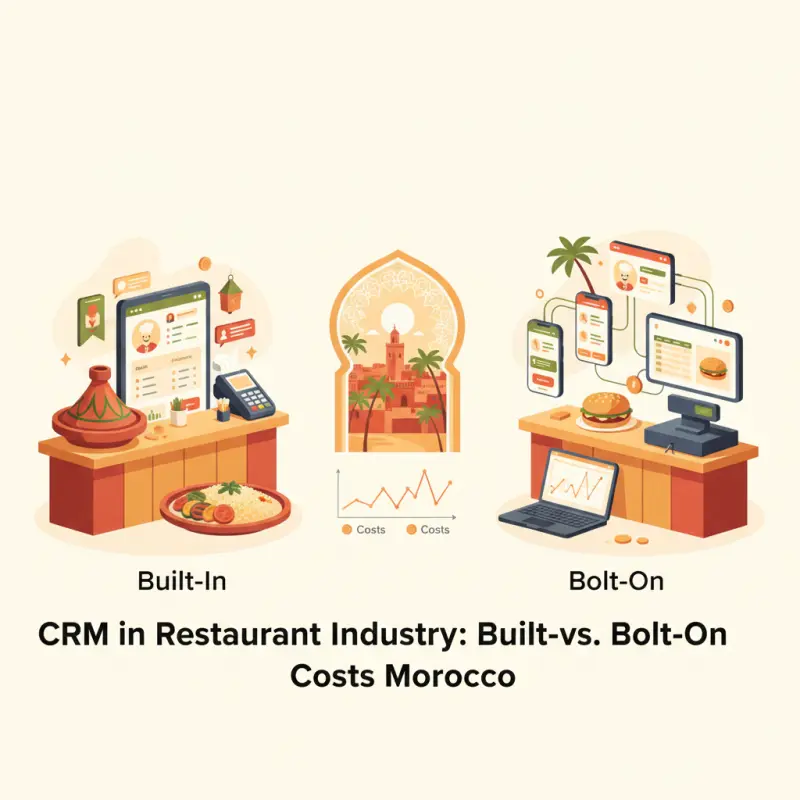
The Real Cost of Restaurant CRM: Built-In vs. Bolt-On
Most CRM in restaurant industry discussions skip the uncomfortable math: what you actually pay versus what you get back. Restaurant owners in Morocco face monthly fees ranging from 500 to 3,000 MAD for standalone CRM platforms — before counting integration costs, training hours, and the inevitable data sync failures.
The pricing model itself reveals a fundamental problem. Commission-based ordering platforms charge you more when your loyalty program succeeds. A Casablanca bistro generating 50,000 MAD in repeat orders through loyalty campaigns pays 7,500 MAD in platform fees at standard 15% commission rates. The better your CRM performs, the more you pay.
Why Most CRM Pricing Is Backwards
Traditional restaurant CRM follows the SaaS playbook: monthly subscription plus per-user fees plus SMS costs plus email credits. A typical setup for a 40-seat restaurant in Marrakech looks like this:
| CRM Component | Monthly Cost (MAD) | Hidden Costs |
|---|---|---|
| Base subscription | 800-1,500 | Annual contracts only |
| POS integration | 300-500 | Setup fee: 2,000-5,000 |
| SMS credits (1,000) | 250-400 | Overage charges |
| Email sends (5,000) | 200-300 | Design templates extra |
| Staff training | 0 | Lost productivity: 3-5 days |
The integration tax hits hardest. When your CRM lives separately from your ordering system, every customer action requires manual updates or brittle API connections. Staff toggle between systems. Data accuracy drops. Customer profiles fragment.
The Math That Matters
Restaurant customer acquisition in Morocco costs between 45 and 65 MAD when accounting for platform fees, marketing spend, and first-order discounts. Yet repeat customers spend 3.2 times more over their lifetime than one-time buyers. The break-even point for loyalty investment happens faster than most realize — typically within 60 days for restaurants with average order values above 120 MAD.
OCHI's approach eliminates the monthly CRM fee entirely. The loyalty system lives inside your ordering platform at zero additional cost. No integration needed. No separate logins. Customer data flows directly from orders to segments to campaigns.
Stack audit
What do you currently use?
Tick what you have. We’ll show what OCHI replaces or connects to.
Points vs. Cashback vs. Tiers: Which Actually Drives Repeat Orders
Every CRM system for restaurants offers points, cashback, or tiers. Few explain which model fits your specific operation. The answer depends on order frequency, average ticket size, and customer psychology in your market.
Points Systems: The Psychology Problem
Points create mental accounting friction. Customers must remember point values, calculate rewards, and decide when to redeem. This cognitive load reduces program participation. Restaurants using 100-point reward thresholds see 18% redemption rates. Those using 10-point thresholds see 34% redemption.
The sweet spot for Moroccan restaurants: 1 point per 10 MAD spent, with rewards at 50-point intervals. This structure feels attainable without overwhelming mental math. A tagine priced at 95 MAD earns 9 points — simple, clear, motivating.
Cashback: Simple but Limiting
Cashback programs trade sophistication for simplicity. "Spend 500 MAD, get 50 MAD off your next order." No points to track. No tiers to climb. Just straightforward value.
High-ticket restaurants benefit most from cashback. A steakhouse in Rabat with 400 MAD average orders sees better results from 10% cashback than complex point structures. Fast-casual spots with 80 MAD tickets need points or tiers to create meaningful rewards without destroying margins.
Tier Systems: The Compound Effect
Tier-based restaurant CRM creates aspirational goals and exclusive experiences. OCHI's data from 1,000+ restaurants shows four-tier systems outperform three-tier systems by 23% in customer lifetime value. The progression matters: Bronze → Silver → Gold → Platinum.
Effective tier thresholds vary by average order value:
- Fast food (60-100 MAD): Silver at 500 MAD, Gold at 1,500 MAD, Platinum at 3,000 MAD
- Casual dining (150-250 MAD): Silver at 1,000 MAD, Gold at 3,000 MAD, Platinum at 6,000 MAD
- Fine dining (400+ MAD): Silver at 2,000 MAD, Gold at 6,000 MAD, Platinum at 12,000 MAD
Customer Segmentation Beyond Demographics: What Actually Predicts Spend
Generic CRM software for restaurants segments by age and location. Successful restaurants segment by behaviors that predict future value. Order timing, group size, and weather sensitivity matter more than demographic guesswork.
The Three Customer Types That Matter
Browsers order frequently but spend little — the coffee-and-pastry crowd hitting your café three times weekly. Splurgers appear quarterly for special occasions, dropping 500 MAD per visit. Loyalists order weekly with consistent 150-200 MAD tickets.
Each segment needs different engagement. Browsers respond to item-specific deals. Splurgers want exclusive experiences. Loyalists value recognition and consistency. One-size-fits-all campaigns waste money and annoy customers.
Segmentation That Drives Revenue
Time-based patterns reveal more than demographics. Lunch regulars in Agadir's business district want speed and reliability. Weekend dinner crowds seek variety and social experiences. Late-night orderers prioritize comfort food and quick delivery.
Weather correlations surprise many operators. Rain increases soup and tea orders by 40% in Fès. Hot days spike cold beverage and salad sales in Marrakech. Smart campaigns align offers with conditions.
Birthday and Anniversary Automation
Birthday discounts sent seven days early see 23% redemption rates — nearly double the day-of delivery rate of 12%. The advance notice lets customers plan their celebration at your restaurant rather than scrambling for last-minute options.
OCHI automates birthday bonuses without manual tracking. Customers receive push notifications with personalized offers. No staff involvement needed. No missed opportunities.
Why Restaurant CRM Should Live in Your Ordering System
Standalone CRM creates data silos. Customer orders live in your POS. Contact details sit in your CRM. Marketing happens in another tool. This fragmentation kills personalization and increases errors.
The Integration Tax
Every additional system reduces data quality. Manual imports introduce errors. API syncs fail during peak hours. Staff training multiplies with each platform. A Casablanca restaurant using separate ordering, CRM, and email systems spends 15 hours monthly on data management alone.
Real-time data matters more than features. When a customer places their tenth order, your system should immediately recognize their new tier status. When they haven't ordered in 30 days, re-engagement should trigger automatically.
OCHI's Approach: CRM Built Into Ordering
OCHI embeds CRM directly into the ordering flow. Every transaction updates loyalty points instantly. Customer segments refresh automatically based on behavior. Marketing campaigns launch from the same dashboard where you manage menus.
The results speak clearly: restaurants using OCHI's built-in loyalty see 34% increases in repeat visits within 90 days. No additional fees. No complex integrations. Just crm in restaurant industry that actually works.
Setting Up Effective Restaurant CRM in Casablanca
A typical 40-seat restaurant in Casablanca starts by importing existing customer emails and phone numbers. Week one focuses on staff training — explaining tier benefits and enrollment process. Week two launches the program with double points for first orders.
Month one establishes baseline metrics: repeat order rate, average order value by tier, redemption patterns. Month two activates automated campaigns: welcome series for new customers, win-back offers for lapsed diners, tier upgrade notifications.
CRM Implementation: The 90-Day Restaurant Loyalty Roadmap
Most restaurants abandon CRM efforts within six months. The successful ones follow a structured rollout that builds momentum rather than overwhelming operations.
Days 1-30: Foundation
Start with customer data collection at every touchpoint. Train cashiers to ask for phone numbers. Add email capture to online orders. Import existing contacts from delivery platforms. Set conservative tier thresholds — you can always adjust upward.
Baseline metrics matter more than perfection. Track current repeat order rates, average frequency, and customer lifetime value. These numbers guide future optimization.
Days 31-60: Activation
Launch tier rewards with clear communication. Table tents explain the program. Staff wear buttons showing tier names. First automated campaigns go live: welcome emails, order confirmations with point balances, tier upgrade celebrations.
Soft launch your referral program with staff and regular customers. Test reward amounts and messaging before broad promotion. Monitor redemption rates weekly.
Days 61-90: Optimization
Analyze segment performance with real data. Which tiers drive the most revenue? What campaigns show highest engagement? Where do customers drop off? Adjust tier thresholds if needed — 10% of customers should reach Gold, 2% should achieve Platinum.
ROI measurement becomes clear by day 90. Compare revenue from repeat customers against program costs. Most restaurants see 3:1 returns when CRM lives within their ordering system rather than bolted on through expensive third parties.
The best CRM for restaurants isn't the one with the most features — it's the one your team actually uses. When loyalty, ordering, and operations share one platform, adoption happens naturally. Staff don't need three logins. Managers see unified reports. Customers enjoy seamless experiences.
Ready to see how built-in restaurant CRM works? Explore OCHI's loyalty features at votrenom.ochi.ma — no additional fees, no separate logins, just better customer relationships.
Frequently Asked Questions
What does CRM cost for restaurants in Morocco?
Restaurant CRM in Morocco typically costs 500-3,000 MAD monthly for the base subscription, plus 300-500 MAD for POS integration, SMS credits, and email sends. Setup fees range from 2,000-5,000 MAD.
Why do commission-based platforms charge more for successful loyalty programs?
Commission platforms take a percentage of every order, so when loyalty programs drive more repeat orders, restaurants pay higher total fees. A restaurant generating 50,000 MAD through loyalty pays 7,500 MAD at 15% commission rates.
How much does customer acquisition cost for Moroccan restaurants?
Customer acquisition in Morocco costs 45-65 MAD per customer when accounting for platform fees, marketing spend, and first-order discounts.
What's the ROI timeline for restaurant loyalty programs?
Restaurant loyalty programs typically reach break-even within 60 days for establishments with average order values above 120 MAD, since repeat customers spend 3.2 times more than one-time buyers.
What are the hidden costs of separate CRM and POS systems?
Separate systems require manual data updates, create customer profile fragmentation, reduce data accuracy, and force staff to toggle between platforms. Integration fees alone cost 300-500 MAD monthly plus 2,000-5,000 MAD setup.
Restaurant owners · Weekly
The guide to running a restaurant in 2026.
One article per week. No commission advice. Just honest operational insight for Moroccan restaurants.

Blog Manager
Comments
No comments yet. Be the first to share your thoughts.