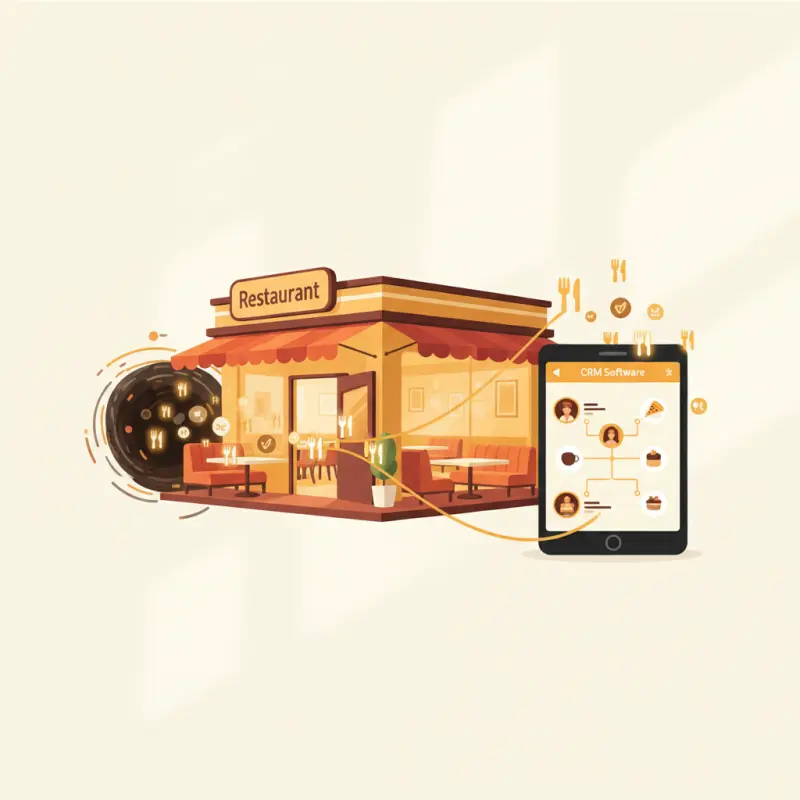
CRM Software for Restaurants: Stop Losing Your Best Customers
Blog Manager
··5 min read
AI Overview
CRM software for restaurants prevents customer loyalty from bleeding into lost revenue by tracking behavior and identifying drift patterns before regulars disappear. Without CRM software for restaurants, a typical 200-customer daily operation might have 40 true regulars visit weekly with zero tracking when they skip visits or celebrate elsewhere. In Agadir's competitive dining scene, restaurants using customer tracking systems see 34% more repeat visits than those relying on memory alone. The economics matter: acquiring new customers costs five times more than retaining existing ones, yet most restaurants invest everything in first-time diners while regulars slip away unnoticed. Points programs feel intuitive but often erode margins through over-redemption, while tier-based systems create clear value hierarchies that customers understand. Start by identifying your weekly regulars through order history analysis and implement milestone recognition before they drift to competitors.
Table of Contents
For restaurant owners
Start your restaurant in 60 minutes.
From signup to your first real order — no commission, no setup fee, no sales call.
Your best customers walk through the door every week. You serve them, they pay, they leave — and you have no idea they just placed their 50th order. That's the hidden cost of running a restaurant without CRM software for restaurants: invisible loyalty bleeding into missed revenue.
In Agadir's competitive dining scene, restaurants tracking customer behavior see 34% more repeat visits than those flying blind. The difference isn't just software — it's understanding which loyalty model actually drives profits versus which ones quietly erode your margins.
Problem: Your Best Customers Are Anonymous
Walk into any restaurant in Morocco and watch the owner greet regulars by memory. "The usual?" they'll ask the businessman who orders chicken tagine every Tuesday. Personal touch, zero data. When that regular skips three weeks, nobody notices. When they celebrate their birthday at a competitor, nobody knows.
The real damage happens in the numbers. A restaurant serving 200 customers daily might have 40 true regulars — customers visiting weekly or more. Without a CRM system for restaurants tracking their behavior, you can't identify when regulars drift away, can't reward milestone visits, can't segment offers based on actual ordering patterns.
Consider this: acquiring a new customer costs five times more than keeping an existing one. Yet most restaurants invest everything in attracting first-time diners while their regulars quietly slip out the back door. The irony? These regulars want to be recognized. They want the points, the perks, the feeling of being valued. They're literally waiting for you to ask.
Stack audit
What do you currently use?
Tick what you have. We’ll show what OCHI replaces or connects to.
The Three Models That Actually Work (And Which One Kills Profits)
Every restaurant CRM promises to boost loyalty. Few explain the economics behind each model — or which one might destroy your margins. Here's what actually happens when you implement each approach in a real restaurant.
Points: Simple but Expensive
Points programs feel intuitive. Spend 100 MAD, earn 10 points. Collect 500 points, get 50 MAD off. Simple math that customers understand instantly. The hidden cost? Redemption rates average 70% in restaurants — far higher than retail. Every point becomes a future liability on your books.
A Casablanca steakhouse implemented points at 10% of purchase value. Six months later, they discovered outstanding points worth 180,000 MAD — an invisible debt growing with every transaction. Processing redemptions ate 2% more in transaction fees. Staff spent hours explaining point balances. The program worked, but at what cost?
Tiers: Status That Drives Behavior
Tier programs tap into something deeper than discounts — they create identity. Customers don't just want savings; they want recognition. The key is making tiers meaningful enough to change behavior.
OCHI's built-in tier system runs Bronze to Platinum, with clear behavioral triggers. Bronze members get basic perks. Gold members — those spending 5,000+ MAD quarterly — receive priority reservations and exclusive menu previews. Platinum status requires 10,000+ MAD, unlocking chef's table experiences and complimentary birthday dinners.
The economics favor the restaurant. Instead of giving away margin on every transaction, you invest in experiences for your best customers. A birthday dinner costs you 30% in food cost but creates a memorable moment worth far more in lifetime value.
Cashback: The Margin Killer
Cashback programs sound generous. "Get 5% back on every order!" But in a business where net margins hover around 10%, giving away half your profit makes no sense. Worse, cashback trains customers to expect discounts rather than value experiences.
A Rabat café tried 5% cashback for three months. Revenue grew 20% — impressive until they calculated the true cost. Between the cashback itself, increased credit card fees, and promotional costs, they netted 2% margins. Sustainable? Hardly.
Why Bronze-Silver-Gold Is Marketing Theater (And What Works Instead)
Generic tier names mean nothing. "Gold member" at your restaurant carries the same weight as "Gold member" at the car wash. No exclusivity, no identity, no emotional connection. The best CRM for restaurants creates tiers that feel unique to your brand.
Consider local language and culture. A Marrakech riad restaurant uses "Medina Member" for entry level, advancing to "Riad Regular" and finally "Palace Guest." Each tier connects to the experience, not just the spend level. Members proudly mention their status because it means something specific.
Behavioral triggers matter more than names. OCHI's system automatically promotes members based on patterns, not just spending. Visit 10 times in 30 days? That consistency earns rewards regardless of order size. Order delivery to the same office address 20 times? The system recognizes a valuable lunch customer worth protecting.
Tier
Qualifier
Perks
Business Impact
Bronze
First order
Birthday bonus, point earning
Data capture, engagement start
Silver
10 orders OR 2,000 MAD
2x points, exclusive offers
Habit formation phase
Gold
5,000 MAD quarterly
Priority reservations, previews
High-value lock-in
Platinum
10,000 MAD quarterly
Chef's table, concierge service
Brand ambassadors
The 34% Repeat Visit Benchmark (And How to Hit It)
Moroccan restaurants average 26% repeat visit rates — meaning three quarters of customers never return. Top CRM software for restaurants changes this equation. OCHI restaurant partners see 34% rates within six months, with some hitting 42% through smart segmentation.
Auto-Points That Actually Convert
Manual point entry kills programs. Staff forget, customers lose receipts, frustration builds. Automated systems capture every transaction, award points instantly, and send balance updates automatically. No friction means higher engagement.
OCHI's integration awards points at checkout — whether online, QR table ordering, or POS. Customers see their balance grow in real-time. Birthday bonuses drop automatically. Referral rewards process without staff intervention. The system runs itself.
Segmentation Beyond "VIP Customer"
Real segmentation goes deeper than spending levels. A Fès restaurant segments by behavior: lunch crowd versus dinner diners, weekday regulars versus weekend visitors, delivery devotees versus dine-in guests. Each segment receives relevant offers.
During Ramadan, dinner segments receive iftar promotions while lunch segments get suhoor deals. Office delivery customers see weekday lunch combos. Weekend diners get family meal offers. Relevance drives response rates from 2% (broadcast) to 18% (segmented).
The Built-In Advantage
Standalone CRM systems mean another login, another integration, another monthly fee. Restaurant platforms with built-in CRM capture data naturally — every order feeds the system. No manual imports, no synchronization issues, no duplicate customer records.
Your CRM Decision: Integration vs. Standalone
Two paths lead to customer data: bolt on a CRM to your existing systems or choose a platform with CRM built in. The economics tell the real story.
Standalone CRM runs 500-2,000 MAD monthly plus integration costs. Setup takes 4-8 weeks. Staff training adds another month. Data synchronization creates ongoing headaches — customer places order through one system, CRM doesn't update until overnight batch processing.
Integrated platforms like OCHI include CRM at no extra cost. Every order automatically updates customer profiles. Points calculate instantly. Segments refresh in real-time. Your complete guide to restaurant operations stays in one system — simpler for staff, cleaner for data.
The question isn't whether you need customer data — it's whether you want to manage multiple systems or run everything through one platform. For restaurants serious about knowing their customers, integration beats separation every time.
Start building real customer relationships. See how OCHI's built-in CRM transforms anonymous diners into loyal regulars at ochi.ma/partners.
Frequently Asked Questions
What is CRM software for restaurants?
CRM software for restaurants tracks customer behavior, order history, and visit patterns to identify regulars, prevent customer drift, and automate loyalty rewards. It turns anonymous diners into known customers with tracked preferences and spending habits.
How much does restaurant CRM software typically cost?
Restaurant CRM costs vary from free built-in features in platforms like OCHI to standalone solutions ranging 200-800 MAD monthly. Zero-commission platforms often include CRM features without additional fees, while third-party systems charge per customer or location.
Can small restaurants benefit from CRM software?
Small restaurants benefit most from CRM software because they rely heavily on repeat customers. A 40-seat restaurant with 20 weekly regulars can increase revenue 15-25% by preventing just two regulars from drifting away monthly.
What's the difference between points and tier-based loyalty programs?
Points programs reward spending with redeemable currency but can erode margins through over-redemption. Tier-based programs create status levels that encourage higher spending to maintain benefits, typically generating better profit margins.
How do restaurants track customer behavior without being intrusive?
Restaurants track behavior through order history, visit frequency, and spending patterns using phone numbers or email addresses collected during ordering. Modern systems like QR ordering automatically capture this data without requiring separate loyalty cards.
Restaurant owners · Weekly
The guide to running a restaurant in 2026.
One article per week. No commission advice.
Just honest operational insight for Moroccan restaurants.
Blog Manager
Comments
No comments yet. Be the first to share your thoughts.