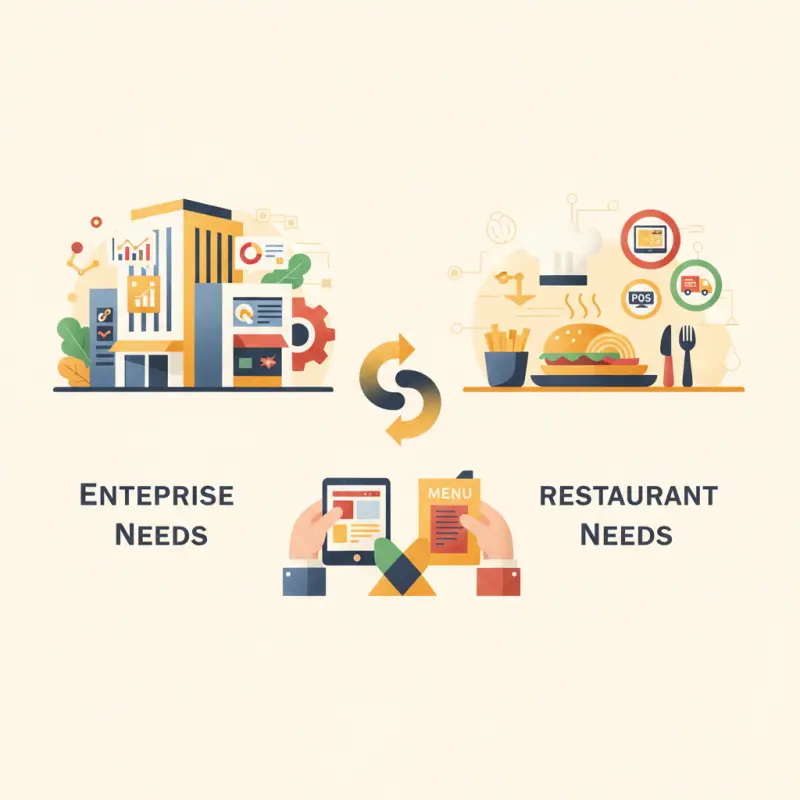
Crunchtime Software Reality Check: Enterprise vs Restaurant Needs
Blog Manager
··5 min read
AI Overview
Crunchtime software manages inventory, labor scheduling, food safety compliance, and analytics for restaurant operations. Most crunchtime software implementations in Morocco cost 400,000+ MAD and require eight months to deploy, yet restaurants typically use only 20% of available features. The software tracks every ingredient from supplier to plate, calculates theoretical versus actual food costs, and can identify significant revenue leaks — one Casablanca steakhouse discovered a 150,000 MAD monthly loss through portion control issues. However, proper implementation requires mapping approximately 2,000 data points for a restaurant with 200 menu items. Enterprise systems like Crunchtime are designed for chains with 50+ locations, not independent operators. Before investing in complex enterprise software, evaluate whether simpler restaurant management platforms can meet your actual operational needs without the enterprise overhead.
Table of Contents
For restaurant owners
Start your restaurant in 60 minutes.
From signup to your first real order — no commission, no setup fee, no sales call.
A Marrakech restaurant group with 12 locations spent 400,000 MAD and eight months implementing enterprise restaurant software — only to use 20% of its features. This isn't unique. Most restaurants investing in crunchtime software discover they've bought a Ferrari to drive through the medina.
The gap between what enterprise restaurant management promises and what independent operators actually need has never been wider. While software vendors pitch AI-driven labor optimization and predictive analytics, restaurant owners in Agadir struggle with basic questions: Will my staff actually use this? Can I afford the monthly fees when tourism dips? Do I really need 47 different reports?
Crunchtime Software: What It Actually Does Beyond the Marketing
Strip away the corporate jargon and crunchtime software does four things: manages inventory, schedules labor, tracks food safety compliance, and generates analytics. Sounds straightforward until you see it in action.
The inventory module tracks every gram of zaatar from supplier to plate. It calculates theoretical food costs based on recipes, compares them to actual usage, and flags variances. A Casablanca steakhouse using the system discovered their theoretical food cost was 28% but actual was 34% — a 150,000 MAD monthly leak. The software pinpointed portion control issues and supplier invoice discrepancies.
Labor management goes beyond simple scheduling. It forecasts staffing needs based on historical sales patterns, weather data, and local events. During Ramadan, it automatically adjusts schedules for iftar rushes. The system even tracks productivity metrics — orders per server hour, prep time per dish, table turnover rates.
But here's what they don't tell you: implementing these modules requires mapping every ingredient, recipe, supplier relationship, and staff role into the system. For a restaurant with 200 menu items, that's approximately 2,000 data points to configure correctly.
Enterprise Focus: Built for 50+ Locations
The minimum viable use case for crunchtime software starts at 50 locations. Below that, you're paying for orchestration capabilities you don't need. The platform assumes centralized purchasing, commissary kitchens, and regional management layers — infrastructure most Moroccan restaurants lack.
Integration adds another layer. Connecting with existing billing petpooja systems requires custom API work. Most restaurants already using petpooja billing discover they need middleware to sync data between platforms. A Rabat restaurant chain spent 60,000 MAD on integration alone, plus 5,000 MAD monthly for the connector service.
Stack audit
What do you currently use?
Tick what you have. We’ll show what OCHI replaces or connects to.
Nobody talks about total cost of ownership. Here's what crunchtime software actually costs:
Cost Category
Initial Year
Annual Ongoing
Software Licenses
300,000 - 500,000 MAD
180,000 - 300,000 MAD
Implementation Services
200,000 - 400,000 MAD
—
Training
50,000 - 100,000 MAD
20,000 - 40,000 MAD
Integration (toast pos company)
60,000 - 120,000 MAD
60,000 MAD
Data Migration from pos toast
40,000 - 80,000 MAD
—
Total
650,000 - 1,200,000 MAD
260,000 - 400,000 MAD
These figures assume everything goes smoothly. Add 30% for scope creep, customization requests, and the inevitable "we need this feature modified" conversations.
The vendor says three months. Your implementation partner suggests six. Reality? Plan for 12-18 months before you see meaningful ROI. Here's why:
Training isn't a two-day workshop. Your head chef needs to understand recipe costing. Every line cook must log prep activities. Servers learn new ordering workflows. Managers navigate 15 different dashboards. A Fès restaurant group trained 200 staff members across eight locations — it took four months just for basic adoption.
Data migration from toast pos company systems presents unique challenges. Menu items don't map cleanly. Historical sales data needs restructuring. Customer databases require deduplication. One Tangier operation discovered their pos toast data included 14,000 duplicate customer records and 300 archived menu items still affecting reports.
Staff adoption remains the biggest hurdle. Experienced servers resist changing workflows. Chefs view recipe standardization as creative restriction. The system demands precision in environments built on intuition and experience.
When Crunchtime Makes Sense (And When It Doesn't)
Enterprise software makes sense for specific scenarios. Multi-location groups with centralized purchasing save 5-8% on food costs through vendor negotiation and waste reduction. Franchises maintain consistency across locations. Hotel chains integrate restaurant operations with property management systems.
But for independent restaurants — even successful ones with multiple locations — the math rarely works. You need approximately 15 million MAD in annual revenue just to justify the software costs. Below that, you're paying enterprise prices for problems you don't have.
The Complexity Trap: Over-Engineering Simple Operations
Why do Casablanca restaurant groups choose crunchtime? Investor pressure for "best-in-class systems." Board presentations showing digital transformation. Competition with international brands using similar platforms.
Why do Agadir independents get buried? They need basic order management, not predictive analytics. They want to track daily sales, not optimize theoretical menu mix. They require simple staff scheduling, not AI-powered labor forecasting based on weather patterns.
The software's 200+ features become a burden. Managers spend hours generating reports nobody reads. Configuration options create analysis paralysis. Updates break custom workflows. Support tickets pile up for features you never wanted but now depend on.
OCHI Alternative: Zero Commission, Zero Subscription Restaurant Management
What if you could have operational control without enterprise complexity? No monthly software fees. No six-figure implementation. No 18-month timeline. Just the tools you actually need, live in days, at prices that make sense for Moroccan restaurants.
OCHI delivers what matters: order management, kitchen display, table management, delivery tracking, inventory control, and actionable reports. The difference? We built it for restaurants like yours, not multinational chains.
Complete Operations Control: votrenom.ochi.ma
Your restaurant gets its own branded platform at votrenom.ochi.ma. Customers order directly — no commissions. Your kitchen sees orders instantly on the display system. Delivery drivers get automatic assignments with GPS tracking. Inventory updates with each sale.
The entire system costs nothing upfront. No monthly subscription eating into margins during slow seasons. You pay only when you make money — a small transaction fee on actual orders. During Ramadan rush? You're covered. Tourist season ends? Your costs drop automatically.
Setup takes days, not months. Your existing menu imports in minutes. Staff training happens in hours — the interface makes sense because we designed it with actual restaurant workers. No consultants. No integration specialists. No dedicated IT staff required.
Real Moroccan restaurants need real solutions. Visit ochi.ma/partners to see how operational control looks without the enterprise price tag.
Enterprise restaurant software has its place — in enterprise restaurants. For everyone else, there's a better way to run your business. Set up your branded restaurant platform at votrenom.ochi.ma — because your technology should work as hard as you do, not harder than you can afford.
Frequently Asked Questions
What does crunchtime software actually do for restaurants?
Crunchtime software manages four core functions: inventory tracking, labor scheduling, food safety compliance, and analytics reporting. It tracks ingredients from supplier to plate and compares theoretical versus actual food costs.
How much does crunchtime software cost to implement?
Implementation costs typically exceed 400,000 MAD with eight-month deployment timelines. Most restaurants discover they use only 20% of the software's features after full implementation.
Is crunchtime software suitable for independent restaurants?
Crunchtime software is designed for enterprise chains with 50+ locations. Independent restaurants often find the complexity and cost excessive for their actual operational needs.
What are the main problems with crunchtime software implementations?
The main issues include high implementation costs, complex data mapping requirements, and feature overload. Restaurants need approximately 2,000 data points configured for 200 menu items, yet most operators never use advanced analytics features.
What should restaurants consider before choosing crunchtime software?
Evaluate your actual operational needs versus enterprise features. Consider whether simpler restaurant management platforms can handle inventory, scheduling, and analytics without enterprise complexity and costs.
Restaurant owners · Weekly
The guide to running a restaurant in 2026.
One article per week. No commission advice.
Just honest operational insight for Moroccan restaurants.
Blog Manager
Comments
No comments yet. Be the first to share your thoughts.