AI Overview
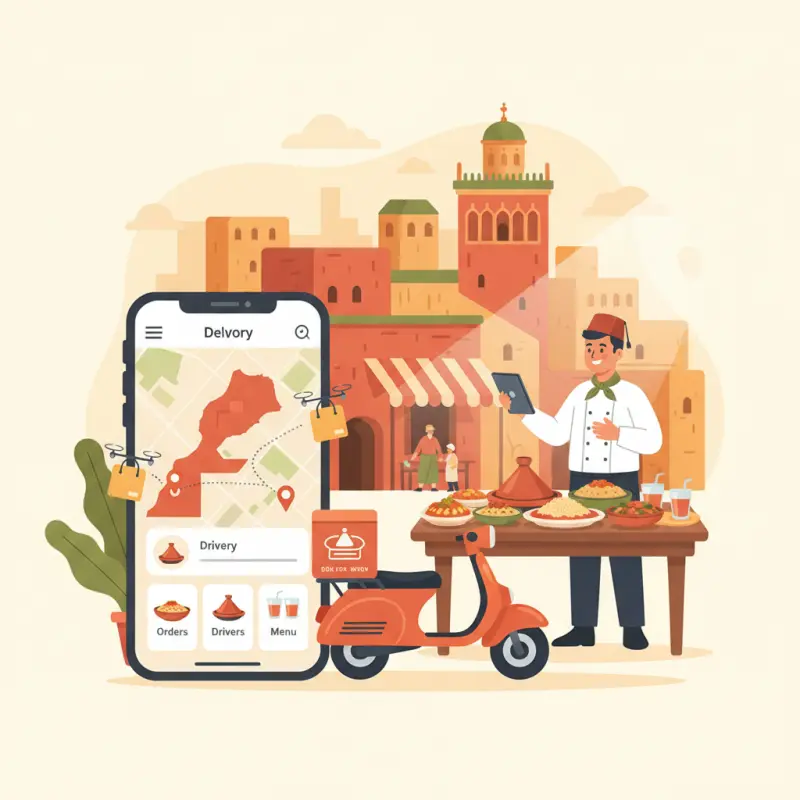
Most food delivery management software fails in Morocco because it's designed for Western markets with standardized addresses and credit card payments. Food delivery management software must handle Moroccan realities: medina addresses like 'third door past the blue fountain,' polygon delivery zones that adapt to traffic patterns, and cash-on-delivery reconciliation. Silicon Valley solutions can't manage driver float or navigate when 70% of orders are cash payments. Smart restaurant operators use platforms that support landmark-based addressing, custom delivery polygons, and multi-language driver interfaces. Google Maps hasn't updated many Moroccan streets since 2019, making GPS accuracy critical. Successful delivery platforms integrate local knowledge with GPS pins that drivers can save for future orders. Choose software built for Morocco's unique address systems and payment preferences.
Table of Contents
Why Most Food Delivery Management Software Fails in Morocco
A restaurant owner in Fès recently told us their delivery drivers spend 40% of their time lost in the medina's maze-like streets. Their expensive food delivery management software couldn't handle addresses like "third door past the blue fountain." This isn't a tech problem — it's a Morocco problem that most platforms ignore.
Walk through Casablanca's sprawling suburbs and you'll find delivery zones that make no sense. A 5-kilometer radius includes wealthy Anfa but cuts off dense residential areas in Sidi Moumen. Meanwhile, drivers juggle orders in Darija, French, and Arabic while navigating streets Google Maps hasn't updated since 2019.
The cash-heavy economy adds another layer. When 70% of your orders are cash on delivery, your software for food delivery needs different features than Silicon Valley solutions built for credit cards. Driver float management, daily reconciliation, and theft prevention become critical — not optional add-ons.
The Zone Setup Problem Nobody Talks About
Radius-based delivery zones work great if your restaurant sits in a perfect circle of equally accessible neighborhoods. In Morocco, they're useless. Agadir's beachfront restaurants can deliver 8 kilometers along the coast in 15 minutes but struggle to reach areas 3 kilometers inland during rush hour.
Smart operators use polygon mapping to draw custom zones that follow actual traffic patterns. But here's what vendors don't tell you: most restaurant delivery software can't handle overlapping polygons for different time slots. Lunch delivery to business districts, dinner delivery to residential areas — your zones need to shift with demand.
Address standardization remains the biggest technical hurdle. When customers write "près de Marjane" or "derrière la mosquée," your online food ordering and delivery platform better have a solution. The best systems let drivers add landmark notes and GPS pins that get saved for future orders.
The Real Cost of Commission-Based Models
Let's run real numbers for a mid-size restaurant in Rabat doing 50 deliveries daily at 120 MAD average order value:
| Platform Type | Commission Rate | Monthly Revenue | Platform Fees | Restaurant Keeps |
|---|---|---|---|---|
| Traditional Aggregator | 25% | 180,000 MAD | 45,000 MAD | 135,000 MAD |
| "Lower" Commission Platform | 15% | 180,000 MAD | 27,000 MAD | 153,000 MAD |
| Zero Commission (OCHI) | 0% | 180,000 MAD | 0 MAD | 180,000 MAD |
That's 45,000 MAD monthly — enough to hire three full-time delivery drivers or upgrade your entire kitchen equipment. But the hidden costs run deeper. Payment processing adds 2.9% plus 0.30 MAD per transaction. Marketing fees kick in when you want visibility. Tablet rentals, integration costs, and "service charges" pile up until you're giving away 35% of revenue.
Stack audit
What do you currently use?
Tick what you have. We’ll show what OCHI replaces or connects to.
The Technical Foundation: What Your Software Must Handle Day One
Forget AI-powered recommendations and blockchain loyalty points. Your food ordering and delivery platform needs to nail the basics or you'll hemorrhage money from day one. Most platforms demo well but crumble under real operational pressure.
Auto-Driver Assignment That Actually Works
Distance-based assignment sounds logical until your closest driver is stuck in Marrakech's Gueliz traffic while another driver 2 kilometers away can arrive in half the time. Effective auto-assignment considers current driver location, active orders in their queue, vehicle capacity, and historical delivery times for each zone.
Peak hour surge management separates amateur platforms from professional ones. When orders spike at 8pm, your system needs preset rules: maximum orders per driver, automatic batch radius, and overflow protocols. OCHI's algorithm groups nearby orders automatically, letting one driver handle three deliveries in a 500-meter radius instead of three separate trips.
Driver capacity limits prevent the classic mistake of overloading your best performers. When Ahmed consistently delivers fast, the system shouldn't reward him with impossible workloads. Smart platforms enforce maximum concurrent orders and mandatory break periods.
Real-Time GPS Tracking vs. Marketing Fluff
Real-time means updates every 5-10 seconds, not every few minutes. Customers watching their order need smooth movement on the map, not jumpy updates that show drivers teleporting across neighborhoods. The technical requirement: WebSocket connections, not HTTP polling.
Customer communication automation reduces support calls by 60%. When drivers mark "preparing to leave restaurant" or "5 minutes away," automated SMS messages keep customers informed. But automation needs nuance — nobody wants six messages for one shawarma.
Night delivery safety features matter more than any platform admits. Drivers need panic buttons, automated check-ins for long delays, and zone restrictions after certain hours. In Casablanca's outer districts, some restaurants cut delivery at 10pm purely for driver safety.
The Numbers Game: Delivery Zone Economics in Practice
Delivery profitability comes down to density math. You need enough orders per square kilometer to justify driver time and fuel costs. Most restaurants learn this through expensive trial and error.
Mapping Profitable Delivery Zones in Agadir
Here's the breakdown for a typical Agadir restaurant with one dedicated driver:
| Zone Radius | Avg Delivery Time | Orders/Hour Possible | Fuel Cost/Delivery | Break-even Orders/Day |
|---|---|---|---|---|
| 3 km | 25 min | 2.4 | 8 MAD | 12 |
| 5 km | 40 min | 1.5 | 15 MAD | 20 |
| 7 km | 55 min | 1.1 | 22 MAD | 28 |
The 3-kilometer sweet spot isn't universal. Beachfront restaurants can profitably deliver 7 kilometers along the corniche because it's one straight road. Meanwhile, restaurants in Talborjt might lose money beyond 2 kilometers due to winding streets and traffic.
Driver Economics: The 70 MAD Minimum Order Reality
Average delivery cost calculation for Moroccan cities: driver wage (15-20 MAD/delivery) + fuel (8-15 MAD) + vehicle wear (5 MAD) + insurance/overhead (5 MAD) = 33-45 MAD per delivery. That's why the 70 MAD minimum order threshold appears everywhere.
Free delivery only makes sense above 150 MAD orders or within 2 kilometers. Some restaurants offer free delivery as a loss leader for customer acquisition, but without careful zone management, they're subsidizing suburban customers at the expense of profitable nearby orders.
Batch delivery changes the economics completely. Two orders to the same building complex cost barely more than one. Smart restaurant delivery software identifies these opportunities automatically, holding orders for 5-10 minutes to enable batching.
Why Zero-Commission Changes Everything
Commission-based platforms create perverse incentives. They profit from higher menu prices (bigger commission) while restaurants struggle with thin margins. They control customer data, making restaurants dependent on platform marketing. Most damaging: they train customers to expect discounts that restaurants fund.
The Commission Trap: A Casablanca Restaurant Case Study
Bab Marrakech, a traditional Moroccan restaurant in Casablanca, shared their numbers: 300,000 MAD monthly delivery revenue through a major aggregator. Commission and fees: 72,000 MAD. Marketing spend to stay visible: 15,000 MAD. Net revenue: 213,000 MAD.
After switching to zero-commission ordering with OCHI, they kept the full 300,000 MAD. The saved 87,000 MAD funded two delivery cars, three new drivers, and a social media manager. Delivery revenue grew 40% in six months because they could afford to market directly to customers.
Customer data ownership transforms marketing possibilities. Instead of paying for platform visibility, restaurants build their own SMS lists, email campaigns, and loyalty programs. One Agadir restaurant discovered their top 50 customers generated 30% of revenue — impossible to know on commission platforms.
How OCHI's Model Works in Practice
Your branded subdomain (votrenom.ochi.ma) becomes your permanent digital address. No app downloads, no platform logos — just your restaurant's brand. Customers bookmark your site and order directly. Google indexes your menu. You own every interaction.
The integrated POS and delivery management means orders flow straight to your kitchen display. No tablets, no manual entry, no missed orders. Drivers see orders on their phones with turn-by-turn navigation. Real-time tracking keeps customers informed without constant calls.
Real-time analytics show profitability by zone, driver performance, and peak patterns. Unlike commission platforms that hide data to maintain control, you see every metric needed to optimize operations. Export reports for your accountant. Track food costs. Monitor customer lifetime value.
Building Your Delivery Operation: The First 30 Days
Success requires methodical setup, not rushed launches. Too many restaurants go live everywhere immediately, then wonder why drivers are overwhelmed and customers frustrated.
Week 1: Zone Setup and Driver Onboarding
Start with a conservative 2-kilometer polygon around your restaurant. Map it during different times — morning traffic, lunch rush, evening peaks. Mark problem areas: construction zones, one-way streets, buildings with difficult access. This base zone proves your operational capacity.
Driver recruitment needs more care than most realize. Beyond driving skills, you need basic smartphone literacy, customer service sense, and reliability. Create a simple training checklist: app navigation, order handling, payment processing, customer interaction standards, emergency procedures.
Menu optimization for delivery means removing items that travel poorly. Crispy foods get soggy. Ice cream melts. Plated presentations collapse. Mark prep times accurately — nothing frustrates customers more than "15 minutes" turning into an hour.
Week 2-4: Testing and Optimization
Soft launch to your existing customers first. Send SMS to your loyalty database announcing delivery. These forgiving customers provide honest feedback without harsh public reviews. Track everything: delivery times, driver feedback, customer complaints, order accuracy.
Key metrics for optimization: average delivery time by zone, driver utilization rate, order accuracy percentage, customer satisfaction scores, and cost per delivery. When delivery times consistently exceed 45 minutes, your zone is too large. When drivers wait idle, it's too small.
Common problems surface quickly. Address verification issues need preset protocols. Payment disputes need clear policies. Driver accidents need insurance documentation. Food quality complaints need resolution standards. Document solutions as they arise — your playbook for scaling.
After 30 days, you'll have real data to expand confidently. Add zones incrementally, always maintaining service quality. Many successful OCHI restaurants grew from 2-kilometer starter zones to city-wide delivery within six months.
The path to profitable delivery isn't complicated — it just requires food delivery management software built for how restaurants actually operate. When you keep 100% of revenue and control every aspect of the experience, growth becomes sustainable instead of subsidized.
Ready to build delivery operations you actually own? See how OCHI's zero-commission platform works at ochi.ma/partners.
Frequently Asked Questions
Why does food delivery management software fail in Morocco?
Most platforms are built for Western markets with standardized addresses and credit cards. They can't handle Moroccan addresses like 'près de Marjane' or manage cash-on-delivery reconciliation effectively.
What delivery zone setup works best in Morocco?
Polygon mapping that follows actual traffic patterns works better than radius-based zones. Smart operators create custom zones that adapt to different time slots and local geography.
How do restaurants handle cash-on-delivery with delivery software?
Effective platforms include driver float management, daily reconciliation tools, and theft prevention features. These aren't optional when 70% of orders are cash payments.
Can delivery software handle Arabic and French addresses?
The best systems support multi-language interfaces and let drivers add landmark notes with GPS pins. This solves the problem when customers write directions in Darija, French, or Arabic.
What makes OCHI different for Moroccan restaurants?
OCHI handles Morocco-specific challenges with GPS delivery tracking, custom zones, and zero commission structure. It's built for local addressing systems and payment preferences.
Restaurant owners · Weekly
The guide to running a restaurant in 2026.
One article per week. No commission advice. Just honest operational insight for Moroccan restaurants.

Blog Manager
Comments
No comments yet. Be the first to share your thoughts.