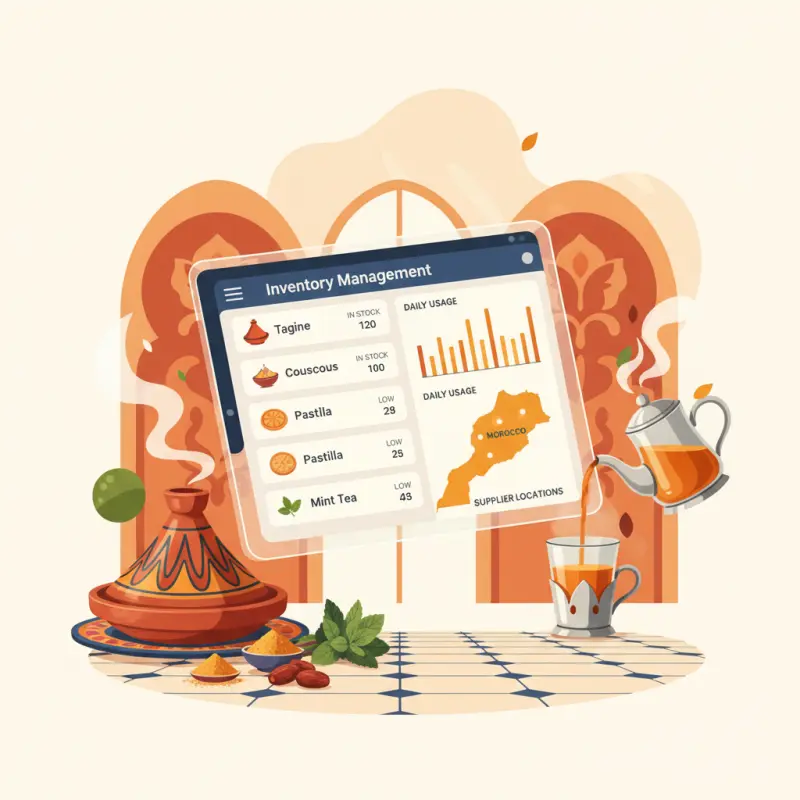
Food Industry Inventory Management Software for Moroccan Restaurants
Blog Manager
··5 min read
AI Overview
Manual inventory tracking costs Moroccan restaurants an average of 15,000 MAD per month in food waste. Food industry inventory management software reduces this waste by 70-80% through automated tracking, real-time alerts, and accurate demand forecasting. Generic Western systems fail in Morocco because they don't accommodate cash transactions, local measurements like individual preserved lemons, or suppliers who deliver at 5 AM expecting immediate payment. Successful inventory systems for Moroccan restaurants must integrate with local wholesale markets, handle gram-level spice tracking, and work with cash-based supplier relationships. Restaurants using proper inventory software report 25% reduction in food costs and eliminate the two daily hours staff spend manually counting stock. Choose software that understands Moroccan cuisine measurements and local business practices.
Table of Contents
For restaurant owners
Start your restaurant in 60 minutes.
From signup to your first real order — no commission, no setup fee, no sales call.
The Real Cost of Manual Inventory in Moroccan Restaurants
Every month, a typical 120-cover restaurant in Casablanca throws away 15,000 MAD worth of food. That's not carelessness — it's what happens when you track inventory with pen and paper in a business where margins already hover around 10%.
The numbers tell a brutal story. Manual tracking leads to 25-30% food waste across Morocco's restaurant industry. Fresh produce rots in walk-ins because no one tracked the delivery date. Expensive proteins expire because the prep cook didn't update the inventory sheet. During Ramadan, restaurants overorder by 40% trying to meet demand, then watch ingredients spoil when customer patterns shift after Eid.
Tourist season brings its own chaos. A seafood restaurant in Agadir might run out of fresh catches on a busy Saturday because their morning inventory count missed a box. That's 50 disappointed customers and thousands in lost revenue — all from a simple tracking error that proper food industry inventory management software would catch instantly.
The hidden costs multiply. Staff spend two hours daily counting stock instead of serving customers. Managers make purchasing decisions based on gut feeling rather than data. Suppliers deliver whatever they want because there's no systematic receiving process. It's death by a thousand paper cuts.
Stack audit
What do you currently use?
Tick what you have. We’ll show what OCHI replaces or connects to.
Why Generic Restaurant Inventory Programs Don't Work in Morocco
Most restaurant stock management software comes from Silicon Valley or London. These systems assume you're tracking steaks by the portion and fries by the case. They don't understand that Moroccan cuisine measures saffron by the gram and preserved lemons by the individual piece.
The disconnect runs deeper than measurements. Western inventory systems expect credit-based supplier relationships with 30-day payment terms. But in Casablanca's wholesale markets, transactions happen in cash. Suppliers deliver at 5 AM and expect payment on the spot. Your fancy cloud-based system means nothing if it can't handle this reality.
Language creates another barrier. Try explaining to your prep cook why they need to input "chicken breast" when they know it as "صدر الدجاج" or "blanc de poulet." Generic restaurant software inventory forces your team to work in translation, slowing operations and increasing errors.
Then there's the recipe problem. A proper harira requires 37 ingredients in precise ratios. Change the chickpea-to-lentil balance by 10 grams and regular customers notice. Western systems built around "one burger patty, two pickle slices" can't handle this complexity. You need gram-level precision for every spice, every herb, every traditional ingredient.
The Real Features That Matter for Restaurant Stock Management Software
Forget the marketing promises about "AI-powered analytics" and "blockchain transparency." Here's what actually matters for Moroccan restaurants:
Feature
Why It Matters
Real Impact
Multi-language support (Arabic/French/English)
Staff can work in their preferred language
50% faster inventory counts
Gram-level tracking
Accurate costing for spice-heavy dishes
3-5% better margins
Cash purchase tracking
Matches local supplier relationships
Complete financial visibility
Waste categorization
Identify patterns (prep waste vs. spoilage)
20% waste reduction
Local supplier directory
Pre-loaded Moroccan wholesalers
One-click reordering
The best restaurant inventory program also handles the basics without drama. Automatic reorder alerts when your olive oil drops below five liters. Recipe costing that updates when tomato prices spike. Integration with local accounting formats so your bookkeeper doesn't need to translate reports.
Mobile access matters too. Your chef should check stock levels from the market at 6 AM. Your manager should approve purchase orders from home. The system should work offline when your internet cuts out — because it will.
How OCHI's Inventory System Cuts Waste by 25%
Restaurant "Riad Tajine" in Agadir was hemorrhaging money through food waste. Their monthly loss: 8,000 MAD. Six weeks after implementing OCHI's restaurant inventory management software, they cut waste to 6,000 MAD. Here's exactly how they did it.
Week one: They uploaded their complete ingredient list — 247 items from argan oil to za'atar — with local supplier codes and current prices. OCHI's system already knew most Moroccan suppliers, making setup faster. Each ingredient got tracked by its actual unit (grams for spices, pieces for vegetables, liters for oils).
Week two: Staff started logging every delivery through the mobile app. When Hassan the supplier arrived at 5:30 AM with fresh produce, the prep cook scanned items, confirmed weights, and logged prices in Arabic. The system automatically updated stock levels and flagged any price variations above 10%.
Week three: Recipe management went live. The chef input exact measurements for their 68 dishes, including variations. The system now tracked that each chicken tagine used 180g of chicken, 15g of preserved lemon, and 2g of saffron. When orders came in, inventory deducted automatically.
The results appeared quickly. Low-stock alerts prevented stockouts during busy Friday nights. Waste tracking revealed they were over-prepping couscous by 30%. Purchase order suggestions based on actual usage patterns meant less spoilage. The 2,000 MAD monthly savings went straight to the bottom line.
Making the Switch: From Paper to Digital Inventory Management
The biggest barrier isn't technology — it's fear. Restaurant owners in Marrakech worry their staff won't adapt. They imagine complex training sessions and confused employees. The reality is simpler.
Start with a pilot program in your dry goods storage. Pick 20 high-value items like olive oil, couscous, and canned goods. Track only these items digitally for two weeks. Your staff learns the system without pressure while you see immediate results on expensive ingredients.
Training should happen during quiet afternoon hours. Show your team how the mobile app works in their preferred language. Let them practice receiving a mock delivery. Most staff master basic operations in under an hour — especially when they realize it makes their jobs easier.
Common mistakes to avoid: Don't try to digitize everything at once. Don't skip the initial physical inventory count. Don't assume your current supplier codes will work — create new ones that make sense in your system. Don't forget to set up user permissions so waiters can't accidentally modify stock levels.
The transition timeline for a typical 60-seat restaurant: Week 1-2 for setup and dry goods, Week 3-4 for proteins and produce, Week 5-6 for recipes and reporting. By week eight, you're running entirely on digital tracking with clear visibility into your operations.
For Moroccan restaurants drowning in manual processes, modern inventory management isn't about fancy features — it's about saving money and reducing stress. The right system pays for itself through waste reduction alone.
Ready to see how much you could save? Set up your personalized inventory system at ochi.ma/partners and start tracking what matters.
Frequently Asked Questions
How much does food industry inventory management software cost for restaurants?
Food industry inventory management software typically costs 200-800 MAD monthly for small restaurants, with enterprise solutions ranging from 1,000-3,000 MAD monthly. The software pays for itself through reduced waste within 2-3 months.
Can inventory management software handle Moroccan cuisine ingredients?
Quality food industry inventory management software allows custom measurements for items like saffron by the gram, preserved lemons by piece, and traditional spice blends. Generic systems often fail with these specific requirements.
Does inventory software work with cash-based suppliers in Morocco?
Modern food industry inventory management software can track cash transactions and immediate payments. The key is finding systems designed for local market conditions rather than Western credit-based supplier relationships.
How does inventory software reduce food waste in restaurants?
Food industry inventory management software tracks expiration dates, monitors usage patterns, and sends alerts before items spoil. This reduces food waste by 25-30% compared to manual tracking methods.
Restaurant owners · Weekly
The guide to running a restaurant in 2026.
One article per week. No commission advice.
Just honest operational insight for Moroccan restaurants.
Blog Manager
Comments
No comments yet. Be the first to share your thoughts.