AI Overview
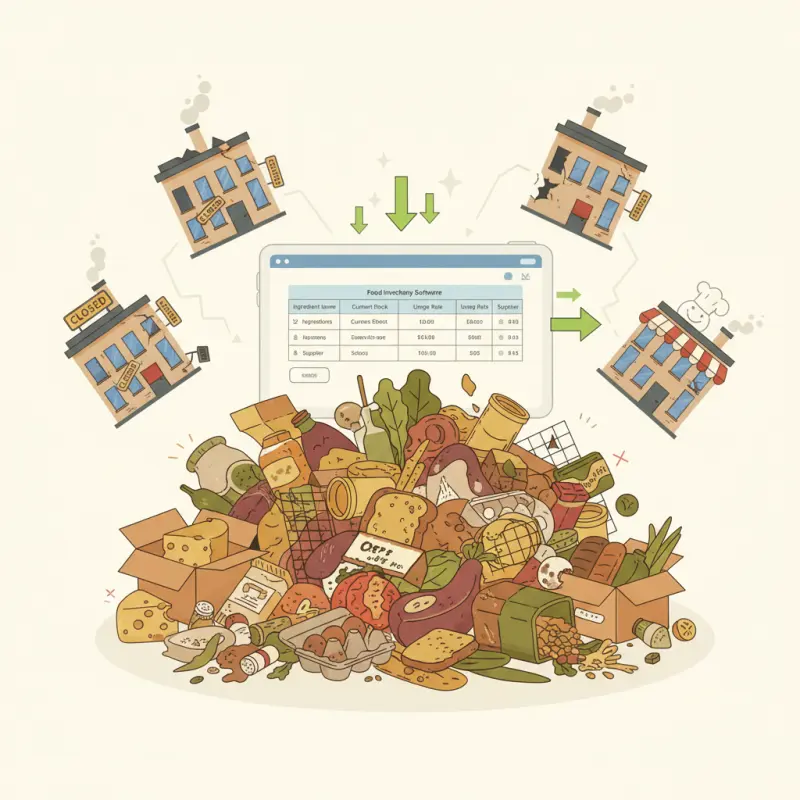
Food inventory tracking software fails in 73% of restaurants within 90 days because vendors ignore kitchen realities and staff limitations. Most food inventory tracking software overwhelms teams with unnecessary features — 47 modules when restaurants need five basic functions. The biggest implementation barriers include feature overload, inadequate training time for staff without smartphone literacy, and choosing wrong precision levels for different ingredient types. Successful restaurants in Morocco start with simple counting systems for items under MAD 50 per unit, reserving gram-level tracking for expensive ingredients like imported beef at MAD 450 per kilogram. Focus on five core modules: receiving, basic counting, supplier invoicing, food cost reporting, and waste tracking. Train one person thoroughly before expanding to the full team.
Table of Contents
Why Most Restaurant Inventory Software Projects Fail in the First 90 Days
Your chef counts inventory twice a week. Your supplier invoices pile up in a drawer. Your food cost percentage stays a mystery until month-end. If this sounds familiar, you're not alone — 73% of Moroccan restaurants still track inventory on paper or basic spreadsheets.
The promise of food inventory tracking software seems simple: less waste, lower costs, better margins. Yet three months after implementation, most restaurants abandon their shiny new system and return to the old ways. The problem isn't the technology. It's the human factor that vendors never discuss.
The Three Implementation Pitfalls Vendors Don't Mention
Restaurant stock management software fails when it ignores the reality of your kitchen. Your 55-year-old head chef who's been cooking for 30 years doesn't need AI-powered predictive analytics. He needs a simple way to record deliveries without learning a new language.
The first pitfall hits immediately: feature overload. You buy a system with 47 modules when your team only needs five. Every extra button, every unnecessary report, every complex workflow adds friction. Your staff spends more time fighting the software than managing inventory.
Training time becomes the second killer. Vendors promise "intuitive interfaces" but assume your team has smartphone literacy. In reality, teaching your prep cook to navigate multiple screens takes weeks, not hours. During peak service, they'll abandon the tablet and grab a notepad every time.
The third pitfall — choosing the wrong precision level — destroys adoption completely. A beachfront restaurant in Agadir doesn't need gram-level tracking for lemons. But that same precision matters for imported beef tenderloin at MAD 450 per kilogram.
How to Pick Your Complexity Level: Quick Count vs. Gram-Level Tracking
Start with this question: what's your average ingredient cost? Items under MAD 50 per unit work fine with simple counting. Your kitchen uses 12 onions today? Record 12 onions. No scales, no decimals, no confusion.
Save precise measurement for high-value proteins, imported items, and ingredients where a 10% variance costs real money. A steakhouse needs gram-level tracking. A sandwich shop counting baguettes doesn't.
The hidden cost of over-engineering shows up in compliance rates. When you demand gram-level precision for everything, your team stops recording anything. Better to have 95% compliance on simple counts than 20% compliance on complex measurements.
Stack audit
What do you currently use?
Tick what you have. We’ll show what OCHI replaces or connects to.
The Real Cost of Food Waste: Numbers from Agadir Restaurants
Walk into any restaurant kitchen in Morocco at closing time. Watch what goes into the trash. The numbers will shock you — the average restaurant throws away 25% of its food purchases. For a mid-size restaurant in Agadir buying MAD 24,000 of inventory weekly, that's MAD 6,000 straight to the garbage.
Breaking Down 25% Food Waste: Where Your Money Actually Goes
Fresh produce leads the waste parade at 40% of total loss. Those beautiful tomatoes you bought Monday? Half turn soft by Thursday. That's MAD 2,400 monthly for a typical 60-seat restaurant. The tragedy? Most of this waste is preventable with proper rotation and forecasting.
Proteins account for 30% of waste — MAD 1,800 monthly. Your cook portions chicken breasts by eye, adding an extra 20 grams per plate. Multiply that by 40 orders daily, and you're losing an entire case of chicken each month.
Dry goods seem stable but still contribute 15% of waste (MAD 900 monthly). Rice absorbs moisture. Flour attracts pests. Spices lose potency. Even "shelf-stable" items have hidden expiration costs.
| Waste Category | % of Total Waste | Monthly Cost (MAD) | Main Causes |
|---|---|---|---|
| Fresh Produce | 40% | 2,400 | Over-ordering, poor rotation |
| Proteins | 30% | 1,800 | Incorrect portions, trim waste |
| Dairy | 15% | 900 | Expiration, temperature issues |
| Dry Goods | 15% | 900 | Pests, moisture, expiration |
The 90-Day ROI Calculation That Actually Works
Restaurant inventory management software typically costs MAD 500-1,500 monthly. Seems expensive until you run the numbers. Cut waste by just 30% (from 25% to 17.5%), and you save MAD 1,800 monthly on a MAD 24,000 weekly spend.
Month one sees a 10% reduction as staff learns the system. Month two brings another 10% as you identify problem areas. By month three, you hit the full 30% reduction. Your MAD 1,000 software investment returns MAD 1,800 in savings — an 80% ROI that continues monthly.
The break-even point arrives faster than most owners expect. With proper implementation, you're cash-flow positive by week eight. Every dirham saved after that drops straight to your bottom line.
Restaurant Software Inventory: Features That Matter vs. Features That Sell
Software companies love to showcase their 3D analytics dashboards and blockchain integration. Your prep cook just wants to know if you're low on tomatoes. The disconnect between marketing features and kitchen reality explains why adoption rates stay dismally low.
The Only Five Features Your Kitchen Staff Will Actually Use
Low-stock alerts top the list — but only if they ping mobile phones. A notification buried in a dashboard helps nobody. Your supplier needs two days for delivery? The alert should fire with three days of stock remaining.
Quick entry for deliveries saves more time than any other feature. Scan a barcode or tap a photo — done in seconds. If entering a delivery takes longer than writing on paper, your team will choose paper.
Recipe cost updates matter when onion prices jump 40% (as they did in Casablanca last winter). Your restaurant inventory program should recalculate menu costs automatically, flagging items that no longer hit margin targets.
A supplier contact directory seems basic but proves invaluable during shortages. One tap to call your backup vegetable vendor beats scrambling through WhatsApp messages during morning prep.
Basic weekly reporting tells you what you need to know: food cost percentage, top waste items, and purchase trends. Anything more complex sits unused.
Why Real-Time Analytics Are Overrated for Most Restaurants
Real-time dashboards sound impressive but create data paralysis. Your chef doesn't need to know that table seven ordered couscous 14 seconds ago. He needs to know you used 20% more lamb than expected this week.
Weekly reports drive better decisions than minute-by-minute updates. They show patterns, not noise. They prompt action, not anxiety. Save the real-time tracking for stock traders — kitchens run on daily and weekly rhythms.
How OCHI's Inventory Fits Your Existing Workflow
OCHI builds inventory tracking into the tools your team already uses. No separate logins, no additional tablets, no workflow disruption. When your cashier rings up a tagine, the system deducts ingredients automatically. When your chef marks an order prepared, stock levels update instantly.
Gram-Level Tracking Without the Learning Curve
The magic happens at your existing POS terminal. Staff enters delivery data once — the same ingredients track across dine-in, delivery, and takeout channels. Your dashboard at votrenom.ochi.ma shows real-time stock levels, but your team never leaves their familiar interface.
Automatic alerts prevent stockouts before they disrupt service. Running low on mint for tea? Your manager gets a mobile notification with supplier contact details. One tap creates the purchase order. No spreadsheets, no mental math, no forgotten items.
Integration with recipe management means portion control becomes automatic. Define your tagine recipe once: 200g lamb, 150g vegetables, 100g couscous. Every order deducts exactly these amounts, eliminating the guesswork that creates waste.
From Spreadsheets to Automation: The Gradual Transition
Week one starts simple — basic stock counting replaces your paper sheets. Count your top 20 ingredients daily. Everything else stays weekly. Build the habit before adding complexity.
Weeks three and four introduce supplier information and purchase history. Now you're tracking not just what you have, but what you pay and who delivers it. Price variances become visible immediately.
Weeks five and six bring recipe costing online. Start with your five best sellers. See the true cost per plate, including sides and garnishes. Adjust prices or portions based on data, not instinct.
Month two activates purchase order automation. The system suggests orders based on par levels and lead times. Review, adjust if needed, and send to suppliers with one click.
Making the Switch: Your 30-Day Implementation Plan
Success comes from gradual adoption, not overnight transformation. This 30-day plan has guided dozens of Marrakech restaurants from chaos to control without disrupting operations.
Week 1: Baseline Your Current Waste
Before changing anything, measure everything. Count inventory Monday morning and Friday night. Track every item that hits the trash — spoilage, prep waste, plate returns. Weigh it if possible.
Calculate your current food cost percentage using actual usage, not theoretical recipes. The gap between what recipes say and what happens reveals your opportunity. Most restaurants discover they're 5-7% higher than expected.
Document your findings in simple language. "We throw away 3kg of tomatoes weekly" beats "Our fresh produce waste coefficient exceeds industry standards." Concrete numbers motivate change.
Week 2-3: Staff Training and System Setup
Train in two-hour sessions during slow periods, not eight-hour marathons on your day off. Focus on one task per session: counting inventory, entering deliveries, checking stock levels.
Start implementation with three menu items — choose different categories like one protein, one vegetable, one dry good. Track these perfectly before expanding. Success builds confidence.
Set accuracy targets at 95%, not 100%. That missing 5% accounts for sampling, staff meals, and honest mistakes. Demanding perfection guarantees failure and encourages fudged numbers.
Week 4: First Data Review and Adjustments
Compare your actual usage against theoretical recipes. Find a 20% variance on chicken portions? Either your recipes lie or your portions vary. Video your line cooks to identify the truth.
Adjust standard portions based on real consumption patterns. If every burger gets 170g of beef instead of the 150g recipe, update the recipe. Accurate data beats wishful thinking.
Identify your top five waste sources by dollar value, not volume. That daily basket of stale bread might seem significant, but spoiled shrimp costs more. Focus where money bleeds fastest.
The path from manual counting to automated food inventory tracking software doesn't require a revolution. Small steps, consistent execution, and honest measurement transform your kitchen's relationship with waste. Browse more operational insights that successful Moroccan restaurants implement daily, or see how OCHI's integrated approach eliminates the friction between technology and tradition at ochi.ma/partners.
Frequently Asked Questions
Why does food inventory tracking software fail in restaurants?
Food inventory tracking software fails due to feature overload, inadequate staff training, and choosing inappropriate precision levels. Most systems include 47 modules when restaurants only need five basic functions.
What precision level should restaurants use for inventory tracking?
Use simple counting for ingredients under MAD 50 per unit. Reserve gram-level tracking for expensive items like imported meats costing MAD 450+ per kilogram.
How long does it take to train restaurant staff on inventory software?
Training takes weeks, not hours, especially for staff without smartphone literacy. Start with one person and expand gradually to avoid overwhelming the team.
What are the essential modules for restaurant inventory software?
Focus on five core modules: receiving deliveries, basic counting, supplier invoice management, food cost reporting, and waste tracking. Avoid systems with unnecessary complexity.
Restaurant owners · Weekly
The guide to running a restaurant in 2026.
One article per week. No commission advice. Just honest operational insight for Moroccan restaurants.

Blog Manager
Comments
No comments yet. Be the first to share your thoughts.