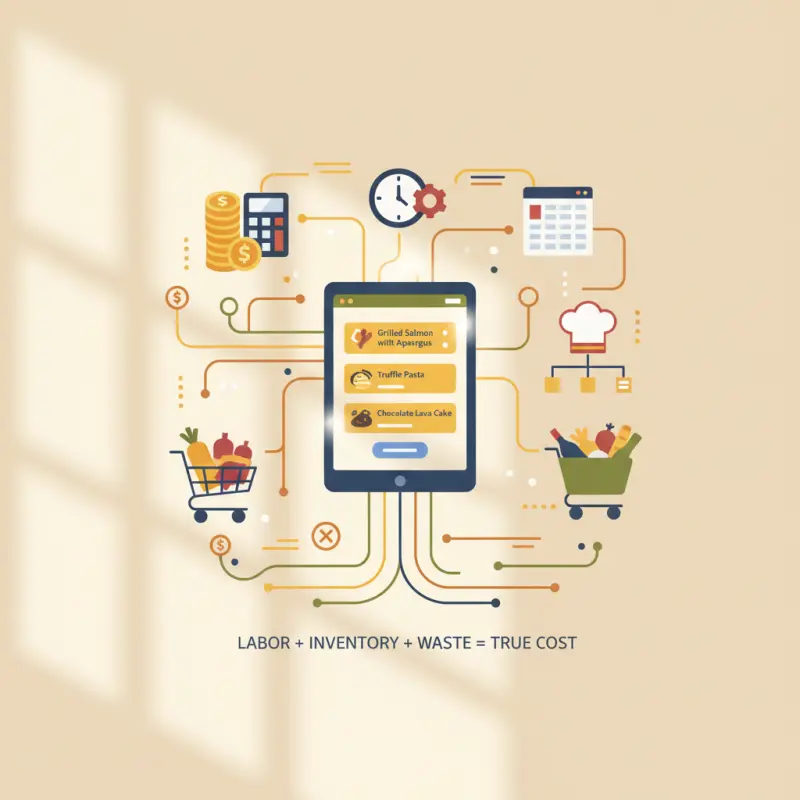
Food Menu Management System: Real Cost Formulas Beyond Basic Software
Blog Manager
··5 min read
AI Overview
Most food menu management systems use simplified formulas that underestimate real food costs by 10-15%. The standard calculation divides ingredient cost by portions but ignores prep waste (typically 15%), portion variance (±20g), and spoilage (5%). A dish with 25% theoretical food cost often runs 32.5% in practice. Restaurants in Morocco need food costs below 25% when fixed costs total 65% to maintain 10% profit margins. Tangier operations face different cost structures than Casablanca venues due to varying rent and labor expenses. Track actual usage for one week, weigh portions consistently, and monitor waste to get accurate data. Feed your food menu management system real numbers, not theoretical portions, to make profitable pricing decisions.
Table of Contents
For restaurant owners
Start your restaurant in 60 minutes.
From signup to your first real order — no commission, no setup fee, no sales call.
Why Your Food Cost Formula Matters More Than Your Menu Software
A restaurant owner in Tangier discovered his best-selling tagine had a 45% food cost after running proper calculations. He'd been using the simplified formula every food menu management system teaches: ingredient cost divided by portions. The real story started when he factored in waste, prep labor, and portion variance.
Most restaurants aim for 28-35% food costs. This benchmark works — if you calculate it correctly. The problem starts with how restaurant owners learn to calculate food costs in the first place.
The Real Food Cost Formula (Not the Simplified Version)
Here's what most restaurant menu management software won't tell you. The standard calculation misses three critical factors that can add 10-15% to your actual costs:
Cost Factor
Typical Calculation
Real Impact
Example (100 MAD dish)
Base ingredients
25 MAD
25 MAD
25%
Prep waste (15%)
Ignored
3.75 MAD
+3.75%
Portion variance (±20g)
Ignored
2.50 MAD
+2.5%
Spoilage (5%)
Ignored
1.25 MAD
+1.25%
True food cost
25 MAD (25%)
32.50 MAD
32.5%
Your 25% margin just became 32.5%. Multiply this across 50 menu items and you understand why restaurants fail despite busy dining rooms.
The solution isn't complex. Track actual usage, not theoretical portions. Weigh portions for one week. Count prep waste. Monitor what gets thrown away. Any decent restaurant pricing software should handle these calculations automatically — but you need to feed it real data.
When 28% Food Cost Actually Means You're Losing Money
A small restaurant in Agadir can't operate on the same margins as a 200-seat operation in Casablanca. Fixed costs change the equation completely. Rent takes 15% in Gueliz versus 8% in industrial zones. Staff costs hit 35% with table service versus 25% for quick service.
The math is unforgiving. If your fixed costs total 65%, you need food costs below 25% to clear 10% profit. The standard 28-35% range assumes 50-55% fixed costs — realistic for high-volume restaurants, fantasy for most independents.
Stack audit
What do you currently use?
Tick what you have. We’ll show what OCHI replaces or connects to.
Four Menu Items That Are Probably Costing You Money Right Now
Every restaurant has them. The chef's special that requires imported ingredients. The vegetarian option that spoils quickly. The dessert that takes 30 minutes to prepare. The breakfast item that needs its own prep station.
A restaurant in Marrakech ran this audit using their online menu ordering system data. They discovered four profit killers hiding in plain sight:
The Recipe Costing Reality Check
Their seafood pastilla looked profitable at 65 MAD with a calculated 30% food cost. Then ingredient prices shifted. Fresh shrimp jumped 20% in summer. Phyllo dough varied by supplier. The special spice blend required ordering from Casablanca with shipping costs.
By the time they factored real costs, that 30% had climbed to 42%. Their restaurant menu management system showed healthy sales. Their bank account told a different story.
Labor time compounds the problem. That 30-minute dessert doesn't just cost ingredients — it costs chef time during service rush. Most recipe builders ignore this. They calculate ingredient cost and stop there, missing the operational reality of execution.
Portion creep kills margins slowly. Chefs add "just a bit more" sauce. Servers give regular customers extra fries. New staff overpour oils and dressings. A 10% portion increase across your menu erases most profit margins.
How to Audit Your Current Menu in 30 Minutes
Pull last month's sales from your POS. Sort by quantity sold. Take your top 10 items — they probably represent 60% of revenue. For each item, calculate actual food cost including waste and variance.
Red flags to watch for: items with food costs above 35%, dishes requiring ingredients from multiple suppliers, anything with shelf life under three days, menu items only one chef can prepare correctly.
Cross-reference with your online ordering data. Items that photograph poorly often underperform online despite strong in-house sales. Your digital menu needs different optimization than your printed menu.
The Psychology Behind Menu Pricing (And Why Software Can't Do This for You)
Restaurant pricing software suggests 99 MAD because it works in London and New York. In Morocco, odd pricing signals low quality. Customers expect round numbers — 100 MAD feels more premium than 99 MAD.
Why 99 MAD Doesn't Work in Morocco
Cultural context beats algorithmic optimization. Moroccan diners associate price endings with quality tiers. Round numbers (50, 100, 150) signal established restaurants. Fractional pricing (49, 79, 99) suggests fast food or promotions.
The anchoring effect works differently here too. Place a 200 MAD premium tagine next to 120 MAD options — the 120 MAD dishes now look reasonable. Place the same dishes next to 80 MAD options — they look expensive. Local competition sets these anchors, not global pricing models.
Three Pricing Strategies That Beat the Algorithm
Competitor-based pricing keeps you in the market but can race margins to zero. Cost-plus ensures profitability but might price you out. Value-based pricing focuses on customer perception — what they'll happily pay for the experience.
Smart operators blend all three. Use competitor pricing for commodity items (drinks, sides). Apply cost-plus to unique dishes with clear ingredient stories. Reserve value-based pricing for signature items that define your brand.
Sometimes you price below margin targets strategically. Loss leaders bring customers in. Kids' meals keep families coming. Lunch specials fill slow hours. But these decisions require data, not guesses.
How Modern Restaurant Management Systems Handle the Math
The best food menu management systems don't just store recipes — they track the full lifecycle. When tomato prices spike 30% in Ramadan, your costs update automatically. When you switch suppliers, margins recalculate instantly. When portion sizes drift, alerts flag the variance.
What to Look for in Food Menu Management System Features
Real-time cost tracking separates professional systems from basic menu builders. Your restaurant menu management software should connect supplier invoices to recipe costs automatically. Price changes flow through to margin calculations without manual updates.
Multi-location management adds complexity. A restaurant group in Rabat needs different prices for tourist areas versus residential neighborhoods. The same dish might cost 20% more to prepare in one location due to supplier logistics. Your system should handle location-specific costing.
Integration matters more than features. The fanciest recipe builder fails if it doesn't connect to your POS, inventory, and online ordering. Data silos kill restaurant profitability faster than food costs.
The OCHI Approach: Recipe Builder That Thinks Like an Owner
OCHI's recipe management starts where others stop. When you update supplier prices, every affected recipe recalculates automatically. Margin alerts warn before you lose money, not after. The system tracks actual versus theoretical usage, flagging portion control issues early.
The integration runs deep. Menu changes sync instantly across your kitchen display, waiter tablets, and online storefront. Price updates reflect everywhere — no manual copying between systems. Multi-branch restaurants manage location-specific pricing from one dashboard.
What sets it apart is the connection to real operations. Your online menu ordering system pulls the same data as your kitchen printer. Inventory deducts based on actual orders, not theoretical recipes. Cost reports show true margins, not optimistic projections.
Ready to see which menu items are costing you money? Set up your restaurant menu management system at votrenom.ochi.ma and get your first month of cost analysis free. Or explore how OCHI's complete platform handles everything from recipes to delivery zones.
The math of restaurant profitability hasn't changed. What's changed is having tools that show you the real numbers — before they show up as losses on your P&L.
Frequently Asked Questions
What factors do food menu management systems typically miss in cost calculations?
Most systems ignore prep waste (15%), portion variance (±20g), and spoilage (5%). These hidden factors add 10-15% to your actual food costs beyond basic ingredient pricing.
Why is 28-35% food cost not suitable for all restaurants?
This range assumes 50-55% fixed costs. Restaurants with 65% fixed costs need food costs below 25% to maintain 10% profit margins.
How can I get accurate food cost data for my menu management system?
Track actual usage for one week, weigh portions consistently, count prep waste, and monitor spoilage. Feed your system real data instead of theoretical portions.
What's the difference between theoretical and real food cost calculations?
Theoretical calculations divide ingredient cost by portions. Real calculations include waste, variance, and spoilage that add 7-10 percentage points to actual costs.
Restaurant owners · Weekly
The guide to running a restaurant in 2026.
One article per week. No commission advice.
Just honest operational insight for Moroccan restaurants.
Blog Manager
Comments
No comments yet. Be the first to share your thoughts.