AI Overview
Most restaurant menu items lose money because owners price by intuition instead of food cost mathematics. Food menu software should solve this by calculating precise ingredient costs and maintaining the industry-standard 28-35% food cost ratio, but most platforms focus on digital presentation over profit analysis. Restaurants in Morocco often sell popular items like kefta skewers at 60% food cost when they should target 28%. The formula is simple: ingredient cost divided by menu price equals food cost percentage. A 150 MAD lamb mrouzia with 78 MAD in ingredients runs at 52% food cost, guaranteeing losses after labor and overhead. Smart restaurateurs use integrated POS systems that track real ingredient costs and automatically flag unprofitable items. Calculate your actual food costs weekly, then reprice items above 35% immediately.
Table of Contents
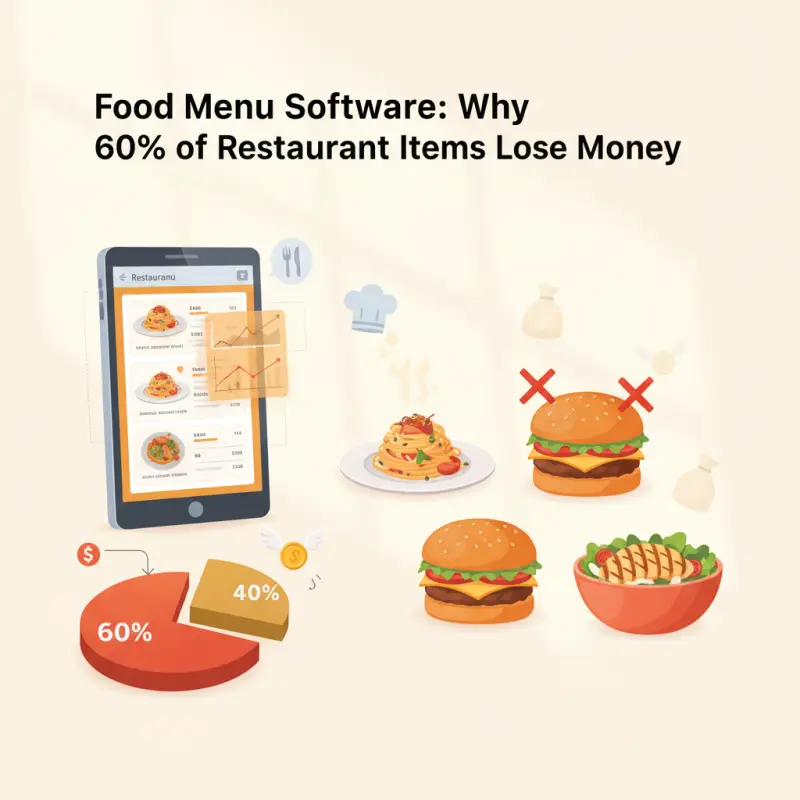
Most restaurants lose money on 60% of their menu items and don't even know it. While everyone obsesses over QR codes and digital menus, the real profit killer sits in plain sight: pricing decisions based on guesswork instead of math.
Food menu software promises to fix this. But most platforms give you pretty menus while your chicken tagine quietly bleeds money at 85 MAD when it should cost 120 MAD. The gap between what restaurants need — precise cost calculations — and what software delivers has never been wider.
The Hidden Cost Crisis: Why 60% of Menu Items Lose Money
The food cost formula is simple: ingredient cost ÷ menu price = food cost percentage. Keep it between 28% and 35%, and you make money. Let it creep above 40%, and you work for free.
Yet walk into any restaurant in Casablanca and ask the owner for their food cost on lamb mrouzia. You'll get a shrug, a guess, or silence. They know the menu price (150 MAD) but not the actual cost (probably 78 MAD, putting them at 52% — a loss after labor and overhead).
The 28% Rule Every Restaurant Owner Ignores
The 28% target isn't arbitrary. It leaves room for labor (25-30%), overhead (20-25%), and profit (10-15%). Break this rule, and something has to give. Usually, it's your bank account.
Here's what happens when you price by feel instead of formula:
| Menu Item | Selling Price | Actual Cost | Food Cost % | Status |
|---|---|---|---|---|
| Grilled Fish Plate | 95 MAD | 42 MAD | 44% | Losing money |
| Vegetable Couscous | 65 MAD | 18 MAD | 28% | Profitable |
| Beef Kefta Skewers | 85 MAD | 51 MAD | 60% | Major loss |
| Harira Soup | 35 MAD | 8 MAD | 23% | Star performer |
The kefta skewers? They're popular. Customers love them. And every order costs the restaurant money.
When "Popular" Items Kill Your Margins
Volume doesn't fix bad margins — it amplifies them. If you lose 15 MAD per kefta order and sell 50 daily, that's 750 MAD vanishing every day. In a month, you've lost 22,500 MAD on one menu item.
Traditional restaurant menu management software shows you sales data but rarely connects it to profitability. You see "Kefta: 1,500 orders" and think success. The software doesn't tell you those 1,500 orders cost you money.
Stack audit
What do you currently use?
Tick what you have. We’ll show what OCHI replaces or connects to.
Recipe Costing: The Math Behind Every Profitable Dish
Real recipe costing goes beyond adding up ingredients. It captures the true cost of putting food on a plate.
Breaking Down a 45 MAD Tagine (Real Numbers)
Let's calculate a chicken tagine with preserved lemons and olives, currently priced at 45 MAD in a Marrakech restaurant:
| Component | Quantity | Unit Cost | Total Cost |
|---|---|---|---|
| Chicken thigh | 250g | 28 MAD/kg | 7.00 MAD |
| Preserved lemons | 40g | 45 MAD/kg | 1.80 MAD |
| Green olives | 60g | 35 MAD/kg | 2.10 MAD |
| Onions | 100g | 4 MAD/kg | 0.40 MAD |
| Spices (ras el hanout, ginger) | 15g | 120 MAD/kg | 1.80 MAD |
| Oil | 30ml | 25 MAD/L | 0.75 MAD |
| Bread (served with) | 1 piece | 1.50 MAD | 1.50 MAD |
| Subtotal | 15.35 MAD |
At 15.35 MAD ingredient cost and 45 MAD menu price, that's 34% food cost. Seems acceptable until you factor in the hidden costs.
Hidden Costs: Waste, Prep Labor, and Storage
Add 10% for trimming and waste (1.54 MAD). Include 15 minutes of prep labor at 40 MAD/hour (10 MAD). Account for spoilage and storage (5%). True cost: 28.23 MAD. Real food cost percentage: 63%.
The tagine loses money. The online menu ordering system shows a best-seller, but the math reveals a profit drain. This is why restaurant pricing software matters — it does the full calculation, not just the obvious parts.
Menu Psychology vs. Pure Math: Where Software Falls Short
Here's what most restaurant menu management systems miss: sometimes losing money makes sense. Menu engineering isn't pure mathematics. It's psychology with a spreadsheet.
Why Your Most Expensive Item Should Lose Money
Place a 450 MAD lobster thermidor on your menu in Agadir. Price it at cost — zero profit. Why? It makes your 180 MAD grilled prawns look reasonable. The lobster sells twice a week. The prawns, with their healthy 30% food cost, sell 40 times.
This is price anchoring. Customers rarely order the most expensive item, but its presence shifts their value perception. The lobster loses money but drives profitable sales elsewhere.
The Decoy Effect: Strategic Loss Leaders
Your breakfast menu needs a 25 MAD traditional option that barely breaks even. It brings morning traffic. Those customers order 35 MAD orange juice (15% cost) and 45 MAD coffee drinks (20% cost). The breakfast loses. The check wins.
Smart food menu software recognizes these patterns. It shows you item profitability and purchase patterns — which items sell together, which drive beverage sales, which bring repeat customers.
OCHI's Recipe Builder: Auto-Calculating Real Costs
OCHI's restaurant menu management software tracks every ingredient cost in real-time. When tomato prices spike 30% in Ramadan, your recipe costs update automatically. No spreadsheet gymnastics. No manual recalculations.
The system handles recipe scaling too. Your tagine recipe serves one? OCHI calculates costs for catering orders of 50. Adjust portion sizes, and costs recalculate instantly. Link recipes to your inventory, and stock levels deduct automatically with each order.
Scenario: Café Atlas Discovers Four Items Below Cost
Café Atlas in Rabat connected their menu to OCHI's recipe builder. Within minutes, red numbers exposed the truth: their famous seafood pastilla (priced at 65 MAD) cost 71 MAD to make. Their grilled vegetables (45 MAD) cost 52 MAD. Two signature salads ran losses too.
The owner faced a choice: raise prices or redesign recipes. They tweaked portions, substituted two ingredients, and raised the pastilla to 85 MAD. Result: food cost dropped from 41% to 31% across the menu. Monthly profit increased by 34,000 MAD.
Real-Time Price Updates When Ingredient Costs Change
Supplier raises chicken prices by 15%? OCHI flags every affected menu item. You see exact impact: "Chicken tagine food cost increased from 34% to 39%." Make informed decisions — adjust portions, tweak recipes, or accept the margin hit strategically.
This beats the alternative: discovering your margins evaporated three months later during inventory count.
From Spreadsheet Chaos to Profit Control
Moving from guesswork to precision takes method, not just software. Here's the path from chaos to control.
Week One: Audit Your Current Disaster
List your top 20 selling items. Calculate true food cost for each — ingredients, waste, prep labor. Identify the bleeders. You'll find surprises: that "profitable" fish special probably isn't.
Create recipe cards with exact measurements. "A handful of spices" isn't a measurement. "15g ras el hanout" is. Precision starts with standardization.
Month Two: Track Performance and Adjust
Monitor daily food cost percentage. It should hover near your target (28-35%). Wild swings mean problems — portion control, theft, or pricing issues.
Test price adjustments on low-visibility items first. Raise your side salad from 25 to 30 MAD. Nobody notices. But that 20% increase on a 20% food cost item drops significant profit to your bottom line.
Review purchase patterns monthly. Items that sell together need collective margin analysis. Your 45% food cost appetizer might be acceptable if it always leads to wine orders.
See how votrenom.ochi.ma calculates your real food costs automatically — no spreadsheets, no guesswork. Explore the full platform at ochi.ma/partners or check out our blog for more restaurant insights.
Frequently Asked Questions
What is the ideal food cost percentage for restaurants?
The ideal food cost percentage ranges from 28% to 35%. This leaves adequate room for labor costs (25-30%), overhead (20-25%), and profit margins (10-15%).
How do you calculate food cost percentage?
Divide ingredient cost by menu price to get food cost percentage. For example, a 150 MAD dish with 45 MAD in ingredients has a 30% food cost ratio.
Why do popular menu items often lose money?
Popular items lose money when restaurants price based on customer demand rather than actual costs. High volume amplifies losses - selling 50 unprofitable items daily can cost 750 MAD in losses.
What features should restaurant menu software include?
Essential features include real-time ingredient cost tracking, automatic food cost percentage calculations, profit margin alerts, and integration with inventory systems to update costs as supplier prices change.
How often should restaurants review menu pricing?
Review menu pricing weekly to catch cost increases early. Ingredient prices fluctuate frequently, and delayed adjustments can turn profitable items into loss leaders within months.
Restaurant owners · Weekly
The guide to running a restaurant in 2026.
One article per week. No commission advice. Just honest operational insight for Moroccan restaurants.

Blog Manager
Comments
No comments yet. Be the first to share your thoughts.