AI Overview
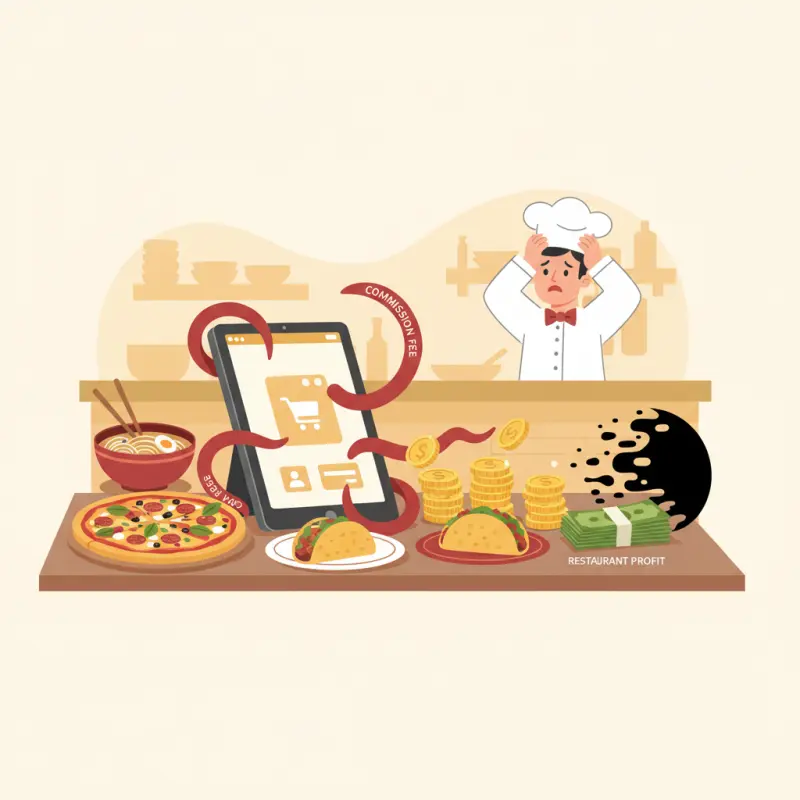
Commission-based food ordering system online platforms charge 15-30% fees that eliminate most restaurant profit margins. A food ordering system online charging 20% commission costs a Moroccan restaurant earning 50,000 MAD monthly around 10,000 MAD in fees alone. Traditional platforms like Talabat and Glovo create dependency by owning customer relationships and forcing price matching. Restaurants lose control over pricing, branding, and direct customer communication. Hidden costs include lost customer data, reduced brand visibility, and inability to run direct marketing campaigns. Commission fees scale with success, meaning growing restaurants pay exponentially more to middlemen. Zero-commission alternatives like OCHI allow restaurants to keep 100% of revenue while maintaining customer relationships and pricing control through branded subdomains.
Table of Contents
Why Most Food Ordering System Online Solutions Cost You Money (Even the "Free" Ones)
A restaurant in Casablanca celebrates hitting 50,000 MAD in monthly online orders — then discovers they're handing over 15,000 MAD to their ordering platform. This isn't an isolated case. Across Morocco, restaurants using commission-based platforms watch 15-30% of their revenue disappear before covering a single ingredient cost.
The math is brutal. Take any restaurant online ordering system charging standard commissions. On 50,000 MAD monthly orders, you lose between 7,500 and 15,000 MAD. That's your profit margin. That's your staff raises. That's your renovation budget — gone to a platform that adds no value to your food.
The Commission Trap: Why 15-30% Fees Kill Your Margins
Traditional online food ordering platforms operate on a simple premise: they bring customers, you pay commission. Sounds fair until you run the numbers. A typical Moroccan restaurant operates on 20-25% profit margins. When platforms take 15-30%, you're left working for them, not your business.
The trap deepens as you grow. Success means higher commissions. A restaurant growing from 30,000 to 100,000 MAD in monthly online orders watches commission fees jump from 4,500 to 15,000 MAD. Your reward for building customer loyalty? Paying more to the middleman.
The True Cost of Platform Dependency
Commission fees are just the visible cost. The hidden costs cut deeper. When customers order through third-party apps, they're not your customers — they belong to the platform. You can't email them. You can't offer direct promotions. You can't build relationships.
Price control vanishes too. Many platforms force restaurants to match in-store prices, preventing you from adjusting for commission costs. Others display your competitors side-by-side, turning your carefully crafted menu into a commodity price war. Your brand becomes a small logo in their app, indistinguishable from dozens of others.
Platform comparison
Where does your money really go?
| Commission | 27% | 25% | 30% | 0% |
| Customer data | They own it | They own it | They own it | You own it |
| Your branding | Theirs | Theirs | Theirs | Yours |
| Payout cadence | Biweekly | Weekly | Biweekly | Weekly |
| Setup cost | Free | Free | Free | Paid |
QR Code Ordering vs. App-Based Systems: The Revenue Impact
Here's what online food ordering system for restaurants providers won't tell you: apps are dead for most restaurants. The data proves it. When faced with downloading yet another app, 67% of customers abandon their order entirely. They'd rather call or visit in person than fill their phone with single-restaurant apps.
QR code ordering flips this dynamic. No download. No registration. Scan, browse, order — done. The friction disappears, and conversion rates soar.
Why Restaurant Apps Fail (And QR Codes Win)
Storage anxiety is real. The average smartphone user regularly deletes apps to free space. Guess which apps go first? Single-use restaurant apps they might open once a month. Your 50,000 MAD app investment becomes digital waste on customers' phones.
QR ordering works because it respects customer psychology. Table-side QR codes let diners browse at their pace, on their device, in their language. No waiter hovering. No rush. Just a relaxed browsing experience that drives higher order values.
The AOV Data: QR Ordering Increases Average Orders by 15-22%
Restaurants implementing QR-based food online ordering system report consistent increases in average order value. Why? Digital menus remove ordering anxiety. Customers add that extra appetizer or dessert without feeling judged. They explore menu sections they'd skip when ordering verbally.
The numbers from Agadir restaurants tell the story. Pre-QR average orders: 85 MAD. Post-QR implementation: 98-104 MAD. That 15-22% increase comes from psychology, not promotion — customers simply order more when browsing privately.
Building Your Restaurant Online Ordering System: Technical Requirements vs. Business Needs
Most online food ordering platforms dazzle with feature lists. AI recommendations. Social media integration. Complex analytics dashboards. But Moroccan restaurant owners need tools that drive revenue today, not tech demos.
Core Features That Drive Revenue
Guest checkout tops the list. Forcing registration kills conversions. Customers want food, not another account to manage. Smart platforms let them order first, register later (or never).
Multilingual support isn't optional in Morocco. Your system needs Arabic (right-to-left), French, and English. Not just menu translations — the entire ordering flow. Payment pages. Confirmation messages. Everything.
| Feature | Revenue Impact | Why It Matters |
|---|---|---|
| Guest Checkout | +25% conversion | No registration friction |
| Multilingual (AR/FR/EN) | +40% market reach | Serve all customer segments |
| Real-time Inventory | -30% cancellations | No disappointing "out of stock" calls |
| Branded Subdomain | +15% repeat orders | yourname.ochi.ma builds trust |
Features That Sound Good But Don't Move Sales
Complex loyalty point systems rarely work for restaurants. Customers forget their points, lose track of rewards, abandon the mental math. Simple percentage discounts after X orders outperform elaborate point schemes every time.
Social media integration sounds modern but delivers minimal ROI. Customers don't want to share their tagine order on Instagram through your ordering platform. They want their food hot and on time.
The Casablanca Restaurant Case: From Manual Orders to 300% Growth
Restaurant Medina in Casablanca switched from phone orders to QR-based digital ordering in January 2026. Previous monthly orders: 400 (all phone). First month with QR: 650 orders. Third month: 1,200 orders.
The growth came from convenience, not marketing. Regular customers started ordering more frequently. Table turnover increased as orders arrived faster. Kitchen efficiency improved with digital tickets replacing handwritten notes. Their food online ordering system became an operations upgrade, not just a sales channel.
Zero-Commission vs. Subscription Models: The Math for Moroccan Restaurants
Two models dominate online food ordering platforms: commission-based (pay per order) and subscription-based (flat monthly fee). The right choice depends entirely on your order volume and growth plans.
Break-Even Analysis: When Zero-Commission Pays Off
Let's use real numbers. A typical subscription platform costs 500-2,000 MAD monthly. Commission platforms take 15-30% per order. The break-even point shifts based on your volume:
Restaurant A processes 10,000 MAD monthly orders. At 20% commission, they'd pay 2,000 MAD. A 500 MAD subscription saves them 1,500 MAD monthly. Clear winner: subscription model.
Restaurant B processes 100,000 MAD monthly orders. That same 20% commission costs 20,000 MAD. Even a 2,000 MAD subscription saves them 18,000 MAD monthly. The savings compound as they grow.
The Control Factor: Pricing, Promotions, and Customer Relationships
Zero-commission platforms like OCHI give you something commission platforms never can: control. Set your own prices. Run your own promotions. Keep your customer data. Build direct relationships without a middleman taking their cut.
This control translates to flexibility. Offer lunch specials without calculating commission impact. Test price points without platform approval. Email customers directly about new menu items. Your business, your rules.
Implementation Roadmap: From Setup to First 100 Orders
Theory means nothing without execution. Here's how Moroccan restaurants successfully launch their food ordering system online, based on actual implementation data from restaurants across Agadir, Marrakech, and Rabat.
Week 1-2: Menu Digitization and QR Setup
Start with photos. Every item needs one clear, appetizing image. Not professional food photography — just well-lit shots from a decent phone camera. Customers order with their eyes online.
QR code placement matters more than size. Eye-level table stands get 3x more scans than table stickers. Train staff to mention QR ordering when seating guests. Simple verbal cues double scan rates.
Week 3-4: Customer Education and Promotion
Don't force digital ordering on traditional customers. Offer both options. Let comfort levels guide adoption. Early adopters will spread the word when they experience faster service and easier ordering.
Measure what matters: daily order count, average order value, and kitchen efficiency. Ignore vanity metrics like app downloads or social shares. Revenue and operations improvements tell the real story.
The path from manual orders to digital success isn't complicated. Choose a platform that respects your margins. Implement systems that customers actually use. Keep control of your prices, your brand, and your growth. The restaurants winning in 2026 aren't chasing features — they're choosing partners who let them keep what they earn.
Ready to keep 100% of your revenue? Set up your branded ordering system at votrenom.ochi.ma — no commission fees, no long-term contracts. See how OCHI helps restaurants grow.
Frequently Asked Questions
How much do food ordering system online platforms charge in commission?
Most food ordering system online platforms charge between 15-30% commission on each order. This means restaurants lose 7,500 to 15,000 MAD monthly on 50,000 MAD in orders.
Why do commission fees hurt restaurant profit margins?
Moroccan restaurants typically operate on 20-25% profit margins. When ordering platforms take 15-30% commission, restaurants often lose their entire profit margin or operate at a loss on delivery orders.
What are the hidden costs of commission-based ordering platforms?
Hidden costs include lost customer data ownership, reduced brand control, forced price matching, and inability to run direct marketing campaigns. Restaurants become dependent on platforms that own their customer relationships.
Do zero-commission food ordering systems exist in Morocco?
Yes, zero-commission platforms like OCHI allow Moroccan restaurants to keep 100% of their revenue while providing branded ordering websites, QR table ordering, and full customer data ownership.
How do commission fees scale as restaurants grow?
Commission fees increase proportionally with order volume. A restaurant growing from 30,000 to 100,000 MAD monthly sees commission payments jump from 4,500 to 15,000 MAD monthly.
Restaurant owners · Weekly
The guide to running a restaurant in 2026.
One article per week. No commission advice. Just honest operational insight for Moroccan restaurants.

Blog Manager
Comments
No comments yet. Be the first to share your thoughts.