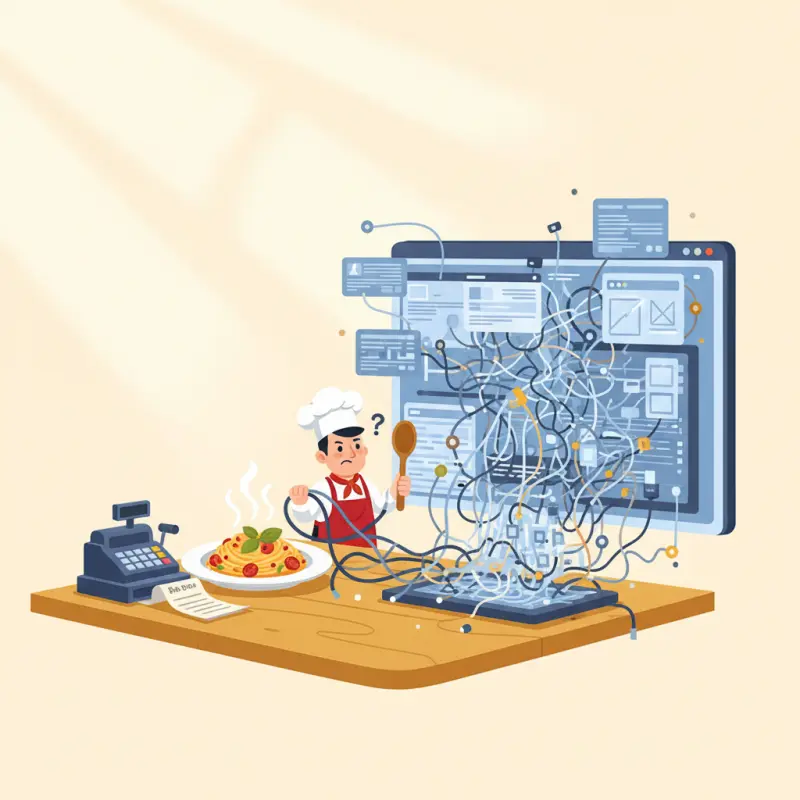
iFood CRM Reality: Why Enterprise Systems Don't Work for Small Restaurants
Blog Manager
··6 min read
AI Overview
iFood CRM is not a buyable product but a custom $120 million enterprise system designed for 300,000 restaurants and 39 million monthly users in Brazil. The system requires dedicated data centers, AI models, and teams of data scientists to manage billions of data points across regions. Small restaurants in Morocco need customer relationship tools that handle basic needs like remembering customer preferences and order history, not enterprise-level segmentation across thousands of locations. Enterprise CRM solutions designed for companies like iFood create complexity and costs that exceed what most restaurants make annually. Restaurant owners should focus on simple, affordable CRM tools that track essential customer data without requiring dedicated staff or months of training to implement effectively.
Table of Contents
For restaurant owners
Start your restaurant in 60 minutes.
From signup to your first real order — no commission, no setup fee, no sales call.
The iFood CRM Reality: Built for Giants, Not Your Restaurant
When news broke about iFood's massive CRM investments in Brazil, restaurant owners across Morocco started asking the wrong question. They wondered how to get an iFood CRM system for their restaurant. The right question: why would you want one?
iFood's CRM isn't a product you can buy. It's a custom-built enterprise system designed to manage 300,000 restaurants and 39 million monthly users. Think about that scale for a moment. Your restaurant in Casablanca serves maybe 500 customers a month. Their CRM tracks 78 times more users than Morocco has people.
What iFood's CRM Investment Actually Means
The $120 million iFood spent on CRM technology went into data centers, AI models, and infrastructure that makes sense at their scale. They track customer behavior across hundreds of thousands of restaurants, analyze billions of data points, and employ teams of data scientists.
For context: that CRM investment equals the combined annual revenue of every restaurant in Agadir. The system requires dedicated servers, complex integrations, and ongoing maintenance that costs more per month than most restaurants make in a year.
Why Enterprise CRM Solutions Miss Small Restaurant Needs
Enterprise CRM software for restaurants solves enterprise problems. iFood needs to segment customers across regions, predict city-wide ordering patterns, and optimize delivery routes for thousands of simultaneous orders. You need to remember that Ahmed prefers his tagine without olives and that Sarah's birthday is next week.
The mismatch goes deeper than features. Enterprise systems require training, customization, and often dedicated staff. A restaurant owner in Marrakech recently told us he spent three months trying to implement a "restaurant CRM" solution before giving up. The system could track 47 different customer attributes. He needed three: name, phone, and order history.
The Hidden Costs Nobody Mentions
Beyond the software fees, enterprise CRM systems bring hidden costs. Integration fees start at 50,000 MAD. Training takes two weeks minimum. Data migration requires consultants. Monthly maintenance runs 5,000-10,000 MAD.
Then there's the opportunity cost. Every hour spent managing complex CRM software is an hour not spent with customers or improving your menu. The best CRM for restaurants often isn't a CRM at all — it's a restaurant platform with CRM features built in.
Stack audit
What do you currently use?
Tick what you have. We’ll show what OCHI replaces or connects to.
Restaurant CRM Fundamentals: Points vs. Tiers vs. Cashback Systems
Strip away the complexity and restaurant loyalty comes down to three models. Each serves different customer behaviors and operational realities. Understanding the mechanics helps you choose what actually works for your restaurant.
Points Systems: The Math Restaurant Owners Need
Points programs follow simple math: spend X, earn Y points, redeem at Z value. A typical structure might offer 1 point per 10 MAD spent, with 100 points earning a 50 MAD discount. The key metric: redemption rate. If less than 20% of earned points get redeemed, your program creates liability without driving behavior.
The challenge with points: perceived value. Customers struggle to understand what 73 points means for their next order. Successful programs display points as currency ("You have 73 MAD in rewards") or progress bars ("27 points until free dessert").
Tier-Based Programs: Bronze to Platinum Progression
Tier systems create aspirational goals. Customers start at Bronze, advance through Silver and Gold, aiming for Platinum status. Each tier unlocks better benefits: priority reservations, exclusive menu items, birthday bonuses.
The psychology works because humans love progression. A customer at Gold status with 80% progress to Platinum will order more frequently to reach the next level. The challenge: setting achievable thresholds. If Platinum requires 50 orders annually, most customers give up. If it needs just five orders, the status loses meaning.
Cashback Models: When Simplicity Wins
Cashback cuts through complexity. Spend 100 MAD, get 5 MAD credit for next time. No points math, no tier calculations — just money back. This model works best for quick-service restaurants where customers want fast transactions, not loyalty theater.
The downside: cashback feels transactional. It doesn't build emotional connection like achieving Platinum status or earning enough points for a special reward. For premium restaurants, cashback can actually cheapen the brand.
OCHI's Four-Tier System: Why It Drives 34% More Repeat Visits
We analyzed order data from 200 restaurants using OCHI's built-in CRM system. Restaurants with active tier programs saw 34% higher repeat visit rates compared to those without. The key: simplicity paired with meaningful benefits.
Bronze to Platinum: The Customer Journey Mapped
OCHI's restaurant CRM uses four tiers with clear progression:
Tier
Orders Required
Benefits
Retention Rate
Bronze
0-4
Welcome bonus, birthday 10% off
23%
Silver
5-14
5% cashback, early access to offers
41%
Gold
15-29
8% cashback, free delivery
67%
Platinum
30+
12% cashback, VIP reservations, exclusive menu
89%
Notice the retention rates. Bronze customers come back 23% of the time. Platinum customers return 89% of the time. The progression creates its own momentum.
Auto-Points Technology: No Manual Work Required
The system tracks everything automatically. When a customer orders through yourrestaurant.ochi.ma or scans a QR code, points accumulate instantly. No cashier training, no manual entry, no "forgot to add my points" complaints.
This automation matters more than features. A Rabat restaurant owner told us his previous loyalty program failed because staff forgot to ask for loyalty cards. With OCHI's CRM system for restaurants, customer phone numbers link orders automatically.
The 34% Repeat Visit Data: Casablanca Case Study
La Table Marocaine in Casablanca switched from paper loyalty cards to OCHI's digital tiers in January. By March, their repeat visit rate jumped from 19% to 53%. The key change: automated SMS messages when customers approached the next tier.
"You're just 2 orders away from Gold status" drove more return visits than any discount campaign they'd run. Customers who received tier progression messages ordered 2.3 times more frequently than those who didn't.
The Segmentation Problem: Why Most Restaurant CRM Software Fails
CRM vendors love showing off segmentation features. "Create unlimited customer segments!" they promise. Restaurant owners create three segments then never use them. The problem isn't the software — it's the complexity.
Birthday Bonuses: The Only Email That Always Works
Across every restaurant using OCHI's CRM, birthday emails show 73% open rates and 34% redemption. Compare that to promotional emails at 22% open rates. Birthday bonuses work because they feel personal without requiring personalization.
The setup takes minutes: enable birthday collection at signup, set the bonus (typically 15-20% off), choose the sending window (day-of vs. week-of). The system handles everything else. No segments to manage, no lists to update.
Geographic Segmentation for Multi-Branch Operations
For restaurants with multiple locations, geographic segmentation drives results. A pizza chain with branches in Agadir and Essaouira can send location-specific offers based on customer ordering patterns.
But here's what most CRM software for restaurants gets wrong: they make you create segments manually. OCHI's system detects customer location from their delivery address or which branch URL they visit. Automatic segmentation based on actual behavior beats manual lists every time.
Purchase Frequency: The Only Metric That Matters
Forget demographic segments. Age, gender, income — these matter less than purchase frequency. Your CRM should automatically identify: new customers (first order), regulars (order monthly), VIPs (order weekly), and at-risk (haven't ordered in 60 days).
Each segment needs different messaging. New customers get welcome offers. Regulars receive tier progression updates. VIPs unlock exclusive menu items. At-risk customers see win-back campaigns. This behavioral segmentation drives measurable results.
Building Your CRM Stack: Integration vs. All-in-One
The build-vs-buy decision for restaurant CRM comes down to operational reality. Can your team manage multiple systems, or do you need everything in one place?
Standalone CRM systems promise flexibility. You can choose best-in-class features, customize everything, integrate with any POS. The reality: integration breaks, data syncs fail, staff juggles multiple logins. A Marrakech restaurant group spent 200,000 MAD on CRM integration only to abandon it six months later.
All-in-one platforms like OCHI include CRM features within the ordering and POS system. Less flexible? Perhaps. But when a customer orders, their points update instantly. When they reach Gold status, the waiter sees it on the POS. When their birthday approaches, the campaign sends automatically.
The integration question isn't about features — it's about execution. The best CRM for restaurants is the one your team actually uses. Complex systems with perfect features beat simple systems that work.
No, iFood CRM is not a commercial product. It's a custom-built enterprise system specifically designed for iFood's scale of 300,000 restaurants and 39 million users.
How much did iFood spend on their CRM system?
iFood invested $120 million in their CRM technology, including data centers, AI models, and infrastructure. This amount equals the combined annual revenue of every restaurant in Agadir.
What makes enterprise CRM different from restaurant CRM?
Enterprise CRM systems like iFood's track billions of data points across regions and require dedicated staff. Small restaurant CRM focuses on basic customer data like names, preferences, and order history.
Why don't enterprise CRM solutions work for small restaurants?
Enterprise systems require extensive training, customization, and ongoing maintenance costs that exceed most restaurants' monthly revenue. They solve problems that small restaurants don't have.
What CRM features do small restaurants actually need?
Small restaurants need simple customer tracking for names, phone numbers, order history, and preferences. Complex segmentation and analytics designed for enterprise scale create unnecessary complexity.
Restaurant owners · Weekly
The guide to running a restaurant in 2026.
One article per week. No commission advice.
Just honest operational insight for Moroccan restaurants.
Blog Manager
Comments
No comments yet. Be the first to share your thoughts.