AI Overview
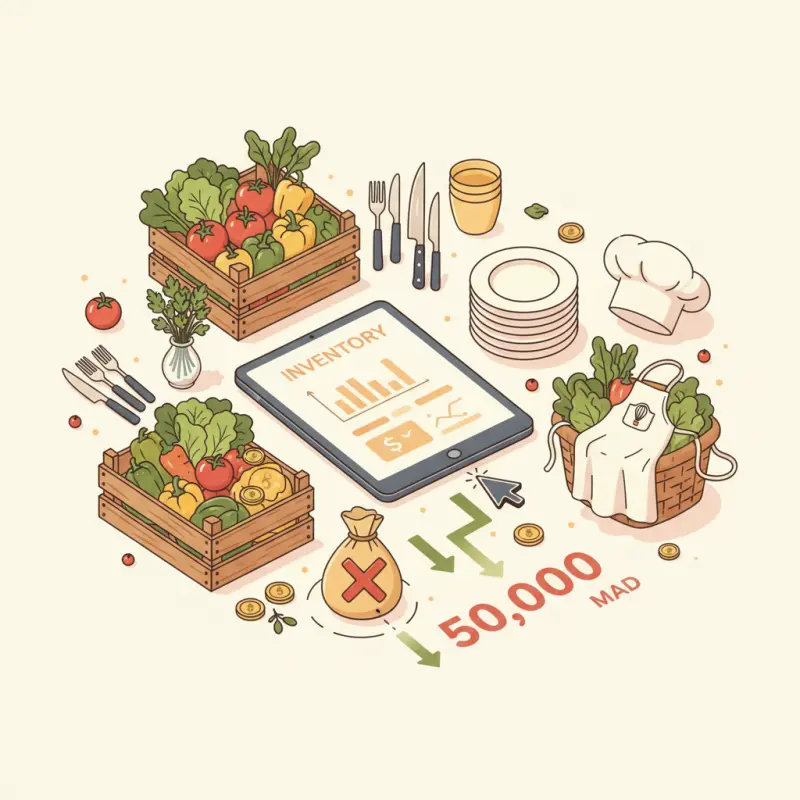
Inventory software for restaurants prevents the 4-10% revenue loss that costs the average Moroccan establishment 50,000 MAD monthly through waste, theft, and over-ordering. Restaurant stock management software replaces manual Excel tracking that misses daily fluctuations and creates dangerous blind spots between actual inventory and recorded stock. A 15-minute waste audit reveals most restaurants discard 15-25% of purchased ingredients while over-ordering items like tomatoes by 30%. Manual systems fail during peak service when chefs can't locate ingredients like harissa paste, triggering panic over-orders that compound losses. OCHI's integrated inventory module tracks stock levels in real-time, flags waste patterns, and automatically adjusts purchasing based on actual usage data. Start by weighing everything you throw away for one week — multiply by four to see your monthly waste cost.
Table of Contents
The Hidden Profit Killer: Why 73% of Restaurants Fail at Inventory
A seafood restaurant in Casablanca discovered they were losing 40,000 MAD every month to spoiled ingredients and untracked waste. They weren't alone — across Morocco, restaurant owners watch profits vanish into poorly managed stockrooms.
The numbers tell a harsh truth. Without proper inventory software for restaurants, the average establishment loses 4-10% of revenue to waste, theft, and over-ordering. For a restaurant doing 500,000 MAD monthly, that's up to 50,000 MAD disappearing — enough to hire two additional staff or renovate the dining room.
Manual tracking creates blind spots. That Excel sheet updated weekly? It misses daily fluctuations. Those handwritten purchase orders? They don't flag when you're buying 30% more tomatoes than you're actually using. Restaurant stock management software isn't a luxury anymore — it's survival equipment in an industry where margins average just 3-5%.
The real damage happens in the gaps between what you think you have and what's actually in your walk-in. When your chef can't find harissa paste during Friday rush, they over-order next time. When prep cooks don't measure portions, your food cost creeps up gram by gram. These small leaks compound into major losses.
Stack audit
What do you currently use?
Tick what you have. We’ll show what OCHI replaces or connects to.
The 15-Minute Inventory Audit That Reveals Your Profit Leaks
Before investing in any restaurant software inventory solution, you need to understand your current losses. This audit takes 15 minutes and shows exactly where money disappears.
Calculate Your Monthly Waste Rate
Start with your trash. For one week, weigh everything you throw away. Spoiled vegetables, burnt tagines, expired dairy — track it all. Multiply by four for your monthly waste weight. Now calculate the cost. Most Moroccan restaurants discover they're tossing 15-25% of purchased ingredients.
Compare your purchasing invoices to your sales. If you bought 100 kg of chicken but only sold dishes containing 75 kg based on standard portions, where did the rest go? This gap reveals your true waste percentage.
Identify Theft and Shrinkage Patterns
Check three high-value items: olive oil, meat cuts, and imported cheese. Count physical inventory against purchase records for the past month. A discrepancy over 5% signals a problem. One Marrakech restaurant found 12 bottles of premium olive oil "missing" monthly — worth 1,800 MAD.
Look for patterns in your shortages. Do they happen on specific shifts? After large deliveries? When certain suppliers deliver? These patterns point to systematic issues that proper tracking eliminates.
Track Stock-Out Revenue Loss
Review last month's 86'd items — dishes you couldn't serve because ingredients ran out. Calculate the lost revenue. If you ran out of fresh fish three times, costing 20 orders at 120 MAD each, that's 7,200 MAD in missed sales. Add the customer disappointment cost, and the real damage doubles.
Why "Good Enough" Inventory Software Costs More Than Premium Solutions
Free spreadsheet templates and basic restaurant inventory programs seem attractive until you calculate the true cost. That "free" solution demands hours of manual data entry, creates integration nightmares, and leaves profit opportunities hidden in the data.
The Excel Spreadsheet Trap
A typical restaurant tracks 200-400 ingredients. Updating quantities, prices, and suppliers in Excel takes your manager 2-3 hours daily. At 150 MAD hourly, that's 13,500 MAD monthly in labor costs alone. Dedicated inventory software for restaurants automates these updates, freeing staff for revenue-generating tasks.
Manual systems also multiply errors. One decimal point mistake on flour quantity throws off every bread and pastry calculation. These compound errors make your data worthless for decision-making.
Integration Costs Nobody Mentions
Your "affordable" inventory tool doesn't connect to your POS. Now staff enter every sale twice — once for the customer, once for inventory deduction. This duplicate work costs time and creates discrepancies when busy servers skip the second entry.
| System Type | Monthly Software Cost | Monthly Labor Cost | Error Rate | True Monthly Cost |
|---|---|---|---|---|
| Excel Sheets | 0 MAD | 13,500 MAD | 15-20% | 13,500+ MAD |
| Basic Software | 500 MAD | 6,750 MAD | 8-12% | 7,250 MAD |
| Integrated Platform | 2,000 MAD | 0 MAD | 1-3% | 2,000 MAD |
Staff Training Time vs. Long-term Savings
Quality restaurant inventory management software requires upfront training — typically 4-6 hours per employee. But compare that to the ongoing confusion of complex spreadsheets. One Agadir restaurant spent 40 hours training staff on their custom Excel system, only to rebuild it six months later when the creator quit.
Real Numbers: How Gram-Level Tracking Cut Food Costs by 8,400 MAD Monthly
Restaurant Atlas in Agadir transformed their operations with precise inventory tracking. Before implementing OCHI's restaurant stock management software, they estimated portions by eye and ordered based on "feeling." The results were predictable — and expensive.
Recipe Costing That Actually Works
Atlas started by entering exact recipes into their system. Their signature seafood pastilla required 14 ingredients, each now tracked to the gram. They discovered their "standard" portion varied by up to 40% between cooks. Standardizing portions using digital recipes cut food cost from 38% to 34% — saving 6,000 MAD monthly on this dish alone.
The gram-level tracking revealed surprising waste sources. Their prep team was trimming vegetables aggressively, discarding 30% of usable product. Simple training with visual guides reduced vegetable waste to 12%, saving another 1,800 MAD monthly.
Supplier Negotiations Armed with Data
With six months of precise usage data, Atlas approached suppliers with facts. They showed exactly how much fish, produce, and dry goods they used monthly. This data-backed negotiation secured 5-8% better pricing on high-volume items. Annual savings: 28,000 MAD.
Waste Tracking by Category and Cause
OCHI's waste tracking feature categorized every loss: spoilage (45%), preparation waste (30%), customer plate waste (20%), and errors (5%). This breakdown guided targeted improvements. They adjusted order quantities for quick-spoiling items, reducing spoilage waste from 23% to 8% of purchases within three months.
Building Your Inventory System: The 30-Day Implementation Plan
Transitioning from chaos to control takes commitment but not complexity. This proven 30-day plan has worked for over 100 Moroccan restaurants.
Week 1-2: Baseline Assessment and Setup
Start with a complete physical inventory count. Yes, every spice jar and sauce bottle. This becomes your baseline. Enter all ingredients into your restaurant inventory program with current quantities and average costs. Create recipes for your top 20 dishes — these typically represent 70% of sales.
Set up your supplier list with contact details and standard order quantities. Configure low-stock alerts for critical ingredients. You don't want to discover you're out of couscous during Friday dinner rush.
Week 3-4: Staff Training and Process Rollout
Train kitchen staff on recipe adherence using the system's portion guides. Show them how consistent portions control costs and satisfy customers. Train receiving staff to enter deliveries immediately — accuracy depends on real-time updates.
Run parallel systems for one week. Continue your old method while using the new system. Compare results to identify and fix any process gaps. By week four, fully transition to digital tracking.
Measuring Success: Key Metrics to Track Monthly
Monitor four key metrics: food cost percentage, waste percentage, stock-out incidents, and inventory turnover rate. A 2% improvement in food cost percentage equals 10,000 MAD monthly savings for a typical Moroccan restaurant. Track these numbers religiously — they're your profit scorecard.
The best restaurant inventory management software makes this transition smooth. OCHI's system connects inventory directly to POS sales, automatically deducting ingredients with each order. No double entry. No guesswork. Just accurate data driving profitable decisions.
Ready to see your exact waste reduction potential? Test OCHI's inventory system at votrenom.ochi.ma — track every gram, eliminate guesswork, keep 100% of your profits. Browse ochi.ma/partners to see how gram-level tracking transforms restaurant profitability.
Your stockroom holds the key to 5-10% more profit. The only question is whether you'll unlock it.
Frequently Asked Questions
How much money do restaurants lose without inventory software?
Restaurants without proper inventory software lose 4-10% of revenue to waste, theft, and over-ordering. For a restaurant doing 500,000 MAD monthly, that equals up to 50,000 MAD in losses.
What causes inventory losses in restaurants?
Main causes include spoiled ingredients, untracked waste, over-ordering, theft, and poor portion control. Manual tracking creates blind spots between recorded and actual stock levels.
Can Excel spreadsheets handle restaurant inventory management?
Excel fails at restaurant inventory because it only captures weekly snapshots, missing daily fluctuations. It can't flag over-ordering patterns or track waste in real-time during service.
How do I calculate my restaurant's waste rate?
Weigh everything you throw away for one week — spoiled vegetables, burnt food, expired items. Multiply by four for monthly waste, then calculate the cost using purchase prices.
What features should restaurant inventory software include?
Essential features include real-time stock tracking, automatic reorder points, waste logging, portion control monitoring, and integration with POS systems for accurate usage calculations.
Restaurant owners · Weekly
The guide to running a restaurant in 2026.
One article per week. No commission advice. Just honest operational insight for Moroccan restaurants.

Blog Manager
Comments
No comments yet. Be the first to share your thoughts.