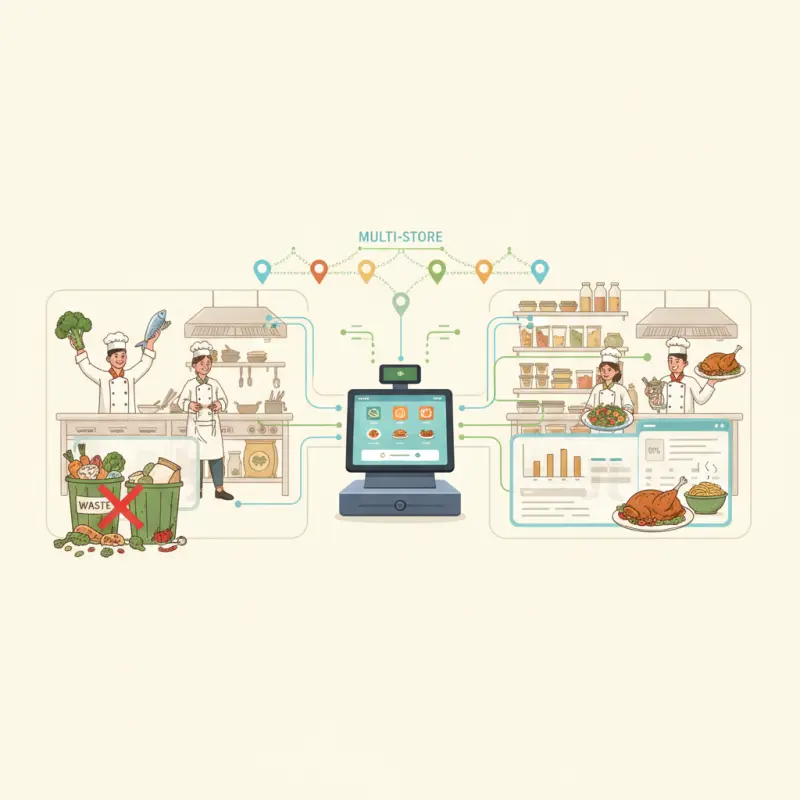
Irestora Restaurant POS with Smart Inventory Multi Store Cuts Food Waste
Blog Manager
··5 min read
AI Overview
An irestora restaurant pos with smart inventory multi store system cuts food waste by 25% within eight weeks through real-time tracking and automated alerts. Moroccan restaurants waste 30% of purchased ingredients monthly — a medium restaurant in Casablanca loses 45,000 MAD per month from over-ordering, spoilage, and theft. Smart inventory systems prevent delayed spoilage detection by tracking stock daily rather than weekly, eliminate fear-based over-ordering through precise demand forecasting, and catch portion inconsistencies before they compound. Multi-store functionality synchronizes inventory across locations, preventing waste from poor distribution. Restaurants using integrated POS with inventory management see immediate improvements in cost control and operational efficiency. Start by implementing automated low-stock alerts and daily variance reports to identify your biggest waste sources.
Table of Contents
For restaurant owners
Start your restaurant in 60 minutes.
From signup to your first real order — no commission, no setup fee, no sales call.
The average restaurant in Casablanca throws away 30% of purchased ingredients every month. Most owners shrug it off as "the cost of doing business" — but for a mid-size restaurant buying 150,000 MAD in ingredients monthly, that's 45,000 MAD literally going in the trash.
This waste isn't just spoiled vegetables or expired meat. It's over-ordering from uncertainty, theft that goes unnoticed, and portions that vary by whoever's working the kitchen that day. The real shock? A proper irestora restaurant pos with smart inventory multi store system can cut this waste by 25% within eight weeks.
The 30% Problem Most Moroccan Restaurants Accept as Normal
Walk into any restaurant kitchen in Agadir at closing time and you'll see the same scene: bags of wilted produce, expired dairy, and mystery containers nobody remembers ordering. The owner watches thousands of dirhams disappear into garbage bins while margins shrink and menu prices creep higher.
Here's what that 30% waste actually costs:
Restaurant Size
Monthly Food Purchase
Average Waste (30%)
Annual Loss
Small (30 seats)
75,000 MAD
22,500 MAD
270,000 MAD
Medium (50 seats)
150,000 MAD
45,000 MAD
540,000 MAD
Large (100+ seats)
300,000 MAD
90,000 MAD
1,080,000 MAD
That medium restaurant? They're losing enough to hire two full-time employees. Yet most owners treat this like weather — something you complain about but can't control.
Stack audit
What do you currently use?
Tick what you have. We’ll show what OCHI replaces or connects to.
Why Manual Stock Tracking Creates More Waste Than You Think
The clipboard hanging in your storage room isn't just outdated — it's actively costing you money. Manual tracking fails in three predictable ways that compound into massive waste.
First, delayed spoilage detection. Your chef orders 50kg of tomatoes because they "think" inventory is low, but 20kg sits forgotten in cold storage. By the time someone notices, half have rotted. This happens because manual counts happen weekly at best, while produce spoils daily.
Second, the fear buffer. When you can't see real-time stock levels, every department over-orders "just in case." The bar stocks extra lemons for weekend rush that never comes. The kitchen doubles meat orders before holidays. Each buffer adds 5-10% waste that proper restaurant stock management software eliminates through accurate forecasting.
Third, the invisible theft. Without item-level tracking, you'll never notice if 2kg of shrimp disappears daily. Staff know which items aren't counted carefully. A Marrakech steakhouse discovered 15% of their premium cuts were walking out the back door — but only after implementing gram-level tracking.
The Multi-Location Multiplication Effect
Running multiple branches without centralized restaurant software inventory? Each location becomes its own silo of waste. The Rabat branch over-orders fish while the Casablanca location runs out. Managers can't share surplus inventory. Purchase prices vary because each negotiates separately with suppliers.
Data from multi-branch restaurants shows waste increases 15% per additional location when inventory operates independently. A three-location restaurant group wastes 45% more than a single location — purely from coordination failures that modern systems prevent.
What Actually Works — Three Non-Negotiable Features for Restaurant Stock Management Software
Forget feature lists with 50 checkboxes. After analyzing dozens of successful inventory transformations, three capabilities actually move the needle on waste reduction.
Gram-level tracking reveals patterns invisible to broader measurements. When you track flour by the 25kg bag, a daily loss of 500g disappears in rounding. Track by gram? That's 15kg monthly — enough for 300 bread loaves.
Automatic reorder points based on actual usage, not gut feelings. The system knows you use 12kg of onions every Tuesday and 18kg every Saturday. It factors in supplier lead time and suggests orders that arrive exactly when needed — no emergency runs, no spoilage from over-ordering.
Real supplier cost comparison across all ingredients. That "great deal" on chickens might cost more per gram of usable meat than your regular supplier. A good restaurant inventory program calculates true cost including waste, not just invoice price.
Why Gram-Level Tracking Beats "Close Enough"
Most restaurant inventory management software tracks in kilos or "units" — close enough for accounting but useless for waste reduction. A Marrakech restaurant tracking flour by the bag thought they were efficient. Switching to gram-level tracking revealed their pizza station was using 2.3kg extra flour daily from over-dusting.
That's 69kg monthly. At 15 MAD per kilo, they were losing 1,035 MAD just on flour dust. Multiply this across every ingredient and "close enough" becomes "bleeding money."
The Real Numbers — What 25% Waste Reduction Looks Like
Let's follow a real scenario: a 50-seat restaurant in Agadir currently spending 150,000 MAD monthly on ingredients. Their waste breaks down like this:
Waste Category
Current Loss
After Smart Inventory
Savings
Spoilage
20,000 MAD
14,000 MAD
6,000 MAD
Over-ordering
15,000 MAD
10,000 MAD
5,000 MAD
Portion variance
7,000 MAD
5,000 MAD
2,000 MAD
Theft/Loss
3,000 MAD
1,000 MAD
2,000 MAD
Total
45,000 MAD
30,000 MAD
15,000 MAD
That's 180,000 MAD saved annually — enough to upgrade equipment, bonus staff, or simply improve margins without raising prices.
OCHI's Inventory Dashboard in Action
OCHI's system tracks every gram of every ingredient across all menu items. Order a tagine? The system deducts exact amounts of meat, vegetables, and spices from inventory. Approaching expiry dates trigger alerts before spoilage. The dashboard at votrenom.ochi.ma shows real-time stock levels accessible from anywhere.
Purchase orders generate automatically based on sales patterns. If you sold 200 pizzas last Tuesday and have 180 reservations this Tuesday, the system knows to order 10% more cheese. Supplier management compares prices across vendors for every ingredient, ensuring you get the best deal on quality you trust.
Multi-branch operators see all locations on one screen. Transfer surplus inventory between branches with one click. Track which locations waste most and why. Your Casablanca branch consistently over-orders seafood? The data reveals it instantly.
Implementation Reality Check — What Happens Week One vs. Week Eight
Week one will test your patience. Staff complain about "extra work" of precise measurements. Orders seem wrong because they're based on data, not habits. Some ingredients spoil because you're adjusting from over-ordering. This is normal.
Week four brings clarity. Patterns emerge in the data. That Tuesday fish special? You've been ordering 30kg but only selling 22kg worth. Staff start trusting the system's suggestions. Waste visibly decreases.
Week eight delivers results. Most restaurants see 15-20% waste reduction by this point. The exceptional ones pushing all features hit 25% or more. Staff who resisted now defend the system because their sections run smoother. Check our blog for more operational insights.
The key to smooth implementation? Start with high-value ingredients only. Track your proteins and expensive items first. Add produce and dry goods once the team masters the basics. Full implementation takes 12 weeks, but you'll see ROI by week six.
The restaurants still accepting 30% waste as normal are the same ones wondering why margins keep shrinking. Smart inventory isn't about fancy software — it's about finally seeing where your money actually goes. See what OCHI can do for your restaurant's bottom line.
Frequently Asked Questions
How does an irestora restaurant pos with smart inventory multi store reduce food waste?
Smart inventory systems track stock in real-time, send automated alerts before items spoil, and use historical data to predict accurate ordering quantities. This eliminates the guesswork that leads to over-ordering and forgotten inventory.
What percentage of food waste can smart inventory systems prevent?
Properly implemented smart inventory systems reduce food waste by 25% within eight weeks. This translates to significant savings — a medium restaurant can save 11,250 MAD monthly from reduced waste alone.
Why do multi-store inventory features matter for restaurant chains?
Multi-store inventory synchronizes stock levels across all locations, prevents duplicate ordering, and enables efficient redistribution of excess inventory before spoilage occurs. This coordination is impossible with manual tracking systems.
How quickly do restaurants see results from smart inventory implementation?
Most restaurants see measurable waste reduction within the first month and achieve the full 25% reduction by week eight. The system learns ordering patterns and provides increasingly accurate recommendations over time.
What's the main cause of the 30% food waste in Moroccan restaurants?
Fear-based over-ordering accounts for the largest portion of waste. Without real-time inventory visibility, managers order excess stock as a safety buffer, leading to spoilage and expired products.
Restaurant owners · Weekly
The guide to running a restaurant in 2026.
One article per week. No commission advice.
Just honest operational insight for Moroccan restaurants.
Blog Manager
Comments
No comments yet. Be the first to share your thoughts.