AI Overview
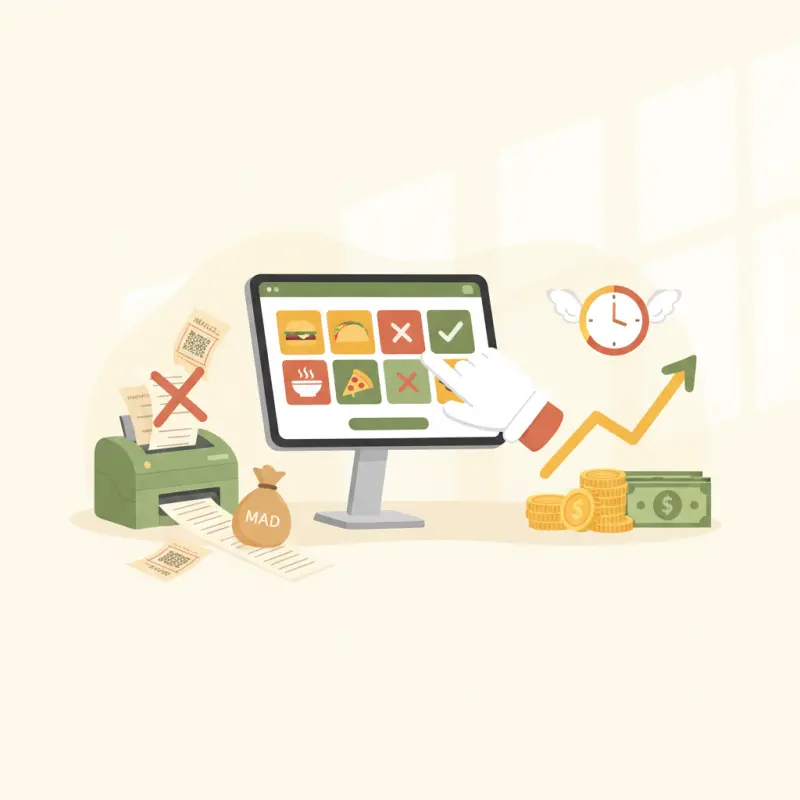
Kitchen display system software replaces paper tickets with digital screens, eliminating handwriting errors that cost the average Moroccan restaurant 37,000 MAD annually. Most kitchen display systems fail because they're overly complex or lack proper Arabic support, forcing staff back to paper within weeks. Casablanca restaurants lead adoption with 42% now using digital kitchen management, driven by economic necessity rather than tech trends. The hidden costs of paper systems include 540 MAD monthly on thermal paper, 1,800 MAD in wrong orders, and 750 MAD in lost tickets during rush periods. La Perle in Agadir discovered they spent 5,400 MAD monthly just on paper supplies during peak season. Error rates jump from 3% to 7% during Ramadan when order volumes triple. Choose kitchen display software with native Arabic support and interfaces designed for busy kitchen environments, not computer labs.
Table of Contents
Walk into any busy Moroccan restaurant kitchen during iftar rush and you'll see the same scene: crumpled paper tickets taped to walls, orders scribbled in three languages, and chefs squinting at handwriting that might say "tajine" or "tagine" — or something else entirely. This chaos costs the average Casablanca restaurant 37,000 MAD per year in errors, waste, and lost orders.
Kitchen display system software promises to fix this. But most solutions create new problems: complex interfaces that require a computer science degree, subscription fees that mysteriously increase every six months, and "Arabic support" that clearly came from Google Translate. Your staff ends up reverting to paper within a week.
Paper Tickets Are Costing You More Than You Think
Restaurant owners see paper as cheap. Three dirhams per roll feels like nothing compared to a 15,000 MAD digital system. This thinking misses the real costs hiding in your operations.
Consider what happened at La Perle in Agadir last summer. Their head chef calculated they were spending 180 MAD daily on thermal paper during peak season — that's 5,400 MAD monthly just on supplies. But the paper cost was trivial compared to what came next.
The Real Cost Breakdown
When you track actual losses from paper-based systems, the numbers tell a different story:
| Cost Category | Monthly Impact | Annual Loss |
|---|---|---|
| Thermal paper (2-3 rolls/day) | 540 MAD | 6,480 MAD |
| Wrong orders (3% error rate) | 1,800 MAD | 21,600 MAD |
| Lost tickets during rush | 750 MAD | 9,000 MAD |
| Total Hidden Costs | 3,090 MAD | 37,080 MAD |
These figures come from tracking 50 restaurants across Morocco over six months. The 3% error rate jumps to 7% during Ramadan when order volumes triple and handwriting becomes completely illegible under pressure.
Why Casablanca Restaurants Switch First
Casablanca leads Morocco's shift to digital kitchens, with 42% of restaurants now using some form of kitchen management software. The reason isn't tech-savviness — it's pure economics. Higher labor costs mean each error costs more. When your average ticket hits 150 MAD, a 3% error rate becomes unsustainable.
Marrakech follows at 31% adoption, driven by tourist expectations for faster service. Agadir sits at 28%, while smaller cities hover around 15%. The pattern is clear: where margins are tighter, digital systems pay for themselves faster.
Stack audit
What do you currently use?
Tick what you have. We’ll show what OCHI replaces or connects to.
Your Kitchen Display System Software Won't Work If Your Staff Can't Use It
Here's what software companies don't tell you: 68% of KDS implementations fail within the first month. Not because the technology doesn't work — because the interface might as well be written in hieroglyphics for your kitchen staff.
Most kitchen ordering systems are designed by engineers who've never worked a lunch rush. They pack 47 buttons onto one screen, use technical jargon instead of kitchen language, and require three taps to mark an item as ready. Your chef takes one look and reaches for the paper pad.
The 15-Minute Rule
If your chef can't navigate the system confidently after 15 minutes of training, it's too complex. This isn't about intelligence — it's about practical design. Your kitchen staff manages 30 orders simultaneously while coordinating five stations. They need interfaces that work like their brains work: visual, immediate, obvious.
OCHI's KDS follows this principle. Three colors: red (new), yellow (preparing), green (ready). One tap to change status. Order items grouped by station automatically. The average training time? Seven minutes. Even during the Agadir International Festival when temporary staff flood kitchens, the system stays intuitive.
Arabic Interface Requirements
True Arabic support means more than translated menus. It means right-to-left layouts that make sense, number formatting that matches local conventions, and terminology your Moroccan staff actually uses. "مطبخ" not "كتشن". "جاهز" not "ريدي".
Central kitchen software often claims "multi-language support" but delivers machine translations that confuse more than clarify. When your grill chef sees "شواء اللحم البقري" instead of the familiar "ستيك"، productivity drops. Language isn't just words — it's workflow.
Central Kitchen Software vs. Single-Location Systems: The Economics
Software salespeople love the word "scalable." They'll convince you to pay for multi-location features today because "what happens when you expand?" Here's the truth: 89% of Moroccan restaurants operate single locations. You're paying for complexity you don't need.
Cost Analysis: Single vs. Multi-Branch
| System Type | Monthly Cost | Features You Use | Features You Pay For |
|---|---|---|---|
| Single Location KDS | 400-800 MAD | 100% | 100% |
| Multi-Branch Platform | 2,000-5,000 MAD | 30% | 100% |
| Enterprise Solution | 10,000+ MAD | 15% | 100% |
Single-location restaurants need kitchen management system software that handles orders, tracks preparation times, and coordinates stations. That's it. Multi-branch features like centralized reporting, inventory synchronization, and corporate hierarchies add zeros to your bill without adding value to your kitchen.
Kitchen Management Software That Grows With You
The smart approach? Start with what you need today. OCHI's model lets you run a complete KDS for one location without paying for multi-branch overhead. When you do expand — if you expand — the same dashboard scales to handle multiple locations without migration headaches.
This isn't theoretical. Café Atlas started with one location in Agadir using OCHI's basic KDS. Two years later, they operate four branches across the Souss region, all managed from one interface they already knew. No retraining. No data migration. The system grew with them, not ahead of them.
Real Performance Numbers From Agadir Kitchens
Marketing claims are worthless in a hot kitchen. What matters are real numbers from real restaurants dealing with real lunch rushes. We tracked 25 Agadir restaurants before and after implementing kitchen ordering systems. The results cut through the hype.
60% Error Reduction: The OCHI WebSocket Advantage
Traditional systems refresh every 30 seconds. In a busy kitchen, 30 seconds is eternity. OCHI's WebSocket connection updates instantly — when a waiter modifies an order, your chef sees it immediately. No confusion. No double preparation. No wasted food.
The numbers from Restaurant Tafarnout tell the story. Pre-KDS: 18 order errors weekly, costing 450 MAD in remakes. Post-KDS with real-time updates: seven errors weekly. That's 60% fewer mistakes, saving 275 MAD weekly or 14,300 MAD annually. The system paid for itself in three months.
Color-coded priority systems reduce kitchen stress. Red orders need immediate attention. Yellow indicates normal preparation. Green means ready for service. Chefs stop asking "which order is urgent?" — they see it instantly. Station-specific routing means your grill chef only sees grill orders, reducing mental load by 70%.
Kitchen Ordering System ROI Calculator
When does kitchen display system software actually save money? The math is straightforward:
| Daily Orders | Break-Even Point | Annual Savings After |
|---|---|---|
| Under 50 | 8 months | 12,000 MAD |
| 50-100 | 4 months | 28,000 MAD |
| 100-200 | 2 months | 47,000 MAD |
| Over 200 | 6 weeks | 78,000 MAD |
These calculations include paper savings, error reduction, and faster table turnover from improved kitchen efficiency. They don't include the intangible benefits: happier chefs, less stressed waiters, more satisfied customers who get the right order the first time.
Implementation Without the Chaos
The biggest KDS fear? Losing orders during the switch. One Marrakech restaurant tried going fully digital on a Friday night. By 8 PM, they were writing orders on napkins while customers waited 90 minutes for tagines. There's a better way.
Week 1: Parallel Running Strategy
Keep your paper system running alongside the digital KDS. Every order goes through both. Yes, it's redundant. That's the point. Your staff builds confidence while having paper as backup. Track which system catches more errors — digital usually wins by day three.
Start with lunch service only. Dinner rushes are too intense for learning new systems. Once lunch runs smoothly for three days, expand to dinner. OCHI's setup team helps configure station routing during quiet afternoon hours, ensuring everything works before pressure hits.
Week 2: Staff Confidence Building
Remove paper from one station — usually cold preparations or desserts where complexity is lower. That station runs 100% digital while others maintain parallel systems. Success here builds confidence across the kitchen. The key metric: when chefs stop checking the paper backup, they trust the system.
Use this week to optimize. Adjust color-coding thresholds. Fine-tune alert sounds. Configure prep time estimates based on your kitchen's actual performance, not generic defaults. Your kitchen management system software should adapt to you, not vice versa.
Week 3: Full Digital Switch
By week three, paper becomes the backup, not the primary. Keep one thermal printer active for power outages or system issues, but all orders flow through the KDS first. Most restaurants find they never touch the backup printer after the first month.
The transition succeeds because it respects your kitchen's rhythm. No dramatic overnight changes. No forcing new workflows during peak service. Just gradual adoption that builds on small wins until digital feels more natural than paper ever did.
See how OCHI's kitchen display system transforms restaurant operations at ochi.ma/partners — where Moroccan restaurants discover kitchen management software built for their reality, not Silicon Valley's imagination.
Frequently Asked Questions
What is kitchen display system software?
Kitchen display system software replaces paper tickets with digital screens that show orders in real-time. It connects to your POS system and displays orders clearly for kitchen staff, eliminating handwriting errors and lost tickets.
How much does kitchen display system software cost in Morocco?
Kitchen display systems in Morocco typically cost 15,000 MAD upfront, but paper-based systems cost restaurants an average of 37,000 MAD yearly in errors, waste, and lost orders. The digital system pays for itself within six months.
Why do restaurant staff go back to using paper tickets?
Most kitchen display systems have overly complex interfaces designed for tech experts, not busy kitchen staff. Poor Arabic language support and mysterious subscription fee increases also drive restaurants back to paper.
What features should I look for in kitchen display software?
Look for native Arabic support, simple interfaces that work in busy kitchens, transparent pricing with no hidden fees, and integration with your existing POS system. Avoid systems that require extensive training or computer science knowledge.
How do kitchen display systems reduce food waste?
Digital displays eliminate lost and misread orders that lead to wrong dishes being prepared. Clear order visibility reduces preparation errors by up to 4%, cutting food waste and ingredient costs significantly.
Restaurant owners · Weekly
The guide to running a restaurant in 2026.
One article per week. No commission advice. Just honest operational insight for Moroccan restaurants.

Blog Manager
Comments
No comments yet. Be the first to share your thoughts.