AI Overview
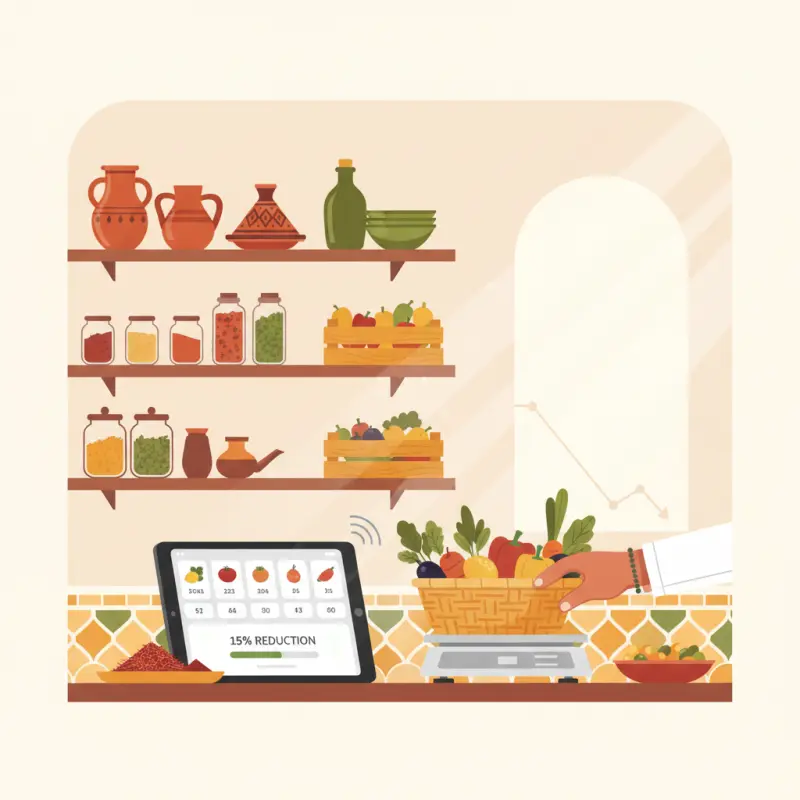
A kitchen inventory management system cuts restaurant waste by tracking ingredients in real-time, reducing overordering and spoilage. Most Moroccan restaurants lose 156,000 MAD annually through manual Excel tracking — 25,000 MAD in staff time, 18,000 MAD in emergency purchases, and 19,000 MAD in spoilage. Manual systems break down during busy periods like Ramadan when orders triple. Digital inventory systems integrate with POS data to track usage patterns and predict demand. Restaurants in Casablanca and Agadir using automated inventory management report 15% lower food costs within three months. The technology pays for itself through reduced waste — restaurants typically recover implementation costs in 60 days. Start by tracking your five highest-cost ingredients digitally before expanding to full inventory management.
Table of Contents
Your restaurant in Casablanca runs through 12,000 dirhams of ingredients every week. If you're tracking them on paper or Excel, you're probably losing 2,500 of those dirhams to waste, overordering, and theft. A proper kitchen inventory management system isn't about technology — it's about knowing exactly where your money goes.
Most Moroccan restaurants still count inventory the way their parents did: clipboard, pen, and hope. The cost of this "free" method adds up faster than a Friday night rush. Let's look at what manual tracking actually costs you, why restaurant stock management software matters, and how to make the switch without disrupting service.
Why Your Spreadsheet Is Costing You More Than You Think
That Excel file on your manager's laptop feels like it works. You update it weekly, maybe daily if you're disciplined. But the hidden costs pile up where you can't see them.
The Real Cost of "Free" Excel Tracking
Your chef spends 15 minutes every morning counting stock. Your manager spends another 20 reconciling orders. That's 35 minutes daily — or 213 hours per year. At average wages, you're paying 25,000 MAD annually for someone to type numbers into cells.
The real damage happens during service. You run out of chicken at 8 PM on Saturday. Your supplier is closed. You send someone to Marjane, paying 30% more than wholesale. This happens twice a month across different ingredients. Annual premium: 18,000 MAD.
| Hidden Cost | Time/Frequency | Annual Cost (MAD) |
|---|---|---|
| Staff counting time | 35 min/day | 25,000 |
| Emergency purchases | 2x/month @ 30% markup | 18,000 |
| Spoilage from missed dates | 3% of inventory | 19,000 |
| Over-ordering buffer | 15% safety stock | 94,000 |
| Total | 156,000 |
When Manual Systems Break Down
Ramadan arrives. Your orders triple. The spreadsheet that worked for 200 covers now buckles under 600. You order by instinct, not data. Some nights you throw away tagines. Other nights you run out of couscous. Your food cost jumps from 32% to 41%.
Then your inventory manager quits. They knew the spreadsheet's logic, the supplier codes, which cells linked where. Your new hire starts fresh. Two months of purchasing data vanish into confusion. This is when restaurants realize manual systems aren't systems — they're habits dressed up as processes.
Stack audit
What do you currently use?
Tick what you have. We’ll show what OCHI replaces or connects to.
The Kitchen Inventory Management System That Actually Works
A real restaurant inventory management software does three things Excel can't: track in real-time, predict needs, and survive staff changes. But not every system fits every kitchen.
Three Non-Negotiable Features for Moroccan Restaurants
First, offline capability. Internet in Agadir drops during storms. Marrakech medina buildings block signals. Your restaurant software inventory must work without connection, syncing when possible. Lose WiFi, not data.
Second, proper Arabic support. Not Google Translate Arabic — actual right-to-left interface design. Your Moroccan staff shouldn't struggle with English menus to count chickpeas. The system should speak their language, display their numbers, respect their workflow.
Third, local supplier integration. Your restaurant inventory program needs to know that Makro closes at 7 PM, that your fish vendor only accepts cash, that produce prices spike during Eid. Generic software assumes generic suppliers. You need local.
Why Gram-Level Tracking Changes Everything
Your recipe calls for 150 grams of beef per tagine. But your cook uses "a handful" — sometimes 120 grams, sometimes 200. Multiply by 50 tagines daily. Your food cost swings 15% based on hand size.
Gram-level tracking in your restaurant inventory management software enforces portions. When the POS records a tagine sale, exactly 150 grams deduct from inventory. No guesswork. Your theoretical food cost matches reality for the first time.
This precision reveals patterns. Tuesday's cook uses 10% more oil than Thursday's. The weekend crew forgets to log staff meals. Small leaks you never saw before. Each one fixable, each one worth 2-3% of revenue.
The 90-Day Implementation Reality Check
Switching from clipboard to kitchen inventory management system isn't instant. Here's what actually happens when a real restaurant makes the change.
Weeks 1-30: The Chaos Phase
Your staff hates the new system. The chef who's counted inventory for 10 years resents typing into tablets. The morning routine breaks. Orders feel wrong because they're based on data, not instinct.
You'll run both systems parallel — paper and digital. Double work, double frustration. Some days the counts won't match. You'll wonder if the old way was better. This is normal. Every successful implementation goes through this valley.
By week three, patterns emerge. The tablet is faster than paper for large counts. Automatic calculations catch math errors. Young staff adapt quickly, train others. Resistance softens.
Weeks 31-60: The Adjustment
First accurate reports arrive. You discover your oil costs are 20% higher than assumed. Your meat portions vary by 30%. These aren't failures — they're insights you never had before.
Purchase orders start automating. The system knows you need 40 kg of tomatoes every Monday. It sends orders to suppliers automatically. No forgotten items, no panic calls. Your restaurant stock management software starts saving time instead of consuming it.
Weeks 61-90: The Payoff
Waste drops. Not dramatically — gradually. Week 9: down 8%. Week 10: down 11%. Week 12: stabilized at 15% reduction. On 600,000 MAD monthly purchases, that's 90,000 MAD saved.
The real win: predictability. You know Tuesday's exact needs. You spot price creeps immediately. Your P&L reflects operations, not surprises. The kitchen inventory management system pays for itself in under four months.
OCHI's Inventory Module: Built for Moroccan Kitchens
OCHI understands Moroccan restaurant operations because we built our restaurant inventory management software here, not imported it. Every feature reflects local needs.
Real Results: Restaurant Marrakech Case Study
Dar Moha in Marrakech tracked inventory on paper for 15 years. Food costs ran 34%, wastage around 28%. They assumed this was normal for a 200-seat restaurant.
After implementing OCHI's inventory module: gram-level ingredient tracking, automated supplier orders, and real-time deduction from POS sales. Week 12 results: 21% wastage, 31% food cost. Annual savings: 380,000 MAD.
The key wasn't just tracking — it was integration. When a waiter enters an order, ingredients deduct immediately. When stock hits reorder points, suppliers get notified. When prices change, margins recalculate. One system, not five.
Integration with POS and Kitchen Display
Your chef sees orders on the Kitchen Display System. Each dish shows required ingredients. If stock runs low, the item grays out before you disappoint customers. No more "sorry, we're out of lamb" at 9 PM.
Purchase orders generate from actual depletion, not estimates. Monday's order reflects weekend sales plus par levels. Suppliers receive orders in their preferred format. You approve with one click. The restaurant software inventory handles the rest.
Making the Switch: Your 30-Day Action Plan
Don't buy any kitchen inventory management system yet. First, understand your current reality.
Week 1-2: Audit Your Current Losses
Count everything for two weeks. Not just monthly — daily. Track how long it takes. Note every emergency purchase, every spoiled item, every "we're out of" moment. Calculate your true food cost including waste.
Document supplier minimums, delivery schedules, payment terms. List every recipe with exact measurements. This baseline tells you what the restaurant inventory program must improve.
Week 3-4: Test Drive Options
Trial three systems maximum. More creates confusion. Test with real data: upload your recipes, enter actual counts, process mock orders. Watch your staff use it. Their feedback matters more than features lists.
Calculate potential ROI. If waste drops 15% and ordering time saves 10 hours weekly, what's that worth? Compare against system costs. Include training time. The best kitchen inventory management system returns investment in under six months.
The question isn't whether you need restaurant inventory management software. It's whether you can afford to keep guessing. Every day without proper tracking costs money — in waste, in time, in missed opportunities. Start your trial today and see what you've been missing.
Transform your inventory management with OCHI's integrated system at ochi.ma/partners.
Frequently Asked Questions
What is a kitchen inventory management system?
A kitchen inventory management system tracks restaurant ingredients, supplies, and costs in real-time through digital software instead of paper or Excel spreadsheets. It connects to POS systems to automatically update stock levels when items are sold.
How much money can restaurants save with inventory management software?
Moroccan restaurants typically save 156,000 MAD annually by switching from manual tracking to digital inventory systems. This includes reducing spoilage by 3%, eliminating emergency purchases, and cutting staff counting time by 213 hours per year.
Do kitchen inventory systems work for small restaurants in Morocco?
Yes, inventory management systems benefit restaurants of all sizes in Morocco. Small restaurants often see faster returns because they have tighter margins and can't absorb waste as easily as larger operations.
How long does it take to implement restaurant inventory management software?
Most restaurants complete inventory system setup in 2-3 weeks. Start by tracking your highest-cost ingredients first, then expand to full inventory. Restaurants typically recover implementation costs within 60 days through reduced waste.
Can inventory management systems integrate with existing restaurant POS?
Modern inventory management systems integrate with most restaurant POS platforms through APIs. This automatic integration updates stock levels when orders are processed, eliminating double data entry and reducing errors.
Restaurant owners · Weekly
The guide to running a restaurant in 2026.
One article per week. No commission advice. Just honest operational insight for Moroccan restaurants.

Blog Manager
Comments
No comments yet. Be the first to share your thoughts.