AI Overview
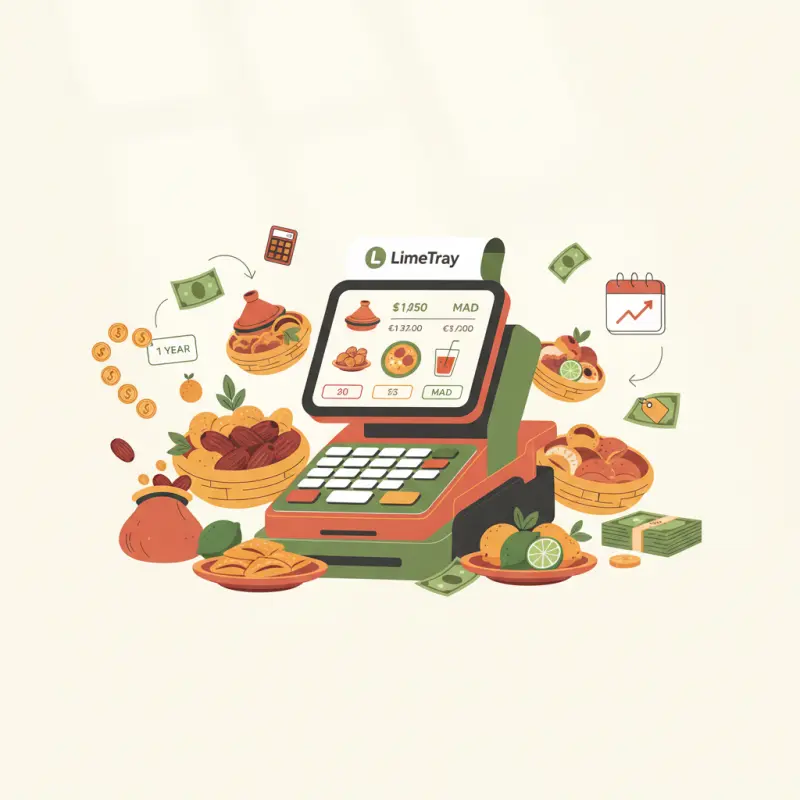
LimeTray POS pricing starts at $49 monthly but the true first-year cost reaches $2,400+ when you include setup fees, hardware, staff training, and transaction costs. The basic LimeTray Essentials plan costs $588 annually, but add $300 onboarding, $400 hardware, $250 training, and $200 integration fees. Payment processing adds another 2.9% per transaction. A Casablanca restaurant processing 1,000 monthly orders at 150 dirhams average pays 43,500 dirhams yearly in processing fees alone. For restaurants processing 500,000 dirhams monthly, that's 174,000 dirhams annually just for payment processing. Calculate total cost of ownership before committing to any POS system.
Table of Contents
A Rabat restaurant owner discovered last month that four of his best-selling items were priced below cost — bleeding 91,250 dirhams annually. This happens when restaurants focus on POS features instead of profit fundamentals.
LimeTray POS pricing starts at $49 monthly, but the real cost of restaurant menu management software runs much deeper than subscription fees. When you factor in setup costs, training time, transaction fees, and the silent profit leaks from underpriced menu items, that affordable monthly rate becomes a six-figure annual expense.
The Real Cost of POS Pricing Models: Beyond Monthly Fees
Restaurant owners see "$49/month" and breathe a sigh of relief. But here's what LimeTray's pricing page doesn't highlight: the true first-year investment that turns that $588 annual subscription into a $2,400+ commitment.
The $2,400 First-Year Reality
Let's break down what a typical Casablanca restaurant actually pays:
| Cost Component | LimeTray Essentials | LimeTray Standard | LimeTray Premium |
|---|---|---|---|
| Monthly Subscription | $49 | $99 | $199 |
| Annual Subscription | $588 | $1,188 | $2,388 |
| Setup & Onboarding | $300 | $500 | $800 |
| Hardware (Tablet/Printer) | $400 | $600 | $800 |
| Staff Training (10 hours) | $250 | $350 | $500 |
| Integration Fees | $200 | $400 | $600 |
| First Year Total | $1,738 | $3,038 | $5,088 |
These numbers assume smooth implementation. Add payment gateway setup, menu migration, and the inevitable troubleshooting calls, and you're looking at $2,400+ for even the basic tier.
Transaction Fees: The Silent Profit Killer
But here's where it gets expensive. Payment processing adds 2.9% + $0.30 per transaction. For a Marrakech restaurant processing 1,000 orders monthly at 150 dirhams average, that's 43,500 dirhams annually in processing fees alone.
Compare this to traditional cash operations or integrated systems with negotiated rates. That 2.9% compounds faster than most owners realize. On 500,000 dirhams monthly revenue, you're paying 174,000 dirhams yearly just to accept cards through standard processors.
Food cost calculator
What’s your real margin?
Food cost
29.2%
Gross margin
70.8%
Profit / dish
85 MAD
Healthy · under 30%
Digitize your menu with OCHIMenu Pricing Strategy: Where Most Restaurants Lose Money
The real profit leak isn't in your POS fees — it's in your menu prices. Industry benchmarks suggest food costs should stay between 28-35% of menu price. Yet most restaurants operate blind, discovering profit problems only during quarterly reviews.
The 4-Item Profit Leak Scenario
Take that Rabat restaurant we mentioned. Their signature tagine was priced at 85 dirhams with a food cost of 72 dirhams — an 85% food cost ratio. They sold 50 daily. The math is brutal:
Daily loss: (72 - 59.5) × 50 = 625 dirhams
Annual loss on one item: 228,125 dirhams
They had three other items with similar problems. Total annual profit leak: 91,250 dirhams from just four menu items. This happens because most restaurant pricing software treats menus as static displays instead of dynamic profit centers.
Recipe Costing: Manual vs. Automated Systems
Manual recipe costing takes two hours weekly for a 50-item menu. That's 104 hours annually of management time spent on spreadsheets. But the real cost isn't time — it's the three-month lag between ingredient price changes and menu adjustments.
When olive oil prices jumped 15% last quarter, restaurants using manual systems continued selling at old prices for weeks. Those with automated restaurant menu management systems adjusted within 24 hours, protecting their margins immediately.
Why Restaurant Menu Management Software Fails Most Owners
Here's the uncomfortable truth: most online menu ordering systems focus on aesthetics over economics. They promise "beautiful digital menus" while ignoring the fundamental question: are your prices profitable?
The Menu Psychology Trap
Restaurant owners invest in professional menu designs, thinking presentation drives sales. But a gorgeous menu displaying unprofitable items just accelerates losses. The industry obsession with "user experience" masks the real need: margin protection.
A Fès pizzeria spent 15,000 dirhams on menu photography and design. Their online orders increased 40%. Their profits decreased 15%. Why? The items they promoted most prominently had the worst margins. Pretty pictures don't fix pricing problems.
Data That Actually Matters
Forget heat maps showing where customers click. Here's what restaurant menu management software should track:
Item-level profitability trends. Not just sales volume — actual contribution margin. Which items make money? Which lose it? Most POS systems show you what sells. Few show you what profits.
Inventory cost variance alerts matter more than font selection. When chicken breast costs spike 20%, your system should flag every affected menu item immediately. Design updates can wait. Margin protection can't.
OCHI's Recipe Builder: Auto-Cost Recalculation in Action
This is where modern restaurant pricing software proves its worth. OCHI's recipe builder links ingredient costs directly to menu prices, recalculating margins automatically when supplier prices change.
Live Pricing Example
When tomato prices surged 25% during last summer's shortage, traditional POS users discovered the problem during month-end reviews. OCHI users received alerts within 24 hours, with specific price adjustment suggestions for every affected item.
Restaurant using manual system: continued selling margherita pizza at 75 dirhams despite food cost rising to 31 dirhams (41% ratio). Lost 6 dirhams per pizza for three weeks before noticing.
Restaurant using OCHI: received alert when food cost exceeded 30%. Adjusted price to 82 dirhams within one day. Maintained healthy 28% food cost throughout the shortage.
Beyond POS: Full Cost Control
The difference extends beyond individual items. OCHI's system maintains cost consistency across multiple branches — critical for growing restaurant groups. When an Agadir restaurant chain updates olive oil cost in the system, every branch's menu prices reflect the change instantly.
This integration between inventory management and menu pricing prevents the disconnects that plague traditional setups. Your Casablanca branch won't accidentally sell below cost because someone forgot to update the spreadsheet.
The Zero-Commission Alternative: Total Cost Comparison
Let's examine real numbers for a restaurant generating 50,000 dirhams monthly revenue:
| Cost Component | Traditional Setup | OCHI Platform | Annual Savings |
|---|---|---|---|
| POS System (LimeTray Standard) | 1,188 DH | 0 DH | 1,188 DH |
| Delivery Platform Commission (20%) | 120,000 DH | 0 DH | 120,000 DH |
| Payment Processing (2.9%) | 17,400 DH | Negotiated rates | 8,700 DH |
| Menu Management Software | 2,400 DH | Included | 2,400 DH |
| Setup & Training | 3,000 DH | 0 DH | 3,000 DH |
| Total Annual Cost | 143,988 DH | 8,700 DH | 135,288 DH |
The zero-commission model transforms unit economics. Instead of working to cover platform fees, every dirham stays in the restaurant. For a business with 10% net margins, saving 135,288 dirhams equals generating 1.35 million in additional revenue.
50,000 Dirham Monthly Revenue Breakdown
Traditional setup requires multiple vendors: LimeTray for POS, a delivery aggregator charging 15-25% commission, separate payment processing, and often additional menu management tools. Total cost: 24% of revenue.
OCHI's integrated platform eliminates these layers. One system handles online ordering, table QR codes, POS operations, and delivery management. No commissions. Direct customer relationships. Actual cost: under 2% of revenue.
Calculate your restaurant's real profitability at votrenom.ochi.ma — see how zero-commission ordering affects your bottom line.
The question isn't whether you can afford better restaurant technology. It's whether you can afford to keep bleeding profits through outdated pricing models and disconnected systems. When ingredients cost more tomorrow than today, will your menu prices reflect that reality? That's the difference between POS features and profit protection.
Ready to see how integrated cost management transforms restaurant economics? Explore OCHI's complete platform at ochi.ma/partners.
Frequently Asked Questions
What does LimeTray POS actually cost in the first year?
LimeTray POS first-year costs range from $1,738 for the basic plan to $5,088 for premium, including subscription, setup, hardware, and training fees.
Are there transaction fees with LimeTray POS?
Yes, LimeTray charges 2.9% plus $0.30 per transaction for payment processing. This can cost Moroccan restaurants 43,500+ dirhams annually.
What's included in LimeTray's monthly subscription price?
The monthly subscription covers software access only. Hardware, setup, training, integrations, and payment processing cost extra.
Does LimeTray offer commission-free ordering in Morocco?
No, LimeTray charges transaction fees on all payments. Commission-free alternatives like OCHI keep 100% of restaurant revenue.
How much do LimeTray setup and training costs add up to?
Setup and training costs range from $550 to $1,300 depending on your plan tier and restaurant complexity.
Restaurant owners · Weekly
The guide to running a restaurant in 2026.
One article per week. No commission advice. Just honest operational insight for Moroccan restaurants.

Blog Manager
Comments
No comments yet. Be the first to share your thoughts.