AI Overview
Effective menu management in restaurant operations requires calculating true food cost percentage beyond basic ingredient costs. Most Moroccan restaurants miss critical components like prep labor, waste, and portion creep that inflate actual costs by 3-7%. A chicken pastilla priced at 18 MAD ingredients becomes 29.5 MAD when accounting for prep time, waste, and over-portioning. Different restaurant models demand different targets: fast-food operations in Marrakech run efficiently at 32% food costs while fine-dining establishments near Rabat's Royal Palace need 24% to cover skilled labor. The standard 28-35% food cost benchmark fails sandwich shops in Agadir but works for white-tablecloth dining in Casablanca's Triangle d'Or. Calculate your real food cost using: (Cost of Goods Sold ÷ Food Revenue) × 100, including all hidden expenses. Track portion sizes daily and train staff on exact measurements to prevent profit erosion.
Table of Contents
Your chicken tagine shows a 22% food cost on paper. In reality, after waste and over-portioning, it's closer to 29%. That seven-point difference costs you 840 MAD per week on this single dish.
Most restaurant owners in Morocco track menu prices by gut feeling. They raise prices when suppliers increase costs, lower them when competition heats up, and wonder why profits stay flat despite busy dining rooms. The math behind menu management in restaurant operations determines whether you survive past year two.
The Food Cost Formula Every Restaurant Owner Gets Wrong
The restaurant industry preaches a 28-35% food cost as gospel. This benchmark works for white-tablecloth dining in Casablanca's Triangle d'Or but destroys margins for a sandwich shop in Agadir. Your restaurant type, location, and service model demand different math.
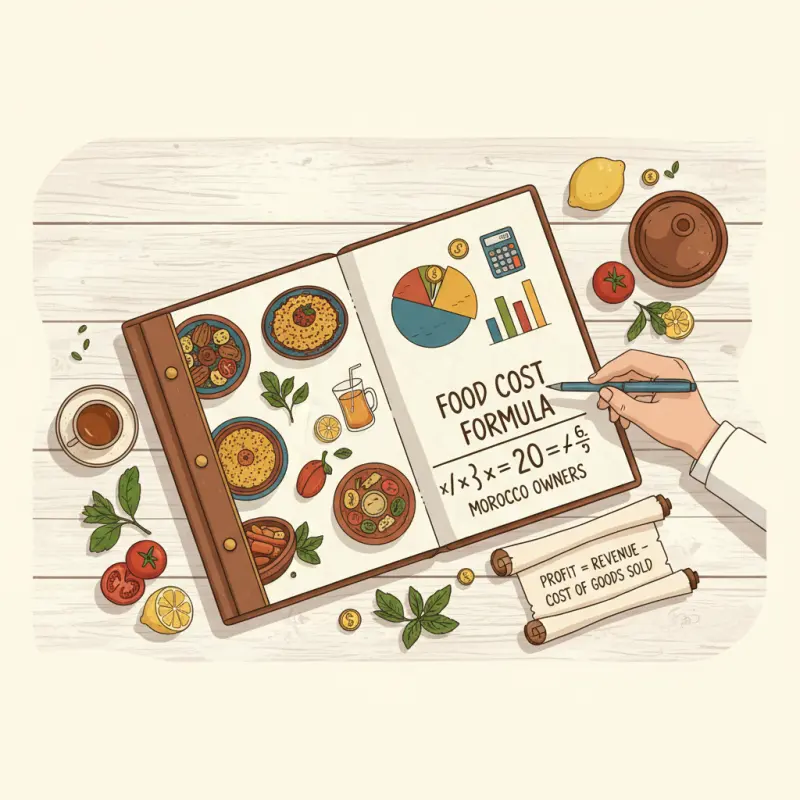
Here's the formula that matters: (Cost of Goods Sold ÷ Food Revenue) × 100 = Food Cost Percentage. Simple enough. Yet most owners calculate COGS wrong, missing critical components that inflate their actual costs.
Calculate Your Real Food Cost Percentage
Take a traditional chicken pastilla. The recipe costs 18 MAD in ingredients. You price it at 65 MAD, giving you a comfortable 27.7% food cost. Except you forgot three things: the 45 minutes of prep labor (8 MAD), the phyllo sheets that tear during assembly (2 MAD waste), and the portion creep when your line cook adds extra almonds (1.5 MAD). Your actual food cost hits 35.4%.
Different restaurant models require different targets. A fast-food operation in Marrakech runs efficiently at 32% because labor costs stay low. A fine-dining establishment near Rabat's Royal Palace needs 24% food costs to cover skilled chef salaries and premium service. Know your model, know your number.
The Hidden Costs Most Owners Miss
Waste, theft, and over-portioning add 3-7% to your stated food cost. A busy restaurant serving 200 covers daily loses 420-980 MAD to these invisible drains. That's up to 29,400 MAD monthly — enough to pay a full-time employee.
Labor cost for prep work rarely factors into menu pricing. Your sous chef spending two hours making harira from scratch costs 60 MAD in wages. Spread across 20 portions, that's 3 MAD per bowl before you count a single lentil.
Delivery packaging burns another hole. Those sturdy containers for your online menu ordering system cost 2-4 MAD per order. On 50 daily delivery orders, packaging alone runs 3,000-6,000 MAD monthly. Most restaurants absorb this cost instead of building it into delivery pricing.
Food cost calculator
What’s your real margin?
Food cost
29.2%
Gross margin
70.8%
Profit / dish
85 MAD
Healthy · under 30%
Digitize your menu with OCHIFour Menu Items Are Bleeding Your Profits Right Now
Pull your sales data from last month. Sort by quantity sold. Now calculate the true profit on your top 10 sellers. You'll find at least four items losing money once you factor in real costs.
A seafood restaurant in Agadir discovered their "signature" grilled prawns — featured prominently on their restaurant menu management system — lost 12 MAD per plate. They'd sold 847 portions the previous month, bleeding 10,164 MAD while thinking they ran a popular dish.
The Menu Audit That Takes 15 Minutes
Start with your POS data export. List every menu item with quantity sold and revenue generated. Calculate the true cost per item including ingredients, prep labor, and packaging. The math reveals painful truths.
| Menu Item | Sold/Month | Menu Price | True Cost | Profit/Loss |
|---|---|---|---|---|
| Grilled Prawns | 847 | 95 MAD | 107 MAD | -10,164 MAD |
| Caesar Salad | 423 | 55 MAD | 18 MAD | +15,651 MAD |
| Lamb Tagine | 312 | 85 MAD | 84 MAD | +312 MAD |
| Vegetable Couscous | 208 | 45 MAD | 52 MAD | -1,456 MAD |
This 15-minute exercise exposed 11,620 MAD in monthly losses from just two dishes. The restaurant raised prawn prices to 115 MAD and removed the vegetable couscous, replacing it with a profitable 48 MAD quinoa bowl.
Pricing Psychology That Actually Works in Morocco
Price anchoring succeeds in affluent areas but backfires elsewhere. A Casablanca brasserie added a 295 MAD imported steak to make their 125 MAD local beef seem reasonable. Orders increased 34%. The same strategy in a family restaurant in Fès drove customers away.
Charm pricing (49 vs. 50 MAD) boosts order rates by 23% in online ordering but means nothing for dine-in guests. Your restaurant pricing software should allow different pricing strategies for different channels.
Menu positioning matters more than font size. Items in the upper-right corner (the "golden triangle") sell 17% more often. Place your profitable dishes there, not your loss leaders.
Restaurant Menu Management Software Solves Half the Problem
Manual menu updates across multiple platforms waste eight hours weekly. You change prices in your POS, update printed menus, brief staff, modify your website, adjust delivery platforms, and still miss something. Each mistake costs money.
Manual Menu Management Costs You 8 Hours Per Week
Track the time: updating your POS (30 minutes), designing and printing new menus (3 hours), training staff on changes (1 hour), updating your website (1 hour), modifying each delivery platform (30 minutes each for 4 platforms = 2 hours), fielding customer complaints about wrong prices (30 minutes). Total: 8 hours of productive time lost to administrative tasks.
Human error compounds the problem. Studies show 12% of manual menu updates contain pricing mistakes. A restaurant with 60 items changing prices quarterly makes 28 errors annually. Each error averages 180 MAD in lost profit from underpricing or customer disputes.
What Restaurant Menu Management System Actually Delivers
Automated systems calculate real-time costs when ingredient prices fluctuate. Your tomato supplier raises prices 15%? The system instantly shows which dishes now operate below your margin threshold.
Margin alerts prevent profit erosion. Set your minimum acceptable margin at 65%. When food costs spike and push any item below this threshold, you receive immediate notifications with suggested price adjustments.
Integration between your online ordering platform and POS eliminates synchronization errors. Change a price once — it updates everywhere. No more customer arguments about website prices not matching in-store menus.
OCHI's Recipe Builder Calculates Costs While You Type
OCHI's restaurant menu management software tracks costs at the ingredient level. Build your recipe once with exact quantities. When supplier prices change, every affected dish recalculates automatically.
Auto-Recalculation When Supplier Prices Change
Upload your new invoice showing chicken breast at 38 MAD/kg instead of 35 MAD/kg. The system instantly recalculates every recipe using chicken: your shawarma wrap food cost jumps from 31% to 33.2%, your chicken tagine from 28% to 30.1%. Margin alerts flag both dishes as approaching your 35% threshold.
The platform suggests new prices maintaining your target margins. Instead of guessing, you see exact recommendations: raise the shawarma from 45 to 47 MAD, the tagine from 75 to 78 MAD. One click updates all menus, online ordering, and your POS.
Multi-Branch Menu Control From One Dashboard
Managing different menus across branches typically requires spreadsheets, phone calls, and confusion. OCHI's centralized control lets you update prices simultaneously or customize by location. Your beachfront location in Agadir charges 10% more than your downtown branch? Set it once and forget it.
Track profitability by location. Maybe your Marrakech branch sells tagines at better margins due to local supplier relationships. The data guides menu decisions — promote high-margin items where they perform best.
Role permissions prevent chaos. Your branch managers can view reports but not change prices. Servers see the menu but can't modify recipes. Only authorized managers adjust costs and margins, maintaining consistency across your operation.
Menu management determines restaurant survival. The math doesn't lie — those four underpriced items drain your profits month after month. Fix your food costs now, or watch competitors with better systems slowly capture your market share. The choice between manual spreadsheets and automated precision becomes obvious when you see the numbers.
Set up your menu cost tracking at votrenom.ochi.ma — see exactly which items make money and which ones don't.
Frequently Asked Questions
What is the correct food cost percentage for restaurants in Morocco?
Food cost percentages vary by restaurant type and location. Fast-food operations in Morocco typically run at 32%, while fine-dining establishments need 24-28% to cover higher labor costs. The standard 28-35% benchmark doesn't apply universally.
How do you calculate true restaurant food costs?
Use the formula: (Cost of Goods Sold ÷ Food Revenue) × 100. Include ingredient costs, prep labor, waste, and portion variations. Most restaurants underestimate by 3-7% when excluding these hidden costs.
What hidden costs affect restaurant menu pricing?
Waste, theft, over-portioning, and prep labor add significant costs. A busy restaurant serving 200 covers daily can lose 420-980 MAD to these factors, adding up to 29,400 MAD monthly.
How often should restaurants review menu costs?
Review food costs weekly and adjust menu prices quarterly. Track supplier price changes, monitor portion control, and calculate actual food waste to maintain accurate pricing.
Restaurant owners · Weekly
The guide to running a restaurant in 2026.
One article per week. No commission advice. Just honest operational insight for Moroccan restaurants.

Blog Manager
Comments
No comments yet. Be the first to share your thoughts.