AI Overview
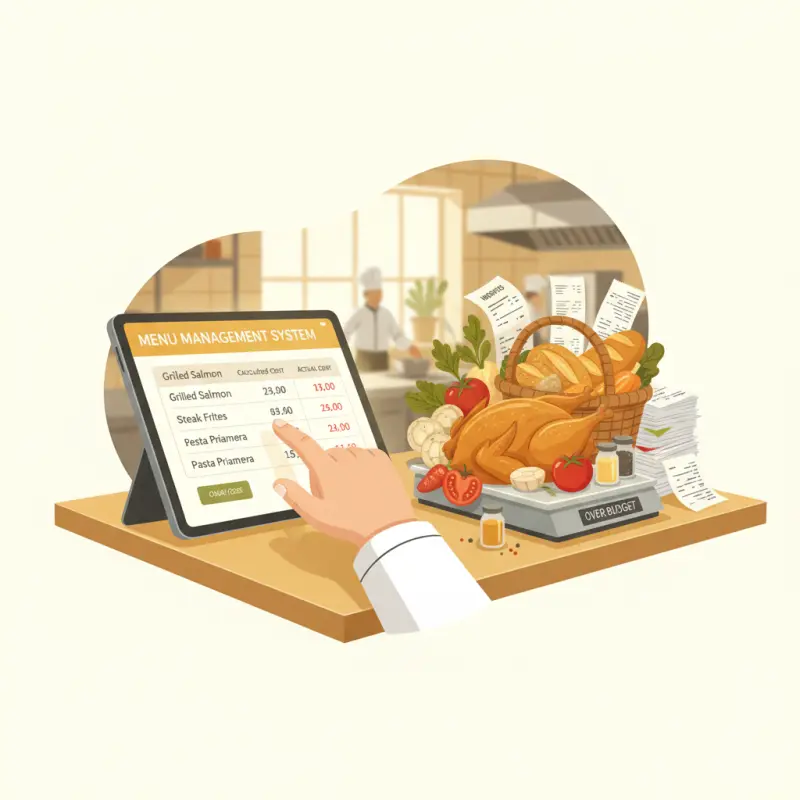
Most restaurants in Morocco experience food costs 15-20% higher than calculated because traditional menu management systems for restaurants track ingredient prices without measuring actual kitchen operations. A restaurant menu management system that only calculates theoretical costs misses the reality of inconsistent portioning, recipe drift between shifts, and unmeasured waste. One Agadir restaurant celebrated 28% calculated food costs while actual costs ran 43%, leading to closure within six months. The gap exists in unmeasured moments: a chef's 'handful' of almonds varies by 40 grams between shifts, costing 4.80 MAD per dish at 120 MAD per kilo. Recipe cards become meaningless without portion control and real-time tracking. Track every gram portioned, every spoiled ingredient, and every recipe variation to bridge the gap between calculated and actual food costs.
Table of Contents
Why Your Food Costs Are Higher Than You Think (And It's Not the Suppliers)
Your tagine shows a 28% food cost on paper. In reality, it's bleeding 35% — and your menu management system for restaurants never told you. Most restaurant owners in Morocco chase the industry benchmark of 28-35% food costs while missing the operational leaks that silently drain profits: over-portioning by untrained staff, recipe drift between chefs, and ingredients expiring in forgotten corners of the walk-in.
The gap between calculated and actual food costs kills more restaurants than bad reviews. You price your menu based on spreadsheet math, but your profits disappear through a thousand tiny cuts in the kitchen.
The 28% Trap: When "Good" Food Costs Hide Poor Management
A restaurant in Agadir celebrated hitting 28% food costs last quarter. Six months later, they closed. The owner discovered their actual costs ran 43% — the difference hidden in unmeasured olive oil, inconsistent protein portions, and vegetables that spoiled before use. Their restaurant menu management software tracked prices but ignored operations.
The industry teaches you to divide ingredient cost by menu price and call it done. This kindergarten math assumes perfect portions, zero waste, and robots in the kitchen. Real kitchens need real tracking: every gram portioned, every spoiled tomato logged, every recipe variation documented.
Recipe Costing vs. Reality: The 15% Gap Nobody Talks About
Your chef's "handful" of almonds varies by 40 grams between morning and evening shifts. At 120 MAD per kilo, that variance costs you 4.80 MAD per dish — invisible until you measure. Multiply this across every ingredient, every dish, every day. The 15% gap between theoretical and actual food costs lives in these unmeasured moments.
Traditional restaurant pricing software calculates costs from standardized recipes. But who ensures the standard becomes reality? Without portion control, recipe cards gather dust while your margins evaporate.
Food cost calculator
What’s your real margin?
Food cost
29.2%
Gross margin
70.8%
Profit / dish
85 MAD
Healthy · under 30%
Digitize your menu with OCHIThe Numbers That Matter: Building Profitable Menu Prices from Scratch
Forget the competitor down the street. Your menu prices must cover your costs, your market, and your positioning. The math is unforgiving but learnable.
The Food Cost Formula That Actually Works in Morocco
Here's the formula that keeps Casablanca restaurants profitable:
| Component | Calculation | Example (Chicken Tagine) |
|---|---|---|
| Raw Food Cost | Sum of all ingredients | 42 MAD |
| True Food Cost | Raw + 10% waste factor | 46.20 MAD |
| Target Food Cost % | Your goal (28-35%) | 30% |
| Menu Price | True Cost ÷ Target % | 154 MAD |
| Market Adjustment | Round to psychological price | 155 MAD |
The 10% waste factor covers spillage, trimming, and spoilage — adjust based on your kitchen's actual performance. Track for one month to find your real number.
Pricing Psychology: Why 45 MAD Outsells 44.99 MAD in Agadir
Moroccan diners trust round numbers. While Western pricing psychology pushes 9.99 endings, local markets respond better to clean figures: 45, 75, 120. Test both approaches with your online menu ordering system and measure actual conversion rates, not theories.
Premium items deserve premium pricing psychology. Your 280 MAD seafood platter feels more valuable than 279 MAD — the penny saved signals cheapness, not value.
When to Price Below Cost (Yes, Really)
Your mint tea costs 3 MAD to make. Price it at 10 MAD and watch tables turn faster, satisfaction scores rise, and beverage sales multiply. Loss leaders work when they drive profitable behavior — but only when your restaurant menu management system tracks the full picture.
Four Menu Items Killing Your Profit Margin Right Now
A Marrakech restaurant discovered four items bleeding money through proper menu analysis. The detective work saved their business.
The Tagine Trap: How Traditional Items Hide Modern Costs
Their lamb tagine with prunes — a signature dish for 20 years — lost 12 MAD per order. Meat prices had climbed 40% in two years while the menu price stayed frozen at "tradition." Nostalgia doesn't pay suppliers.
The vegetable couscous suffered worse: perceived as the "cheap option," it sold at 65 MAD while costing 71 MAD to make. Seven vegetables, each prepped separately, created labor costs the pricing never considered.
Beverage Margins: Your Secret Profit Engine
Fresh orange juice: 8 MAD cost, 35 MAD price, 77% margin. Coca-Cola: 4 MAD cost, 20 MAD price, 80% margin. Yet servers pushed food over drinks, leaving profit on the table. Smart restaurants train staff to suggest beverages first — where margins live.
The Upsell Algorithm: Which Items to Push (And Which to Kill)
Menu engineering follows simple rules: promote high-margin items, bundle low-performers, eliminate dogs. But which is which? Without a proper restaurant menu management system, you're guessing.
Track these metrics for every item: profit margin, popularity index, preparation time. Items with high margins and high popularity get prime menu placement. Low margin, low popularity items disappear.
Why Your Current Menu Management Software Is Backwards
Most systems help customers order. Few help restaurants profit. The real value isn't in pretty pictures — it's in cost tracking that updates with every supplier invoice.
Online Menu Ordering System vs. Profit Optimization: Why You Need Both
Your online menu ordering system brings customers. But without integrated cost tracking, every order might lose money. The systems must talk: when beef prices rise 20%, your menu prices should know immediately.
Digital menus change in seconds. Paper menus trap you with yesterday's costs and tomorrow's losses. The flexibility to adjust prices based on real costs, not annual printing schedules, keeps margins intact.
Real-Time Cost Tracking: When Ingredient Prices Change Daily
Tomatoes in January cost triple their August price. Your restaurant menu management software should alert you when food costs breach targets, not surprise you at month's end. Real-time tracking means real-time decisions.
Building a Menu That Sells Itself
Standardization saves more money than negotiation. When every cook makes the same dish the same way, food costs stabilize and quality soars.
Recipe Standardization: From 5 Versions to 1 Perfect Dish
Document everything: ingredients to the gram, cooking times to the minute, plating with photos. The head chef's "pinch of saffron" becomes 0.5 grams. The sous chef's "generous pour" becomes 30ml. Consistency in the kitchen creates consistency in costs.
Train new staff with precision recipes, not apprenticeships. When recipes live in the restaurant menu management system, not just the chef's head, your food costs survive staff changes.
The OCHI Approach: Menu Management That Talks to Your Inventory
OCHI's recipe builder links every dish to its ingredients, every ingredient to its cost. When you update olive oil from 45 to 52 MAD per liter, every recipe using olive oil recalculates automatically. No spreadsheet gymnastics, no manual updates across dozens of dishes.
The system tracks actual usage against theoretical amounts. If your pasta arrabiata should use 200g of pasta but averages 235g, you'll know. Knowledge becomes control, control becomes profit.
Menu management isn't about pretty descriptions or food photography. It's about knowing exactly what every plate costs and pricing for profit, not prayers. When your restaurant pricing software connects recipes to inventory to sales, the math works itself out. You just cook.
See how OCHI's integrated approach to menu and cost management can transform your restaurant's profitability at ochi.ma/partners.
Frequently Asked Questions
What is a menu management system for restaurants?
A menu management system for restaurants calculates ingredient costs, tracks pricing, and manages recipe standardization. Advanced systems also monitor actual portioning, waste tracking, and kitchen operations to provide real-time cost analysis.
Why do restaurant food costs exceed calculations?
Food costs exceed calculations due to inconsistent portioning, recipe drift between shifts, unmeasured waste, and ingredient spoilage. These operational gaps typically add 15-20% to theoretical food costs calculated in menu management systems.
How can restaurants reduce the gap between calculated and actual food costs?
Restaurants reduce cost gaps by implementing portion control training, standardizing recipes across all shifts, tracking waste daily, and using menu management systems that monitor actual kitchen operations rather than just ingredient prices.
What should restaurants track beyond ingredient prices?
Restaurants should track actual portion sizes, ingredient waste, spoilage rates, recipe variations between chefs, and cooking method consistency. These operational metrics reveal the true cost gaps that pricing calculations miss.
Restaurant owners · Weekly
The guide to running a restaurant in 2026.
One article per week. No commission advice. Just honest operational insight for Moroccan restaurants.

Blog Manager
Comments
No comments yet. Be the first to share your thoughts.