AI Overview
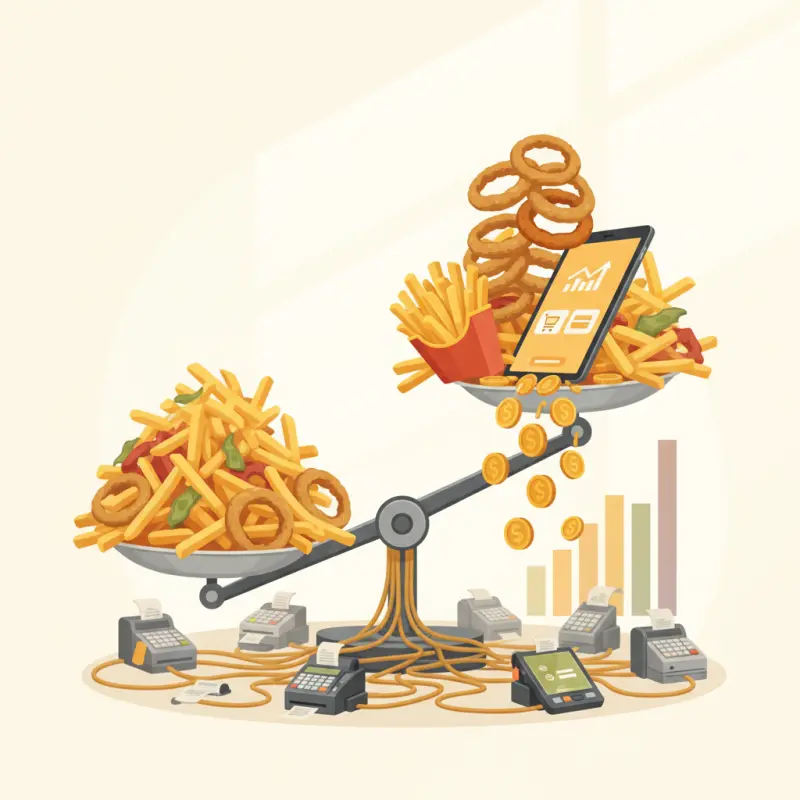
Most Moroccan restaurants lose 3-7% of profit margins through incorrect menu ordering system pricing that applies dine-in economics to delivery orders. Traditional food cost formulas assume customers dine in, but delivery orders carry additional costs: platform commissions (15-30%), packaging (2-4 MAD per order), and payment processing fees (2.9%). Tajine House in Marrakech discovered they earned only 4.40 MAD profit per lamb tagine after platform fees, losing 8,400 MAD annually on their signature dish. The standard 28-35% food cost rule breaks down for online orders because platform commissions reduce the remaining margin from 70% to 35-45%. Restaurants need separate pricing strategies for delivery orders that account for these additional costs to maintain healthy profit margins.
Table of Contents
Most restaurant owners in Morocco lose 3-7% of their profit margin through their menu ordering system — not because of platform fees, but because they're pricing their menus for dine-in service while serving delivery orders. The math doesn't add up, and your bank account shows it.
Why Your Menu Ordering System is Bleeding Money
Check your last month's delivery orders. For each one, you paid 2-4 MAD for packaging, absorbed payment processing fees averaging 2.9%, and if you're on traditional platforms, handed over 15-30% commission. These aren't line items on your P&L — they're silent profit killers hiding in your food cost calculations.
Consider Tajine House in Marrakech. They pushed 200 orders monthly through a commission-based platform. Their signature lamb tagine cost 18 MAD to make, priced at 32 MAD on the menu. After the platform's 30% cut, they netted 22.40 MAD per order — a mere 4.40 MAD profit. Multiply that by 200 orders: they worked all month to make 880 MAD profit on their most popular dish.
The owner discovered they'd lost 8,400 MAD annually on this single menu item. Not from theft. Not from waste. From using a menu ordering system without understanding the true cost structure of online orders.
Food cost calculator
What’s your real margin?
Food cost
29.2%
Gross margin
70.8%
Profit / dish
85 MAD
Healthy · under 30%
Digitize your menu with OCHIThe 28-35% Food Cost Rule Doesn't Work for Online Orders
Every restaurant management course teaches the same formula: keep food costs between 28-35% for healthy margins. This benchmark assumes customers sit in your dining room, servers handle orders, and you control every cost variable. Online ordering breaks every one of these assumptions.
Dine-in economics work like this: 30% goes to food cost, leaving 70% for labor, rent, utilities, and profit. Apply that same 30% to delivery orders, and watch what happens. Platform commission eats 15-30%. Packaging adds 3-5%. Payment processing takes another 3%. Suddenly, that comfortable 70% margin shrinks to 35-45%. You're working harder for less money.
The solution isn't complicated. Use this formula for your restaurant menu management system:
| Component | Calculation | Example (50 MAD dish) |
|---|---|---|
| Base food cost | Actual ingredients + prep time | 12.50 MAD |
| Online target cost | Base cost ÷ 0.25 | 50 MAD minimum |
| Add packaging | + 3 MAD average | 53 MAD |
| Platform commission | Final price ÷ (1 - commission rate) | 75.71 MAD (at 30% commission) |
That 50 MAD dish needs to sell for 76 MAD online to maintain your margins. Most restaurants never do this math.
Recipe Costing: The Missing Piece Most Systems Ignore
Walk into any restaurant kitchen in Agadir and ask the chef what their bestselling dish costs to make. You'll get a guess, not a number. This guesswork compounds when you plug these dishes into your online menu ordering system.
Start with protein costs. Chicken breast runs 45 MAD per kilogram in most Moroccan markets. But raw weight isn't serving weight. Chicken loses 25% mass during cooking. That kilogram yields 750 grams cooked. For a 200-gram portion, your actual protein cost is 12 MAD, not the 9 MAD most restaurants calculate.
Vegetable prices swing wildly. Tomatoes cost 4 MAD per kilogram in July, 6.50 MAD in January — a 40% difference. Cooking oil jumped 30% last year. Your menu prices didn't. This is how restaurant pricing software becomes essential: tracking these fluctuations in real-time.
Smart operators use a menu engineering matrix to guide decisions:
| Category | Margin | Popularity | Action |
|---|---|---|---|
| Stars | High | High | Promote heavily |
| Workhorses | Low | High | Raise prices gradually |
| Puzzles | High | Low | Reposition or remove |
| Dogs | Low | Low | Eliminate immediately |
How OCHI's Recipe Builder Prevents Profit Leaks
Manual cost tracking fails because ingredient prices change faster than spreadsheets update. OCHI's restaurant menu management software connects your supplier invoices directly to recipe costs. Upload an invoice, and every dish using those ingredients recalculates automatically.
Restaurant Atlas in Agadir discovered four dishes selling below cost using OCHI's analytics dashboard. Their vegetable couscous, priced at 35 MAD, cost 33 MAD to make after factoring in recent semolina price increases. They repriced to 42 MAD — a 20% increase that customers accepted without complaint. Monthly profit on that dish alone jumped from 100 MAD to 1,500 MAD.
The platform's zero-commission model changes the pricing equation entirely. When you keep 100% of revenue, you control your margins. Set up your branded ordering site at votrenom.ochi.ma, and every dirham flows directly to your business. No middleman math. No hidden fees eating your profits.
Three-Week Menu Optimization Plan
Stop the bleeding with this systematic approach to menu profitability.
Week 1: Cost Audit
Pull sales reports for your top 20 items. Calculate the exact cost of each dish, including that 25% cooking loss on proteins and 10% prep waste on vegetables. Flag every item falling below the 25% food cost ceiling for online orders. You'll find more than you expect.
Week 2: Strategic Repricing
Increase prices on sub-profitable items by 15-20%. Start with your workhorses — high-volume dishes where small increases generate significant returns. Test customer response by adjusting three items first. Monitor order volumes daily. If orders drop more than 10%, reassess. Most won't.
Week 3: Menu Simplification
Complex dishes with variable ingredients kill consistency and profits. That 15-ingredient signature salad might impress, but if costs swing 30% based on seasonal availability, it's a liability. Focus on five high-margin signature items you can execute perfectly every time. Train your team on exact portion sizes — a 10-gram variance multiplied by 100 orders equals money lost.
Your menu ordering system should make you money, not drain it. The restaurants winning in Morocco's competitive market understand one thing: technology without proper pricing strategy is just an expensive way to lose money faster. See how OCHI helps restaurants build profitable menus at votrenom.ochi.ma — where zero commission means every calculation works in your favor.
Frequently Asked Questions
Why do restaurants lose money with their menu ordering system?
Restaurants apply dine-in pricing to delivery orders without accounting for platform commissions (15-30%), packaging costs, and payment processing fees. This reduces profit margins from 70% to 35-45%.
What's wrong with using the 28-35% food cost rule for online orders?
The 28-35% food cost rule assumes dine-in service with no platform commissions. For delivery orders, additional costs like platform fees and packaging shrink the remaining 70% margin significantly.
How much do platform commissions cost restaurants in Morocco?
Traditional platforms in Morocco charge 15-30% commission per order, plus payment processing fees averaging 2.9% and packaging costs of 2-4 MAD per order.
Should restaurants price delivery orders differently than dine-in?
Yes, delivery orders require separate pricing to account for platform commissions, packaging, and processing fees that don't exist with dine-in service.
How can restaurants avoid losing money on their menu ordering system?
Use commission-free platforms like OCHI, create separate delivery pricing that accounts for all costs, and calculate true profit margins including packaging and processing fees.
Restaurant owners · Weekly
The guide to running a restaurant in 2026.
One article per week. No commission advice. Just honest operational insight for Moroccan restaurants.

Blog Manager
Comments
No comments yet. Be the first to share your thoughts.