AI Overview
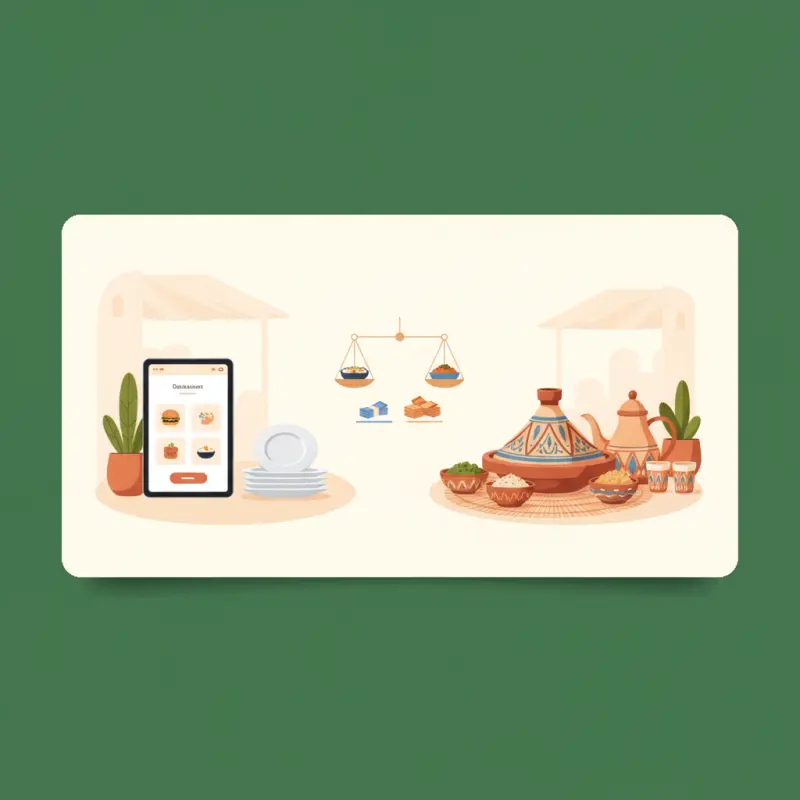
Odoo Restaurant's 69 EUR base price multiplies quickly with hidden costs that most Moroccan restaurants don't anticipate. Odoo restaurant implementations typically cost 350-450 EUR monthly after adding required users, modules, payment processing at 2.9%, and implementation fees of 800-1,500 EUR per day. A restaurant in Agadir processing 50,000 MAD monthly pays approximately 71,400 MAD annually with Odoo plus processing fees. Commission-based platforms like Glovo or Jumia Food charge 25-35% per order, costing 150,000 MAD annually on the same revenue. OCHI's flat monthly fee eliminates commission and processing markups entirely. Calculate your actual monthly software costs including all modules, users, and processing fees before choosing any restaurant platform.
Table of Contents
A restaurant owner in Agadir's Marina district discovered her delivery platform was eating 35% of every order — more than her rent. This isn't unusual. Most Moroccan restaurants choosing between Odoo Restaurant and commission-based platforms face the same math problem: powerful software that costs more than it saves.
The real question isn't which platform has more features. It's which one leaves more money in your pocket while actually running your restaurant.
Commission Models: The Real Cost of Running Your Restaurant
Restaurant software pricing hides in complexity. Odoo Restaurant starts at 69 EUR monthly for their POS module. Sounds reasonable until you add the costs they don't advertise upfront.
Odoo's Hidden Costs Beyond the Base Price
That 69 EUR base price covers one user. Add your cashier, kitchen manager, and delivery coordinator — you're at 207 EUR monthly. Need the inventory module to track ingredients? Another 45 EUR. Want customer loyalty features? Add the CRM module.
Then come the real surprises. Payment processing runs 2.9% plus fees. Third-party delivery integration requires custom development or expensive connectors. Implementation consultants charge 800-1,500 EUR per day. Training your staff in Darija or Moroccan French? Budget for local trainers.
A typical Agadir restaurant with three terminals, five users, and basic modules pays 350-450 EUR monthly — before processing fees or implementation costs.
OCHI's Zero-Commission Reality Check
OCHI charges restaurants a flat monthly fee. No commission on orders. No percentage of revenue. No processing markups. The price you see is what you pay.
For a restaurant processing 50,000 MAD monthly through online orders, the math becomes clear:
| Platform Model | Monthly Cost at 50,000 MAD Revenue | Annual Cost |
|---|---|---|
| Commission Platform (25%) | 12,500 MAD | 150,000 MAD |
| Odoo + Processing (2.9%) | 4,500 MAD + 1,450 MAD | 71,400 MAD |
| OCHI Flat Fee | Fixed monthly rate | No revenue percentage |
Every additional dirham of revenue on OCHI stays with the restaurant. On commission platforms, growth means higher fees.
Break-Even Analysis for Moroccan Restaurants
During Ramadan, Agadir restaurants see order volumes triple. A restaurant doing 150,000 MAD that month pays 37,500 MAD in commission fees alone — enough to hire three additional staff members.
Summer tourism pushes similar spikes. Marina and beachfront restaurants processing 200,000 MAD monthly lose 50,000 MAD to commissions. With Odoo's percentage-based processing, they'd pay 5,800 MAD plus subscription costs.
The break-even point depends on order volume. Restaurants processing over 20,000 MAD monthly save money with flat-fee models. Above 50,000 MAD, the savings become substantial.
Quick check · 3 questions
Is OCHI right for your restaurant?
Step 1 of 3
How do you currently take online orders?
Local Market Fit: Morocco-Specific Features That Matter
International restaurant platforms often stumble on Morocco's unique market dynamics. What works in Paris or Dubai doesn't translate to Casablanca or Marrakech.
Payment Methods Moroccan Customers Actually Use
Cash remains king in Morocco. Over 70% of restaurant transactions happen in cash, especially for delivery orders. Odoo Restaurant, designed for European markets, assumes card payments as default. Their cash handling requires workarounds and manual reconciliation.
OCHI built cash-on-delivery into its core flow. Delivery drivers see cash collection amounts. The POS automatically tracks cash movements. End-of-shift reports reconcile cash against orders without manual counting.
Mobile money adoption grows monthly. Orange Money and inwi money users expect seamless payment. While Odoo requires third-party payment gateway integration, OCHI includes local payment methods in the standard setup.
Arabic Language and Local Customization
Your kitchen staff speaks Darija. Your customers order in Arabic or French. Your receipts need both languages for tax compliance. Odoo offers Arabic translation, but right-to-left support remains inconsistent. Menu items display correctly; reports and analytics often break.
OCHI handles Arabic natively. Menus, order tickets, customer receipts — everything supports proper RTL display. Staff can switch between Arabic, French, and English per user preference. Even SMS notifications respect language settings.
Ramadan and Holiday Operations
Ramadan transforms restaurant operations. Lunch service stops. Iftar creates massive order spikes at sunset. Suhoor runs past midnight. Standard restaurant software struggles with these patterns.
Odoo's scheduling assumes consistent daily operations. Changing hours requires manual updates. Special Ramadan menus need workarounds in the standard catalog structure.
OCHI includes Ramadan mode. Set iftar and suhoor timings once. The platform automatically adjusts order acceptance, delivery estimates, and kitchen prep times. Special occasion menus activate on scheduled dates.
Feature Comparison: What Actually Runs a Restaurant
Feature lists tell partial truths. What matters is how features handle real restaurant chaos — the dinner rush, the modified orders, the arguing customers.
Kitchen Display and Order Management
Odoo Restaurant runs KDS through dedicated terminals. Each kitchen station needs hardware, licenses, and network setup. Orders appear on screens, but modifying items mid-preparation requires manager overrides.
OCHI's cloud-based KDS works on any Android tablet. Kitchen staff update item status with finger taps. When customers change their tagine order from chicken to lamb, the modification flows instantly to the correct station. The waiter sees the change confirmed without leaving the dining room.
Table Management for Moroccan Dining Culture
Moroccan families dine in groups. Eight to 12 people sharing multiple dishes, ordering throughout the meal, splitting bills in complex ways. This isn't edge-case behavior — it's standard Friday lunch.
Odoo handles tables as units. Splitting orders requires manual itemization. Adding dishes mid-meal creates new tickets. The European assumption of starter-main-dessert sequences conflicts with Moroccan communal dining.
OCHI built for this reality. Tables merge and split dynamically. Orders attach to seats or share across the table. The traditional tea service — multiple pots over hours — tracks without creating billing confusion.
Staff Management and Roles
Odoo's permission system follows enterprise software patterns. Create user groups, assign permissions, configure access rights. Powerful but complex. Training a new waiter takes hours of permission configuration.
OCHI defines eight restaurant-specific roles. Select "Waiter" and they access tables, orders, and bills. Choose "Chef" for kitchen display only. No configuration needed. A branch manager in Agadir can onboard evening shift staff in five minutes.
Implementation Reality: Time and Complexity
Software demos run on perfect data in controlled environments. Real restaurants have messy menus, staff turnover, and owners who need systems working yesterday.
Setup Timeline and Business Disruption
Odoo Restaurant implementation follows enterprise timelines. Consultants scope requirements (one week). Configure modules and permissions (two weeks). Import and clean menu data (one week). Train staff on all modules (one week). Test and go live (one week).
Six weeks if everything goes smoothly. Longer when consultants discover your menu structure doesn't fit their taxonomy, or your Ramadan operations need custom workflows.
OCHI activates the same day you sign up. Upload your menu Excel file. Set delivery zones on a map. Your restaurant.ochi.ma subdomain goes live immediately. Staff training happens through the interface — each role sees only what they need.
Technical Requirements and Support
Odoo requires serious infrastructure. Database servers, backup systems, network reliability. When the internet drops during Friday dinner rush, Odoo stops working. Cloud synchronization means cloud dependency.
OCHI runs offline-first. Orders continue through local networks. When internet returns, everything syncs automatically. Critical for Moroccan restaurants where fiber cuts happen weekly.
Support makes the real difference. Odoo's English-first documentation assumes technical knowledge. Finding Darija-speaking consultants who understand restaurant operations proves difficult and expensive.
OCHI provides 24/7 support in Arabic and French. The team knows Moroccan restaurants because they built for Moroccan restaurants. When you call about iftar rush problems, they understand immediately.
The Contrarian Take: Why "Enterprise" Features Can Hurt Small Restaurants
More features sound better until they create more problems. Moroccan restaurants need tools that work, not platforms that require IT departments.
Over-Engineering for Moroccan Restaurant Needs
Odoo includes manufacturing workflows, project management, and recruitment modules. For restaurants, this creates confusion. Staff click wrong modules. Settings hide in subsections of subsections.
The inventory module illustrates the problem. Odoo tracks raw materials through production workflows designed for factories. Recording that you used 2kg of tomatoes for today's tagines requires purchase orders, stock moves, and production orders. Most restaurants give up and track inventory in notebooks.
OCHI's inventory stays simple. Add ingredients, build recipes, track usage automatically through orders. No manufacturing workflows because restaurants aren't factories.
OCHI's Focused Approach vs Odoo's Everything-Platform
Odoo Restaurant exists as one module among dozens. This creates powerful integration possibilities and operational complexity. Your restaurant data mingles with CRM, accounting, and HR modules you don't use but still navigate around.
OCHI does one thing: run restaurants profitably. Every feature, every screen, every workflow serves that goal. No distractions, no confusion, no features that sound impressive but waste time.
The question isn't whether Odoo Restaurant or OCHI has more features. It's which platform helps you serve more customers while keeping more profit. For Moroccan restaurants tired of feeding commission platforms instead of customers, that answer becomes clear.
See what OCHI can do for your restaurant at ochi.ma/partners.
Frequently Asked Questions
What does Odoo Restaurant actually cost for a Moroccan restaurant?
Odoo Restaurant starts at 69 EUR monthly but typical implementations cost 350-450 EUR monthly. This includes multiple users, required modules like inventory and CRM, plus 2.9% payment processing fees and implementation costs.
Does Odoo Restaurant charge commission on orders?
Odoo Restaurant doesn't charge commission on orders, but charges monthly subscription fees plus 2.9% payment processing fees. The total cost often exceeds commission-based platforms for smaller restaurants.
Can Moroccan restaurants use Odoo Restaurant in Arabic?
Odoo supports Arabic language but requires local training and setup. Most Moroccan restaurants need consultants who speak Darija or Moroccan French, adding to implementation costs.
How does OCHI compare to Odoo Restaurant for delivery management?
OCHI includes GPS delivery tracking, driver management, and branded ordering pages at a flat monthly rate. Odoo Restaurant requires additional modules and third-party integrations for similar delivery features.
Restaurant owners · Weekly
The guide to running a restaurant in 2026.
One article per week. No commission advice. Just honest operational insight for Moroccan restaurants.

Blog Manager
Comments
No comments yet. Be the first to share your thoughts.