AI Overview
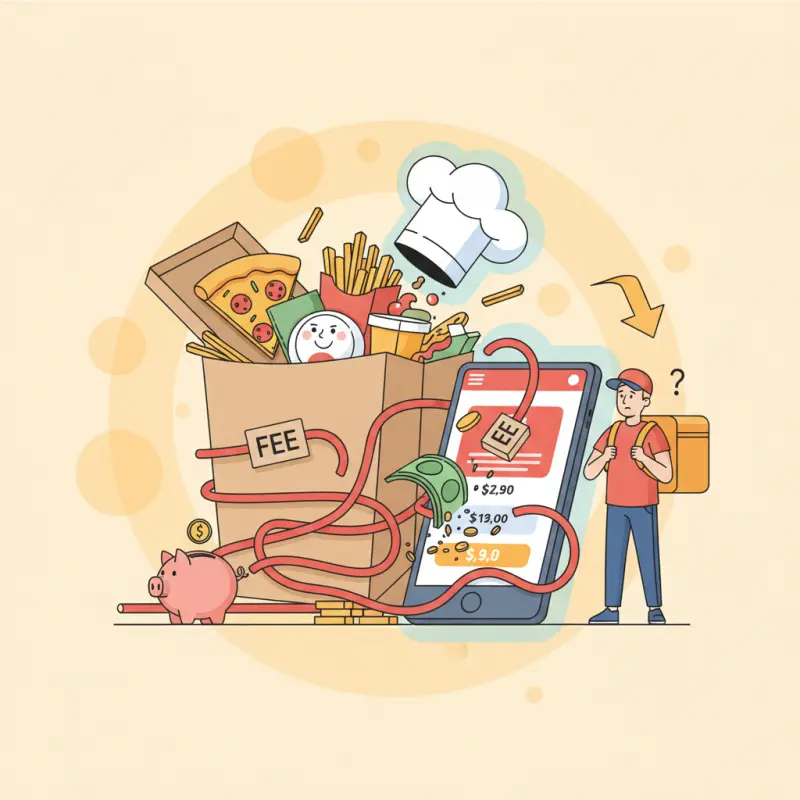
Most restaurants lose money on every delivery order despite growing volumes because commission-based platforms eat their margins. A typical 120 MAD order on an online food ordering and delivery platform loses restaurants money after 30% commissions, payment fees, and promotional costs are deducted. In Morocco, restaurants pay up to 45.60 MAD in fees on a 120 MAD order, leaving only 74.40 MAD before food costs and overhead. Only three restaurant types profit consistently: ghost kitchens with no dining overhead, fast food chains with negotiated rates, and high-ticket restaurants where large orders absorb the commission impact. The solution isn't better marketing or technology — it's finding platforms that don't charge commissions. Commission-free platforms like OCHI let restaurants keep 100% of their revenue while still accessing online ordering tools.
Table of Contents
Why Most Restaurants Fail at Online Ordering (It's Not What You Think)
Three out of four Moroccan restaurants lose money on delivery orders — even as their order volumes grow. The problem isn't the technology or the marketing. It's the math.
Restaurant owners in Agadir and Casablanca are discovering a brutal truth: you can be busy and broke at the same time. Every order that comes through a traditional online food ordering and delivery platform looks like revenue. But when you subtract the 30% commission, the payment fees, and the promotional costs, you're often left with less profit than a dine-in customer who orders just water and bread.
The 30% Commission Trap
Here's what happens to a typical 120 MAD order on commission-based platforms. First, the platform takes 30% — that's 36 MAD gone. Then payment processing takes another 3% (3.60 MAD). If you're running a promotion to stay visible, add 2-5% more (up to 6 MAD). You're left with 74.40 MAD from that 120 MAD order.
Now factor in your food cost (typically 30-35%), labor, packaging, and overhead. That profitable order just became a loss leader. Multiply this by hundreds of orders per month, and you understand why busy restaurants are closing their doors.
Why "Easy Setup" Usually Means "Expensive Operations"
Platforms promise setup in 24 hours. What they don't mention: you'll need to restructure your entire operation to make their model work. Your kitchen needs separate prep areas for delivery. Your staff needs new workflows. Your menu needs delivery-friendly modifications.
The real cost isn't the setup — it's the ongoing operational changes that eat into your margins every single day.
The Three Types of Restaurants That Actually Profit
Only three restaurant models consistently profit from traditional delivery platforms. Ghost kitchens with no dining overhead. Fast food chains with negotiated commission rates. High-ticket restaurants where a 30% commission on a 400 MAD order still leaves room for profit.
Everyone else is trading profit for volume, hoping to make it up somewhere that doesn't exist.
Food cost calculator
What’s your real margin?
Food cost
29.2%
Gross margin
70.8%
Profit / dish
85 MAD
Healthy · under 30%
Digitize your menu with OCHIThe Real Cost of Going Digital: Beyond Commission Fees
Let's talk real numbers — what Moroccan restaurant owners actually pay each month across different platform models.
Commission-Based Platforms: The Hidden Math
| Cost Component | Percentage | Amount per 120 MAD Order | Monthly Cost (500 orders) |
|---|---|---|---|
| Platform Commission | 30% | 36 MAD | 18,000 MAD |
| Payment Processing | 3% | 3.60 MAD | 1,800 MAD |
| Marketing/Promotion Fees | 2-5% | 2.40-6 MAD | 1,200-3,000 MAD |
| Tablet Rental | Fixed | - | 300-500 MAD |
| Total Platform Cost | 35-38% | 42-45.60 MAD | 21,300-23,300 MAD |
A restaurant doing 500 delivery orders monthly loses over 20,000 MAD to platform fees alone. That's a full-time employee's salary disappearing into commission structures.
Subscription Platforms: What You Really Pay
Subscription models promise lower commissions (15-20%) for a monthly fee (2,000-5,000 MAD). But add the payment processing, marketing fees, and that monthly subscription, and you're often paying the same 30-35% — just structured differently.
The psychology changes though. That upfront subscription feels painful, while per-order commissions hide in your daily operations. Neither model solves the core problem: platforms taking too much of your revenue.
Self-Hosted Solutions: The True Setup Cost
Building your own ordering system seems attractive until you price it out. Development: 50,000-150,000 MAD. Annual hosting and maintenance: 12,000-24,000 MAD. Payment gateway integration: 5,000 MAD plus 2.5-3% per transaction. Marketing to drive traffic to your unknown website: infinite.
You'll spend six months and six figures to build what already exists, then compete against platforms spending millions on customer acquisition.
Platform Types Decoded: Which Model Fits Your Restaurant
Not all online food ordering and delivery platforms work the same way. Understanding the differences determines whether you'll profit or just stay busy.
Marketplace Platforms (High Volume, Low Margins)
Marketplaces aggregate restaurants into one app where customers compare prices and reviews. You get volume but lose control. Your carefully crafted tagine sits next to fast food burgers, competing on delivery time and discount depth.
These work for restaurants already operating on thin margins with high table turnover — think shawarma shops and pizza chains. For a traditional Moroccan restaurant in Marrakech's medina, the model destroys what makes you special.
Branded Ordering Systems (Control vs. Cost)
Branded platforms give you your own ordering website and apps. Customers order directly from you, not a marketplace. You control the experience, pricing, and customer data. But you also handle all marketing to drive traffic.
This model suits established restaurants with strong local followings. A beachfront restaurant in Agadir with 10 years of tourists doesn't need marketplace discovery — they need efficient ordering for existing fans.
Commission-Free Platforms (Morocco's Growing Alternative)
Zero-commission platforms like OCHI flip the model. Restaurants pay a subscription or transaction fee, but keep 100% of order revenue. Same prices as your menu, no markup for customers, no commission bleeding your margins.
The math is simple: pay 2,000 MAD monthly to keep all revenue, or pay 20,000 MAD in commissions to make platforms rich. Moroccan restaurants choosing independence are discovering they can be busy AND profitable.
The 90-Day Implementation Reality Check
Here's what actually happens when you launch online ordering — the timeline nobody shares upfront.
Week 1-2: Technical Setup (The Easy Part)
Platform onboarding takes 2-3 days. Menu upload, photos, delivery zones — all straightforward. You'll feel productive. This is the honeymoon phase where everything seems possible.
Reality check: you've completed maybe 10% of the actual work.
Week 3-8: Operations Overhaul (The Hard Part)
Now the real work begins. Kitchen workflows need complete redesign to handle simultaneous dine-in and delivery orders. Staff needs training on new systems — expect resistance and mistakes. Packaging suppliers need sourcing and testing. Food quality standards need adjustment for 20-minute delivery windows.
This phase breaks most restaurants. It's where that "easy setup" becomes operational chaos.
Week 9-12: Marketing and Customer Acquisition (The Expensive Part)
Your platform is live but orders trickle in. Marketplace platforms bury new restaurants without promotional spending. Branded platforms need aggressive marketing to drive awareness. You'll burn through marketing budget trying to get noticed.
First profitable month? Usually month four, if you survive the cash flow crunch.
Month 4+: When You Actually Start Making Money
After three months of chaos and expense, patterns emerge. Kitchen workflows stabilize. Staff becomes efficient. Regular customers develop ordering habits. You finally understand which menu items travel well and which don't.
But if you're on a 30% commission platform, "making money" might still mean losing money. The math doesn't change just because operations improved.
Morocco's Restaurant Tech Revolution: Why Zero-Commission Wins
Something shifted in Morocco's restaurant industry during 2025. Restaurant owners started doing the math. They realized that paying technology to enable orders makes sense. Paying technology 30% of revenue forever doesn't.
Why Moroccan Restaurants Are Choosing Independence
A traditional restaurant in Casablanca shared their numbers: 40,000 MAD monthly in platform commissions. That's 480,000 MAD yearly — enough to hire two full-time delivery drivers, buy a delivery vehicle, and still have money left over. Instead, they were funding platform profits.
Zero-commission platforms let restaurants invest in their own growth, not platform valuations.
The Agadir Success Stories
Agadir's beachfront restaurants pioneered the shift. They already had customer traffic — tourists walking the corniche. They needed ordering efficiency, not discovery. Moving to commission-free systems, they kept the 30% that platforms would have taken and reinvested in better ingredients and staff.
Customer prices stayed the same. Restaurant profits increased. The model proved that platforms don't need to be parasitic to be profitable.
Platform Features That Actually Matter for Local Operations
Moroccan restaurants need specific features that global platforms ignore. Multi-language support for Arabic, French, and English customers. QR code ordering for cafes where paper menus get soggy from beach air. Real-time inventory sync to prevent selling out of daily specials. Branded subdomains that build your restaurant's identity, not the platform's.
OCHI understood this, building features like {restaurant}.ochi.ma subdomains and integrated Arabic support from day one. When platforms are built for local needs, restaurants thrive instead of just survive.
The future of restaurant technology in Morocco isn't about choosing between independence and support. It's about platforms that provide powerful tools without taking ownership of your success. See what OCHI can do for your restaurant at ochi.ma/partners.
Frequently Asked Questions
Why do restaurants lose money on online food ordering and delivery platform orders?
Restaurants lose money because commission fees (typically 30%), payment processing (3%), and promotional costs can consume 35-45% of order value before covering food costs and overhead.
What commission do online food ordering and delivery platforms charge in Morocco?
Most online food ordering and delivery platforms in Morocco charge 25-30% commission per order, plus additional payment processing and promotional fees.
Which restaurants actually profit from delivery platforms?
Only ghost kitchens with no dining overhead, fast food chains with negotiated commission rates, and high-ticket restaurants with large average orders consistently profit from traditional delivery platforms.
How much does a 120 MAD delivery order actually earn restaurants?
After 30% commission, payment fees, and promotional costs, restaurants typically keep only 74.40 MAD from a 120 MAD order before covering food costs and labor.
Are there commission-free alternatives to traditional delivery platforms?
Yes, commission-free platforms like OCHI allow restaurants to keep 100% of their revenue while still providing online ordering, delivery management, and customer features.
Restaurant owners · Weekly
The guide to running a restaurant in 2026.
One article per week. No commission advice. Just honest operational insight for Moroccan restaurants.

Blog Manager
Comments
No comments yet. Be the first to share your thoughts.