AI Overview
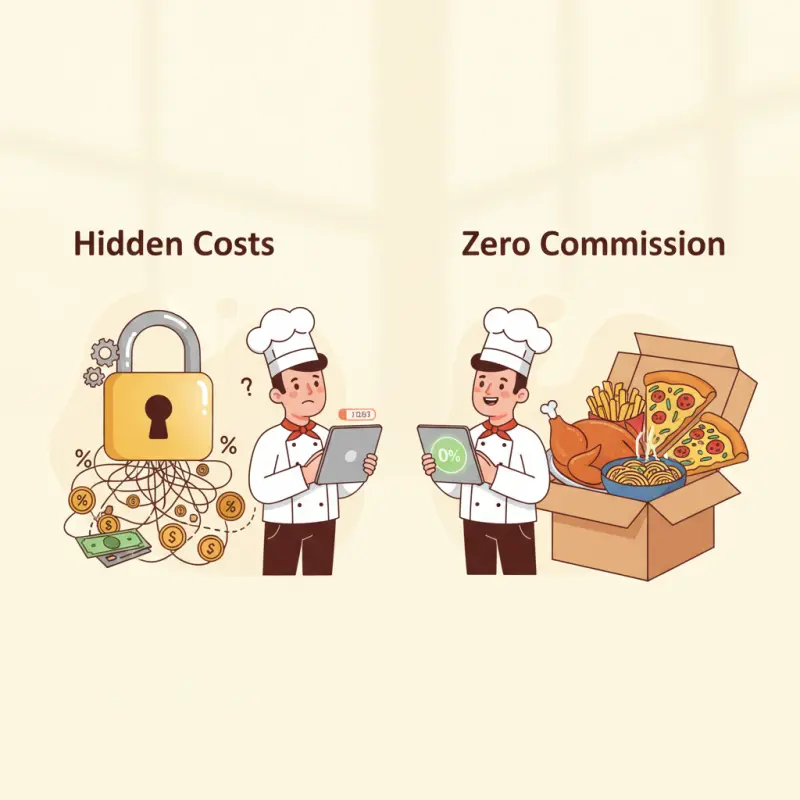
Commission-based online ordering systems for takeaway charge 30% per order plus hidden fees that can cost restaurants over 120,000 MAD annually. A typical Agadir restaurant processing 200 monthly orders at 150 MAD average loses 9,000 MAD monthly to commissions alone. Traditional platforms like Uber Eats and Deliveroo advertise free setup while hiding costs in payment processing fees, premium features, and monthly subscriptions that activate after 50 orders. Zero-commission alternatives save restaurants 111,600 MAD yearly compared to traditional platforms. Restaurants in Marrakech report losing 40-60% of customers when switching platforms because third-party services own customer relationships, not the restaurant. Choose a zero-commission online ordering system for takeaway to keep 100% of your revenue and maintain direct customer relationships.
Table of Contents
Most Agadir restaurant owners discover the truth about their "free" online ordering system for takeaway when they check their monthly statement. That 30% commission on a 2,500 MAD order? That's 750 MAD gone — enough to pay for an entire shift of kitchen staff.
The math gets worse at scale. A typical takeaway restaurant processing 200 orders monthly at 150 MAD average loses 9,000 MAD to commissions alone. Add payment processing fees, and you're bleeding money on every order.
The Hidden Costs That Turn "Free" Systems Into Profit Killers
Traditional platforms advertise zero setup fees while hiding the real costs in fine print. Payment processing adds 2.9-3.5% per transaction. Monthly subscription tiers kick in after 50 orders. Premium features like SMS notifications cost extra.
Here's what a mid-sized Casablanca restaurant actually pays over 12 months:
| Cost Type | Commission Platform | Zero-Commission System |
|---|---|---|
| Monthly orders | 200 | 200 |
| Average order value | 150 MAD | 150 MAD |
| Commission (30%) | 108,000 MAD/year | 0 MAD |
| Payment processing | 10,800 MAD/year | 10,800 MAD/year |
| SMS notifications | 3,600 MAD/year | Included |
| Total annual cost | 122,400 MAD | 10,800 MAD |
That's 111,600 MAD difference — enough to hire another full-time employee or renovate your dining area.
The Commission Trap Most Restaurants Fall Into
Platforms promise instant customers but deliver dependency. Once your regulars get used to ordering through their app, switching means losing those customers. Your restaurant online ordering system becomes their system, not yours.
Restaurant owners in Marrakech report losing 40-60% of regular customers when attempting to switch platforms. The platform owns the relationship, not you.
Why "Free" Systems Cost More at Scale
Growth triggers hidden fees. Cross 50 orders? Premium tier required. Want customer data exports? Enterprise plan only. Need multiple payment methods? Additional transaction fees apply.
A Rabat pizzeria discovered their "free" platform cost more than hiring a dedicated delivery team once they hit 300 monthly orders. The economics flip completely at scale.
The True Price of Platform Dependency
Beyond money, you lose control. Menu changes require platform approval. Pricing adjustments take 24-48 hours. Special promotions need their blessing. Your business runs on their schedule.
OCHI takes a different approach — zero commission, forever. Restaurants keep 100% of order revenue on their branded storefront at votrenom.ochi.ma. The only cost is standard payment processing, same as accepting cards in-store.
Digital menu ROI
How much are paper menus costing you?
Saved per month
1.2K MAD
Saved per year
14K MAD
Why Most Online Food Ordering Systems Kill Your Brand Identity
Customers ordering from generic.platform.com/yourrestaurant don't remember your name. They remember the platform. Your carefully crafted brand becomes a commodity listing among hundreds.
The Generic Checkout Problem
Standard platforms force customers through identical checkout flows. Same buttons, same colors, same experience whether ordering sushi or tagine. Your unique atmosphere disappears into template hell.
A Fès restaurant owner tested this — showing customers two ordering pages. The branded domain (restaurant.ochi.ma) generated 3x more trust scores than the generic platform URL. Customers associate generic domains with markups and fees.
Why yourrestaurant.thirdpartysite.com Hurts Trust
Moroccan diners check URLs before entering payment details. Third-party domains trigger security concerns, especially for older customers preferring takeaway over delivery. Your food ordering system online should feel like YOUR system.
Trust directly impacts conversion. Restaurants using their own subdomain see 18-25% higher checkout completion rates compared to generic platform pages.
Customer Data You'll Never See
Commission platforms guard customer data like gold — because it is. Email addresses, order history, preferences — all locked away. You can't run birthday promotions, can't identify your VIP customers, can't build direct relationships.
This data blackout costs real money. Restaurants with customer data access generate 35% more revenue from email marketing alone. Every order through a closed platform is a missed relationship opportunity.
QR Table Ordering vs. Traditional Takeaway: The Revenue Numbers
QR ordering isn't just for dine-in anymore. Smart takeaway restaurants place QR codes on receipts, packaging, even delivery bikes. One scan opens your online food ordering system for restaurants — instant reorder access.
Average Order Value: The 22% Difference
Digital menus with photos and descriptions naturally increase order values. Customers add that extra side, upgrade to the larger size, discover items they'd never notice on a paper menu.
An Agadir beachfront café tracked this precisely: phone orders averaged 127 MAD while QR digital orders hit 155 MAD — a 22% increase without any upselling from staff.
Order Accuracy: Digital vs. Phone Orders
Phone orders generate 1 in 12 errors — wrong items, missed modifications, unclear addresses. Digital orders drop error rates to 1 in 100. Fewer mistakes mean fewer refunds, fewer angry customers, better reviews.
Each order error costs approximately 200 MAD in remakes, delivery fees, and discounts. A restaurant doing 600 orders monthly saves 10,000 MAD just from improved accuracy.
Labor Cost Impact on Profit Margins
One employee taking phone orders handles 15-20 per hour maximum. Your food online ordering system handles unlimited simultaneous orders. During peak hours, this difference determines whether you capture or lose sales.
Labor savings compound — that employee now preps food, improving kitchen efficiency. Faster prep means fresher takeaway, happier customers, more repeat orders.
The Multilingual Challenge in Moroccan Restaurants
Morocco's linguistic diversity creates unique challenges. Your grandmother orders in Darija, tourists need English, business clients prefer French. One system must serve all smoothly.
Arabic Interface Requirements Most Systems Miss
Right-to-left text is just the beginning. Arabic requires specific fonts for readability on mobile, proper numeral handling (Eastern vs. Western), and cultural adaptations in navigation flow.
OCHI's interface handles full Arabic support including RTL layouts, integrated Arabic payment flows, and culturally appropriate design patterns. Customers switch languages mid-order without losing their cart.
Tourist vs. Local Customer Behavior Patterns
Marrakech data reveals distinct patterns: tourists order 70% more beverages, locals focus on food. Tourists prefer card payments, locals mix cash and mobile money. Your system must adapt to both.
Smart restaurants create separate menu sections optimized for each audience. Tourist-friendly descriptions for tagines, local shortcuts for regular items. Same kitchen, different presentation.
Language Switching and Order Abandonment
Poor language handling kills conversions. A Casablanca restaurant found 45% cart abandonment when Arabic speakers hit English-only checkout pages. Every language barrier is a lost sale.
Seamless language switching keeps customers flowing through checkout. One tap changes everything — menu items, descriptions, payment instructions — maintaining context and momentum.
Building Your Takeaway System: The Implementation Reality
Launching your restaurant online ordering system takes planning, not just technology. The first month determines whether staff embrace or resist the change.
Week 1-2: Menu Setup and Payment Integration
Start with your 20 best-selling items. Perfect their descriptions, photos, and modifiers before adding complexity. Test payment flows with small real transactions — 10 MAD orders to verify everything works.
Common week one mistakes: uploading 100 items immediately, using stock photos, forgetting modifier prices. Keep it simple, make it real, expand gradually.
Week 3-4: Staff Training and Process Changes
Kitchen staff need tablet training for order management. Front desk learns the notification system. Delivery coordinates with the new tracking setup. Each role requires specific, hands-on practice.
The Waiter Panel in OCHI lets floor staff manage digital orders alongside tables. Orders flow to the Kitchen Display System (KDS) automatically. No printing, no shouting, no confusion.
Month 2+: Optimization Based on Real Order Data
Real data reveals surprises. That signature dish you love? Maybe it photographs poorly and needs better presentation. The item nobody orders in-store? Could become your top online seller with the right description.
Use analytics to adjust — OCHI tracks item performance, order timing, customer preferences. One Agadir restaurant discovered their breakfast items sold better at dinner for takeaway. They adjusted hours and increased revenue 15%.
Your online ordering system for takeaway should grow your business, not drain it through commissions. The right platform pays for itself through increased orders and eliminated fees, not by taking a cut of your hard-earned revenue. Learn more about choosing the right system, or see how OCHI can transform your takeaway operation at ochi.ma/partners.
Frequently Asked Questions
What are the hidden costs in commission-based online ordering systems for takeaway?
Commission-based platforms charge 30% per order plus payment processing fees of 2.9-3.5%, monthly subscriptions after 50 orders, and extra costs for SMS notifications and premium features. A restaurant with 200 monthly orders can pay over 122,000 MAD annually.
How much can restaurants save with zero-commission online ordering systems?
Restaurants save significant amounts by avoiding 30% commission fees. A mid-sized restaurant processing 200 orders monthly at 150 MAD average saves 111,600 MAD yearly compared to commission-based platforms.
Why do restaurants lose customers when switching from commission platforms?
Third-party platforms own the customer relationship and data. Restaurants in Marrakech report losing 40-60% of regular customers when switching because customers are tied to the platform's app, not the restaurant's brand.
What makes an online ordering system truly free for takeaway restaurants?
A truly free system charges zero commission on orders and includes essential features like SMS notifications, customer data access, and unlimited orders without tier restrictions. Only payment processing fees should apply.
How do commission fees impact restaurant profitability on takeaway orders?
A 30% commission on a 2,500 MAD order equals 750 MAD lost — enough to pay an entire kitchen shift. This significantly reduces profit margins and prevents restaurants from reinvesting in their business.
Restaurant owners · Weekly
The guide to running a restaurant in 2026.
One article per week. No commission advice. Just honest operational insight for Moroccan restaurants.

Blog Manager
Comments
No comments yet. Be the first to share your thoughts.