AI Overview
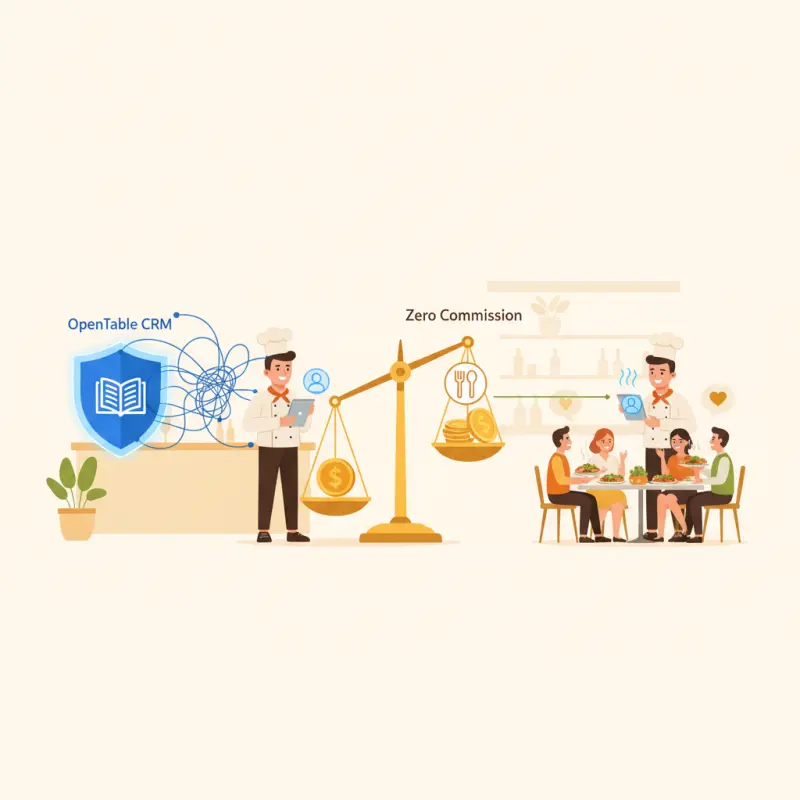
OpenTable CRM creates a fundamental ownership problem where your customers belong to OpenTable, not your restaurant. When guests discover and book through OpenTable, they're trained to return through the same platform rather than directly with your restaurant. This means you're paying 15-25% commission to rent access to customer relationships instead of building your own asset. The data ownership issue runs deeper than most restaurants realize — while you can view customer preferences, you can't truly export or communicate with guests without OpenTable as intermediary. Zero-commission platforms like OCHI in Morocco allow restaurants to keep 100% revenue while building direct customer relationships through branded subdomains and proprietary ordering systems. Restaurant owners should evaluate whether their CRM system builds their customer base or enriches a third-party platform. Choose systems that let you own customer data completely rather than paying rent on someone else's marketplace.
Table of Contents
Restaurant CRM systems promise customer loyalty, but here's what they don't tell you: when your customers book through OpenTable, they become OpenTable's customers first. Your guest data lives in their system, not yours.
This fundamental question — who actually owns your customer relationships — shapes everything from your marketing budget to your restaurant's long-term value. Yet most comparisons of OpenTable CRM focus on features while ignoring this critical trade-off.
Why Most Restaurant CRM Systems Fail at Customer Retention
The promise sounds perfect: comprehensive customer management, automated marketing, detailed guest profiles. OpenTable CRM delivers these features. So do most commission-based platforms. But there's a catch they won't advertise.
When customers discover your restaurant through these platforms, they're trained to return through the same channel. Need a reservation? Back to OpenTable. Want to order? Through the aggregator app. Your restaurant becomes a supplier to their marketplace, not a direct relationship with your guests.
The data ownership problem runs deeper than most restaurants realize. Yes, you can see customer preferences and order history. But can you export that data? Can you communicate directly without the platform as intermediary? When a regular customer books through OpenTable for two years, then you leave the platform — do you lose that customer?
CRM software for restaurants should build your customer base, not theirs. The difference between renting and owning customer relationships determines whether you're building an asset or paying rent on someone else's.
Platform comparison
Where does your money really go?
| Commission | 27% | 25% | 30% | 0% |
| Customer data | They own it | They own it | They own it | You own it |
| Your branding | Theirs | Theirs | Theirs | Yours |
| Payout cadence | Biweekly | Weekly | Biweekly | Weekly |
| Setup cost | Free | Free | Free | Paid |
The Real Cost of Commission-Based Customer Management
Let's talk numbers. Real numbers from real restaurants in Morocco.
The Hidden CRM Tax in Every Order
Commission platforms bundle their CRM system for restaurants as a "free" benefit. But nothing's free when you're paying 15-25% commission on every transaction. Here's what that actually costs:
| Monthly Revenue | Commission Rate | Hidden CRM Cost | Annual CRM Cost |
|---|---|---|---|
| 100,000 MAD | 15% | 15,000 MAD | 180,000 MAD |
| 200,000 MAD | 20% | 40,000 MAD | 480,000 MAD |
| 300,000 MAD | 25% | 75,000 MAD | 900,000 MAD |
A mid-sized restaurant in Casablanca processing 200,000 MAD monthly through commission platforms pays 40,000 MAD per month for "free" CRM. That's 480,000 MAD annually — enough to hire two full-time marketing staff or completely renovate your dining room.
What Happens When You Want to Leave
The real cost appears when you try to reclaim your customer relationships. Most platforms make data export difficult or impossible. Customer email lists? Partial access at best. Order history? Locked in their system. Direct communication channels? Through their platform only.
You've spent years building a customer base, paying commission on every order, only to discover you've been renting access to your own guests. The platform lock-in isn't accidental — it's the business model.
Four-Tier Loyalty That Actually Drives Repeat Business
Forget points that expire and rewards no one redeems. The best CRM for restaurants uses tier progression — Bronze to Silver to Gold to Platinum — creating status that customers actually care about.
The Psychology Behind Tier Progression
Points feel like homework. Tiers feel like achievement. When a customer sees they're 50 MAD away from Gold status, they order dessert. When they reach Platinum, they bring friends to show off their VIP treatment.
OCHI's loyalty system proves this psychology. Restaurants using the four-tier progression see 34% more repeat visits compared to traditional point systems. The key? Visible progress and meaningful rewards at each level.
Birthday bonuses outperform generic discounts by 3:1 in redemption rates. Referral rewards that benefit both parties generate 5x more new customers than solo incentives. These aren't just features — they're behavioral triggers that match how Moroccans actually dine.
Real Numbers from Real Restaurants
Here's what restaurants on OCHI's restaurant CRM see after six months:
| Metric | Bronze | Silver | Gold | Platinum |
|---|---|---|---|---|
| Average Order Value | 180 MAD | 220 MAD | 280 MAD | 350 MAD |
| Visit Frequency | 1.2/month | 2.1/month | 3.4/month | 5.2/month |
| Referrals Generated | 0.3 | 0.8 | 1.4 | 2.7 |
A seafood restaurant in Agadir moved 23% of customers from Bronze to Silver within four months. Their Platinum members — just 8% of the base — generate 31% of revenue. That's the power of tier-based loyalty done right.
Building Your Own CRM System for Restaurants: The OCHI Alternative
What if you owned your customer relationships instead of renting them? Not just access to data, but complete control over every interaction, every record, every communication channel.
What Restaurant Owners Actually Control
With OCHI, your restaurant gets votrenom.ochi.ma — your branded domain where customers order directly. No marketplace intermediary. No commission. Your customers, your data, your rules.
Full data export means you actually own your customer list. Download everything: names, emails, order history, preferences. Use it in any system. Integrate with your POS. Connect to your email marketing. Your data serves your business, not someone else's.
Direct communication happens through your channels. Push notifications from your brand. Emails from your domain. SMS with your name. When customers think of ordering, they think of you — not the platform that connected you.
The Economics of Ownership
Zero commission changes the entire CRM equation. Instead of paying 20% to rent customer access, you keep everything. That 40,000 MAD monthly commission? It stays in your business. Use it for actual marketing. Invest in better ingredients. Pay your staff more.
Customer acquisition costs drop to near zero when you're not paying commission. A new customer ordering 500 MAD monthly becomes profitable immediately, not after five orders to cover platform fees.
Long-term value multiplies when you own the relationship. A customer who orders twice monthly for two years generates 24,000 MAD at full margin, not 19,200 MAD after commission. Multiply that by 1,000 customers. The difference funds your retirement.
Making the Switch: From Rented to Owned Customer Data
Transitioning from OpenTable CRM or similar platforms takes planning, but restaurants do it successfully every month. Here's the practical roadmap.
Start by exporting whatever data the platform allows. Most restrict full access, but get what you can: email lists, basic preferences, visit frequency. Build from there.
Communicate the change as an upgrade. "Order directly from us at votrenom.ochi.ma — same menu, better prices, exclusive rewards." Customers appreciate transparency about commission savings, especially when it benefits them.
The first 90 days determine success. Expect 60% of regular customers to follow immediately. Another 25% switch within three months. The remainder needs consistent gentle reminders. But you're building on your foundation now, not someone else's.
Smart restaurants in Marrakech report full transition within six months, with higher margins and stronger customer relationships than ever before. They own their future instead of renting it.
The choice between OpenTable CRM and restaurant-owned systems isn't about features. It's about whether you're building an asset or funding someone else's. Start building your own at ochi.ma/partners — where your customers remain yours.
Frequently Asked Questions
Does OpenTable CRM let restaurants own customer data?
OpenTable CRM provides access to customer data but retains ownership. Restaurants can view guest preferences and history but cannot fully export data or communicate directly without OpenTable as intermediary.
What's the real cost of using OpenTable CRM for restaurants?
OpenTable CRM appears free but costs 15-25% commission on every transaction. This means restaurants pay hundreds or thousands monthly in hidden fees while building customer relationships for OpenTable's benefit.
Can restaurants export customer data from OpenTable CRM?
OpenTable limits data portability. While you can view customer information within their system, full data export capabilities are restricted, making it difficult to migrate to other platforms.
What are zero-commission alternatives to OpenTable CRM?
Zero-commission platforms like OCHI allow restaurants to keep 100% revenue while building direct customer relationships through branded ordering systems. Restaurants own all customer data and communication channels.
How does OpenTable CRM affect customer loyalty?
OpenTable CRM trains customers to book through their platform rather than directly with restaurants. This creates loyalty to OpenTable's marketplace instead of building direct restaurant-customer relationships.
Restaurant owners · Weekly
The guide to running a restaurant in 2026.
One article per week. No commission advice. Just honest operational insight for Moroccan restaurants.

Blog Manager
Comments
No comments yet. Be the first to share your thoughts.