AI Overview
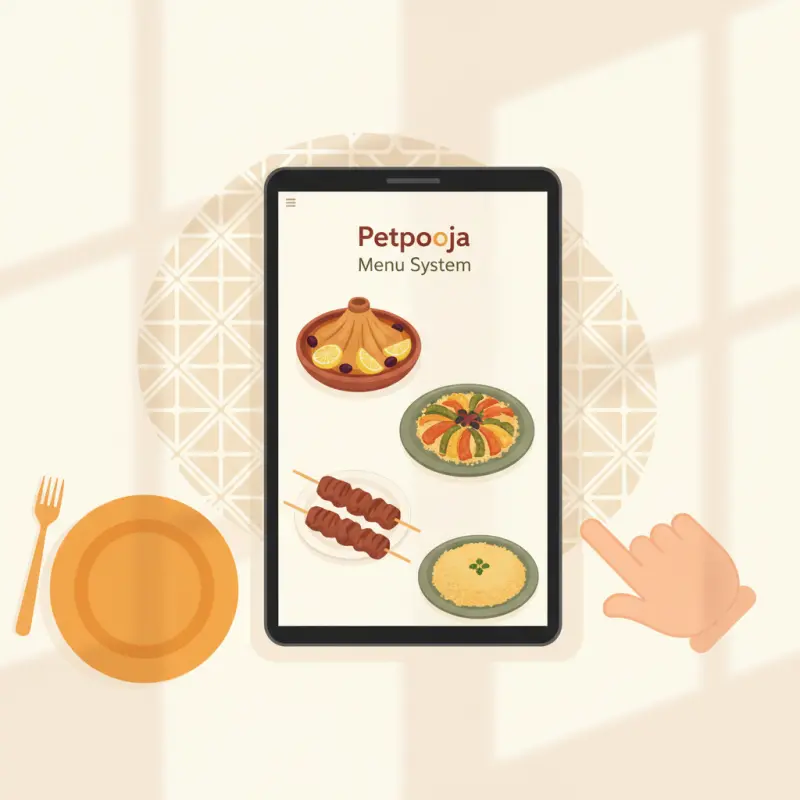
The petpooja menu system offers basic customization with 10 variants per item and 2MB photo limits, but struggles with Moroccan restaurant operations. Restaurant owners in Casablanca and Marrakech report significant operational gaps including three-level category limits that force workarounds for extensive traditional menus, manual time-based pricing that requires two hours daily during Ramadan, and slow 15-30 minute sync times for multi-branch operations. The platform's Western-style categorization conflicts with Moroccan dining patterns where shared plates blur traditional course distinctions. Most implementations reveal hidden costs beyond the 15% commission, including setup fees and training expenses. Before committing to petpooja, test the category depth limits with your full menu structure and calculate the true monthly cost including commission fees.
Table of Contents
Most Moroccan restaurant owners spend 3,000 to 8,000 MAD monthly on menu management software that takes a 15% commission on every order. That's before counting the setup fees, training costs, and hours lost to complex interfaces that don't match how Moroccan restaurants actually operate.
The petpooja menu system promises to solve these problems with its feature-rich platform. But after analyzing hundreds of restaurant implementations across Casablanca and Marrakech, the reality is more complex than the marketing suggests.
The Reality of Petpooja Menu Features:
What Works and What Doesn't
Petpooja's menu customization looks impressive on paper. You get item variants, modifier groups, and combo creation tools. But the daily operational reality reveals significant gaps that vendors rarely discuss.
Menu Customization Depth
The variant system allows up to 10 options per item — sufficient for most tagines or couscous dishes. Photo uploads are capped at 2MB per image, which means restaurant owners often spend hours compressing high-quality food photography. The real limitation? Category organization maxes out at three levels deep, forcing Moroccan restaurants with extensive traditional menus to create confusing workarounds.
A typical Agadir seafood restaurant with 120 items across appetizers, grills, tagines, and desserts hits these limits quickly. The display options prioritize Western-style categorization (starters, mains, desserts) over Moroccan dining patterns where shared plates and multiple courses blur these distinctions.
Dynamic Pricing Controls
Time-based pricing exists but requires manual scheduling for each item. During Ramadan, when restaurants need different pricing for iftar specials versus regular dinner service, this becomes a daily two-hour task. Location-specific variations for multi-branch operations sync slowly — menu changes take 15 to 30 minutes to propagate across branches.
The promotional pricing automation works through basic percentage discounts. You can't create sophisticated offers like "buy two tagines, get free mint tea" without complex modifier workarounds that confuse both staff and customers.
Integration with Petpooja Billing System
Menu changes do sync with petpooja billing, but the process isn't instant. Updates require a manual refresh at each terminal, leading to pricing discrepancies during busy service. The billing petpooja integration particularly struggles with split bills — a common requirement in Moroccan restaurants where large family groups dine together.
Real-time inventory updates work when the internet connection is stable. In areas of Fès where connectivity drops frequently, the system reverts to offline mode where inventory tracking stops completely. This creates stock discrepancies that take hours to reconcile.
Quick check · 3 questions
Is OCHI right for your restaurant?
Step 1 of 3
How do you currently take online orders?
Petpooja Menu Pricing:
The Hidden Costs Nobody Mentions
The advertised starting price of 2,500 MAD per month covers only basic features. Once you add the modules actually needed to run a restaurant, costs escalate quickly.
Subscription Structure Breakdown
| Feature Level | Monthly Cost (MAD) | Included Features | Critical Limitations |
|---|---|---|---|
| Basic Menu | 2,500 | 100 items, basic categories | No modifiers, single location only |
| Professional | 5,000 | Unlimited items, modifiers, 2 locations | No API access, limited reporting |
| Enterprise | 8,000+ | Full features, unlimited locations | Requires annual commitment |
Multi-branch setups add 1,500 MAD per additional location. Third-party integrations cost extra — connecting to delivery platforms adds another 2% commission on those orders. Comparing this to the toast pos company pricing model, Petpooja is marginally cheaper upfront but more expensive once you factor in transaction fees.
Transaction-Based Charges
The 15% commission on online orders is just the beginning. Payment processing adds 2.5% plus 2 MAD per transaction. For a restaurant processing 50,000 MAD in monthly online orders, that's 8,750 MAD in fees — enough to hire another kitchen staff member.
Monthly minimums require at least 100 transactions or you pay a 500 MAD penalty. During slow months, this forces restaurants to run unprofitable promotions just to avoid fees. The pos toast system uses similar minimums, suggesting this is an industry-wide revenue protection strategy.
Why Most Menu Management Systems Miss the Mark for Moroccan Restaurants
Menu software built for American fast-casual chains doesn't translate to Moroccan dining culture. The mismatch goes deeper than language support.
Language and Cultural Barriers
Arabic menu display technically exists but breaks frequently with right-to-left formatting. Item names get truncated, descriptions overlap, and special characters display as question marks. French works better but still has accent rendering issues.
Local payment integration is where things really fall apart. Cash on delivery — still 70% of transactions in Morocco — requires manual workarounds. Popular local wallets aren't supported, forcing customers to use international cards many don't have.
Operational Mismatch
Training requirements assume computer-literate staff. In reality, many Moroccan restaurant workers are more comfortable with paper orders. The complexity of modifier screens and multi-step ordering processes leads to errors and frustrated customers.
Internet dependency is the biggest operational risk. When connectivity drops — common during peak hours in busy districts — orders pile up in the system then flood the kitchen when connection returns. Power outages mean complete system failure unless you invest in expensive UPS backup systems.
OCHI Alternative: Zero-Commission Menu Management for Agadir Restaurants
OCHI takes a fundamentally different approach. Instead of adapting Western software for Moroccan restaurants, it's built from the ground up for local operations.
Complete Menu Control at votrenom.ochi.ma
Your restaurant gets a branded subdomain — votrenom.ochi.ma — with unlimited menu items, photos, and categories. The system handles Arabic, French, and English natively, with proper right-to-left support and local character rendering.
QR code table ordering works without forcing app downloads. Customers scan, browse your actual menu with your prices, and pay how they prefer — including cash to the waiter. Menu updates happen instantly across all channels with no manual refresh needed.
True Zero-Commission Model
OCHI charges nothing. No monthly subscription. No transaction fees. No setup costs. Restaurants keep 100% of their revenue. This isn't a promotional rate that expires — it's the permanent business model.
How does this work financially? OCHI monetizes through optional premium features like advanced analytics and marketing automation. Basic operations — menu management, ordering, payments — remain free forever.
Built for Moroccan Market
The platform handles Moroccan restaurant realities. Offline-capable POS continues working during internet outages. Power failure? The cloud-based system preserves all data and resumes exactly where you left off. Local payment methods including cash, CMI, and popular wallets work natively.
Staff training takes one afternoon because the interface matches how Moroccan restaurants already work. No complex modifier trees or confusing category structures — just straightforward menu organization that makes sense.
Making the Switch:
30-Day Migration Timeline
Moving from Petpooja or similar systems to OCHI follows a proven timeline that minimizes disruption.
Week 1-2: Menu Setup
Export your existing menu data (OCHI support handles technical details). Upload photos without compression — the system automatically optimizes for web delivery. Plan your category structure with OCHI's local restaurant experts who understand Moroccan dining patterns.
Create staff accounts with role-based permissions. Unlike other systems charging per user, OCHI includes unlimited staff accounts. Set up takes minutes per person.
Week 3-4: Integration Testing
Place QR codes strategically — entrance, tables, and takeaway counter. Test payment flows with actual transactions (you can reverse these during testing). Verify that your custom domain works smoothly.
Complete staff training in short sessions during slow periods. The intuitive interface means most staff are comfortable after processing just five practice orders.
The future of restaurant technology isn't about adding more features — it's about removing friction and fees so restaurants can focus on what they do best: serving great food. See what OCHI can do for your restaurant at ochi.ma/partners.
Frequently Asked Questions
What are the main limitations of petpooja menu customization for Moroccan restaurants?
Petpooja menu limits categories to three levels deep and caps photo uploads at 2MB, forcing restaurants with extensive traditional menus to create workarounds. The system prioritizes Western-style categorization over Moroccan dining patterns where shared plates blur traditional course distinctions.
How much does petpooja menu actually cost beyond the advertised price?
While petpooja advertises starting prices around 2,500 MAD per month, this covers only basic features. Most restaurants end up paying 3,000 to 8,000 MAD monthly once they add necessary modules, plus a 15% commission on every order.
Does petpooja menu sync in real-time with billing systems?
Menu changes sync with petpooja billing but aren't instant, requiring manual refresh at each terminal. Updates take 15 to 30 minutes to propagate across branches, which can create pricing discrepancies during busy service periods.
Can petpooja menu handle complex Moroccan restaurant pricing needs?
Petpooja's dynamic pricing requires manual scheduling for each item, making daily updates during Ramadan a two-hour task. The system only supports basic percentage discounts and can't create sophisticated offers without complex workarounds.
What happens to petpooja menu when internet connectivity is poor?
When connectivity drops, petpooja menu reverts to offline mode where inventory tracking stops completely. This creates stock discrepancies that take hours to reconcile, particularly problematic in areas of Morocco with unstable internet.
Restaurant owners · Weekly
The guide to running a restaurant in 2026.
One article per week. No commission advice. Just honest operational insight for Moroccan restaurants.

Blog Manager
Comments
No comments yet. Be the first to share your thoughts.