AI Overview
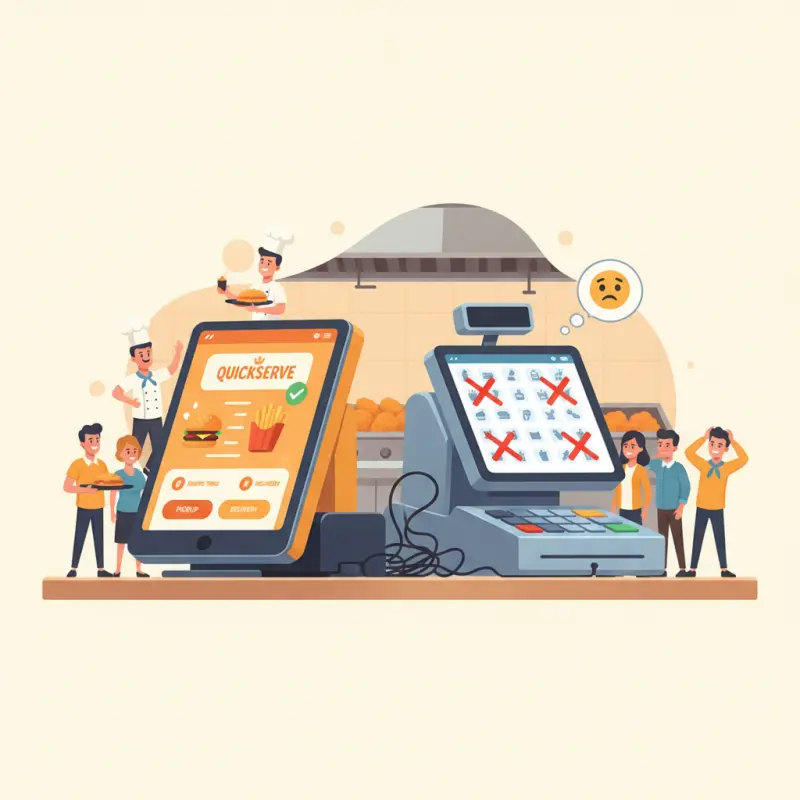
POS fast food software must handle 200+ orders per service window while generic restaurant systems handle just 80. Fast food operations need transaction completion in 15-45 seconds compared to eight minutes for full-service dining. Traditional POS systems waste screen space on table management and wine pairings that don't apply to quick service. Kitchen Display Systems reduce order preparation time by 23 percent compared to paper tickets still used in most Moroccan restaurants. Fast food operators in cities like Casablanca lose MAD 1,500 monthly from five-second order delays during peak hours. Choose POS systems designed specifically for quick service with streamlined interfaces focused on item selection, modifiers, and payment processing only.
Table of Contents
Fast Food Operations Break Most POS Systems
Your lunch rush hits at 12:47 PM in downtown Casablanca. Twenty-three customers wait in line, each expecting their order in under two minutes. Your generic restaurant POS crashes trying to process order number 24. This scenario repeats daily across Morocco's fast food restaurants — because most POS fast food software wasn't built for the unique pressure of quick-service operations.
The difference between fast food and full-service restaurants isn't just speed. It's an entirely different operational model that demands specialized tools. Where a traditional restaurant might handle 80 orders across a four-hour dinner service, fast food operations push 200+ orders in the same window. Generic systems buckle under this pressure.
The 15-Second Order Window
Fast food mathematics are unforgiving. Your average transaction needs to complete in 15 to 45 seconds, compared to eight minutes or more for full-service dining. Every second counts when you're racing against hunger and impatience.
Traditional restaurant POS wastes precious screen real estate on table management, course timing, and wine pairings — features that mean nothing when your customer wants a chicken shawarma wrap in 90 seconds. These split-second delays compound. A five-second lag per order during peak hours costs you MAD 50 or more in lost throughput. Multiply that across 30 peak days monthly, and you're hemorrhaging MAD 1,500 in potential revenue.
The most expensive feature of any POS isn't what it includes — it's what slows you down. Fast food operators need interfaces stripped to essentials: item selection, modifiers, payment. Nothing else.
Kitchen Display Systems vs. Paper Tickets
Paper tickets still dominate Moroccan kitchens, but the numbers tell a different story. Industry data shows Kitchen Display Systems reduce order preparation time by 23 percent. That's 14 minutes saved per hour of service — enough to serve nine additional customers.
Most cafe POS system solutions treat kitchen displays as an afterthought, a premium add-on priced beyond reach. They miss the fundamental workflow: orders need to flow from counter to kitchen to customer without human interpretation, without shuffling papers, without shouting over fryer noise.
OCHI includes KDS as standard because we understand this isn't a luxury — it's operational necessity. Color-coded order status (pending, preparing, ready) eliminates confusion. Kitchen staff see exactly what needs attention without decoding handwritten modifications.
Stack audit
What do you currently use?
Tick what you have. We’ll show what OCHI replaces or connects to.
The Food Truck Reality Check
Food trucks operate in a parallel universe where traditional POS assumptions crumble. No reliable power source. No fixed internet. No climate control. Just you, your equipment, and hungry customers at a beachfront spot in Agadir or a corporate park in Rabat.
Power and Connectivity Demands
Your truck generator powers grills, refrigeration, and ventilation. Adding a power-hungry POS terminal isn't always feasible. Modern POS systems for food trucks must run eight-plus hours on battery power alone. They need 4G backup when the park's WiFi inevitably fails during lunch rush.
Space constraints multiply these challenges. A two-by-two meter truck kitchen has no room for desktop terminals and receipt printer arrays. Everything must fit on a tablet or compact terminal that mounts to existing surfaces without consuming precious prep space.
OCHI's web-based platform runs on any device with a browser — tablets, phones, or ruggedized terminals. No special hardware requirements. No installation headaches. Just load ochi.ma and start taking orders.
Weather-Proof Operations
Agadir summer pushes 40°C. Your POS screen fogs with steam from the flat-top grill. Grease-covered fingers struggle with traditional touchscreens designed for air-conditioned restaurants. Weather isn't just comfort — it's operational reality for mobile food service.
Point of sale systems for food trucks need screens that respond to wet or greasy touches, interfaces large enough to tap accurately while wearing gloves, and hardware that won't overheat when the thermometer climbs. These aren't nice-to-have features. They determine whether you can serve customers or shut down.
The Commission Math Nobody Shows You
POS pricing hides in complexity. Base fees, transaction percentages, hardware rentals, support contracts — vendors bury the true cost under layers of fine print. Let's expose the real numbers.
Hidden Cost Breakdown
| Cost Type | Traditional POS | Commission Platforms | OCHI |
|---|---|---|---|
| Monthly Base | MAD 200-800 | MAD 0 | MAD 299 |
| Transaction Fee | 2.9% | 15-30% | 0% |
| MAD 30K Revenue | MAD 1,070 | MAD 4,500-9,000 | MAD 299 |
| Annual Cost | MAD 12,840 | MAD 54,000+ | MAD 3,588 |
Commission platforms seduce with "free" setup, then extract 15 to 30 percent of every sale. On MAD 30,000 monthly revenue — modest for a busy food truck — you surrender MAD 4,500 minimum. Traditional POS systems seem cheaper until you factor transaction fees that compound invisibly.
Zero-commission changes the equation entirely. Pay once monthly, keep every dirham of sales. No percentages. No surprises.
ROI Timeline for Casablanca Fast Food
Breaking even on zero-commission POS happens faster than operators expect. At 150 orders monthly, you've already saved money compared to commission platforms. A typical Casablanca fast food spot processing 50 orders daily reaches profitability in under a week.
Integration with cafe accounting software multiplies these savings. Accurate sales data flows directly to your books, eliminating manual entry errors that trigger tax audits. One avoided penalty pays for years of POS fees.
OCHI's Modular Approach to Fast Food
OCHI wasn't built by adding features. We built by watching fast food operators work, then removing every friction point. The result: a platform that adapts to your operation, not the reverse.
Built for Speed, Not Show
QR table ordering reduces counter congestion by 40 percent. Customers scan, order from their phones, skip the line entirely. Your branded subdomain — yourname.ochi.ma — keeps them coming back directly, bypassing commission platforms.
Kitchen Display System comes standard because we've seen the paper chaos. Orders flow instantly from customer to kitchen. Color-coded status updates eliminate confusion. No shouting over equipment noise. No lost tickets.
Multi-branch support means your food truck empire runs from one dashboard. Track inventory across locations. Prevent the dreaded "sorry, we're out" that kills customer trust. Real-time GPS shows exactly where each truck operates today.
Multi-Location for Growing Operations
Success in fast food means replication. One profitable location becomes three, then ten. Traditional POS forces you to manage each separately — different logins, manual consolidation, no unified view.
OCHI's architecture assumes growth. Add locations without adding complexity. Inventory syncs automatically. Staff permissions carry across branches. Financial reports consolidate with one click. Build an empire without the administrative nightmare.
What Fast Food Owners Get Wrong About POS
The biggest mistake fast food operators make? Buying for features they'll never use. All-in-one usually means mediocre at everything.
The Feature Bloat Trap
You don't need loyalty programs on day one. Complex discount matrices confuse staff and slow service. Table reservations in a fast food context waste money on functionality that adds zero value.
Focus ruthlessly on order speed. Everything else is distraction. Add complexity only when operations demand it, never because a sales rep insists you need their premium package.
The best POS fast food software does three things exceptionally: takes orders fast, communicates with kitchen clearly, and processes payments reliably. Master these fundamentals before chasing advanced features that impress in demos but fail during Friday lunch rush.
Fast food success isn't about having every possible feature. It's about executing core operations flawlessly, thousands of times daily. Choose tools that understand this reality.
See how OCHI adapts to your fast food operation at ochi.ma/partners.
Frequently Asked Questions
What makes POS fast food software different from regular restaurant POS?
Fast food POS focuses on speed with streamlined interfaces for 15-45 second transactions. It eliminates table management, course timing, and other full-service features that slow down quick service operations.
How many orders can fast food POS systems handle compared to generic systems?
Specialized fast food POS handles 200+ orders per four-hour window while generic systems manage only 80 orders in the same period before performance degrades.
Do Kitchen Display Systems work better than paper tickets for fast food?
Yes, Kitchen Display Systems reduce order preparation time by 23 percent compared to paper tickets. This saves 14 minutes per service hour, allowing nine additional customers to be served.
How much revenue do slow POS systems cost fast food restaurants?
Five-second order delays during peak hours cost MAD 50 daily in lost throughput. Over 30 peak days monthly, this totals MAD 1,500 in potential revenue loss.
What features should fast food POS software prioritize?
Essential features include fast item selection, quick modifier options, and instant payment processing. Avoid systems with unnecessary table management, wine pairing, or course timing features.
Restaurant owners · Weekly
The guide to running a restaurant in 2026.
One article per week. No commission advice. Just honest operational insight for Moroccan restaurants.

Blog Manager
Comments
No comments yet. Be the first to share your thoughts.