AI Overview
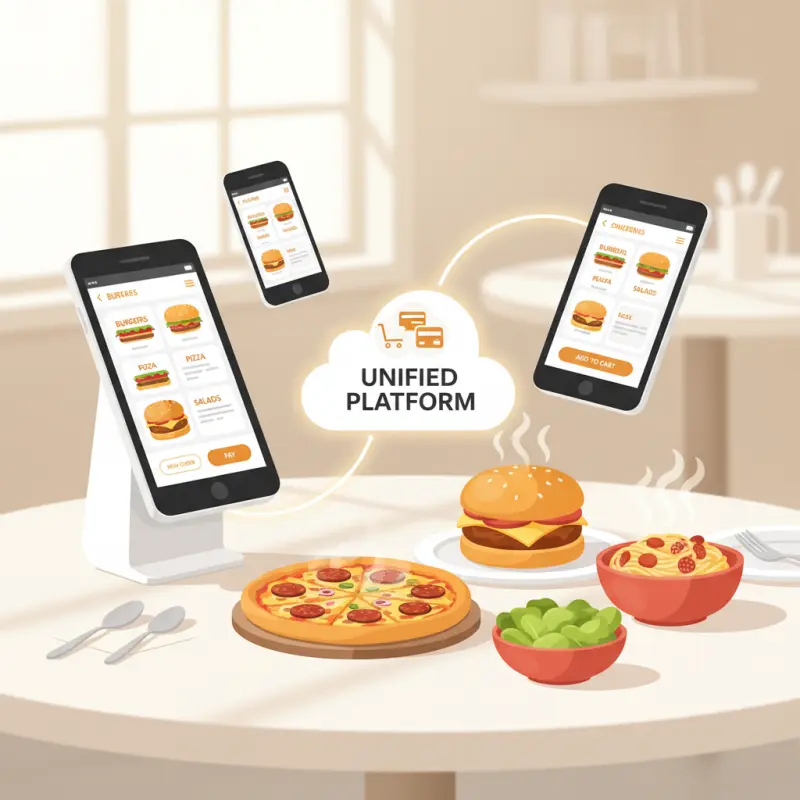
A unified POS system with online ordering eliminates the manual reconciliation that costs restaurants 260 hours annually. Disconnected systems force restaurant owners to spend 45 minutes daily on double data entry between their POS and online ordering platforms. This creates inventory discrepancies that lead to stockouts and lost sales. Manual order transcription between separate systems generates errors that cost restaurants 3-8% of total revenue. True integration means one system that handles in-house orders, online orders, inventory, and customer data simultaneously — not two separate platforms connected by API. Restaurants using unified platforms reduce operational errors by 85% while saving 15,000 MAD annually in lost productivity. Choose a single platform that manages both POS and online ordering from one dashboard to eliminate reconciliation time entirely.
Table of Contents
A restaurant owner in Casablanca told me last week that she spends 45 minutes every night reconciling orders between her POS and three delivery platforms. That's five hours per week — 260 hours per year — doing data entry instead of growing her business.
Most restaurants run their operations through a patchwork of systems that barely speak to each other. The POS handles in-house orders. Online orders come through a separate tablet. Delivery platforms have their own dashboards. Each system has its own inventory count, its own customer database, its own reporting. The result? Chaos that costs money.
The Hidden Cost of Disconnected Systems
Manual order transcription between systems creates errors that directly impact revenue. When your waiter punches a delivery order from a tablet into the POS, mistakes happen. A missed modifier here, a wrong quantity there — these errors cost restaurants between 3% and 8% of their total revenue.
The time cost is equally brutal. Restaurant managers spend an average of 45 minutes daily on double data entry. That's reconciling inventory counts, updating menus across platforms, and entering customer information multiple times. In monetary terms, that's 15,000 MAD annually in lost productivity for a single location.
I watched a café owner in Casablanca discover her POS showed 47 chocolate croissants in stock while her online ordering system showed 12. The reason? Her morning shift updated the POS after the breakfast rush but forgot to adjust the online platform. She lost 35 potential sales that afternoon when customers couldn't order her best-selling item online.
These disconnected systems create a domino effect. Inventory discrepancies lead to stockouts. Stockouts lead to negative reviews. Negative reviews impact future orders. The cycle compounds.
Food cost calculator
What’s your real margin?
Food cost
29.2%
Gross margin
70.8%
Profit / dish
85 MAD
Healthy · under 30%
Digitize your menu with OCHIWhy "Integration" Isn't Always Integration
Here's what vendors won't tell you: most "integrated" solutions are just two separate systems with an API connection. They're not truly unified — they're duct-taped together.
The webhook delay problem illustrates this perfectly. Your customer places an order on your restaurant online ordering system. The platform sends a webhook to your POS. But webhooks can fail. Networks can lag. That 30-to-90-second delay between order placement and kitchen notification? That's not integration — that's a band-aid.
Commission-based platforms have zero incentive to solve this problem. They profit from keeping you dependent on their ecosystem. True integration would give you control, and control means you might leave. So they offer just enough connectivity to keep you subscribed while maintaining the friction that keeps you locked in.
Red flags your "integrated" pos system with online ordering is actually two systems in disguise: duplicate customer databases, separate login credentials for each system, menu updates that require changes in multiple places, and reports that don't match between platforms.
The Language Barrier Nobody Talks About
Morocco's trilingual market creates unique challenges for food ordering system online platforms. Your customers think in Arabic, French, and English — often switching between languages mid-conversation. Yet most ordering systems force a single-language experience.
The data tells a compelling story. Restaurants in Agadir that offer Arabic-language ordering see 15% to 22% higher average order values compared to French-only interfaces. Why? Customers order more confidently in their preferred language. They understand modifiers better. They explore menu sections they might skip in a second language.
Guest checkout becomes critical in multilingual markets. Forcing account creation in a non-native language increases cart abandonment by 34%. But when customers can order as guests in their preferred language, completion rates soar.
QR code ordering at tables amplifies this effect. A family in Marrakech might have members who prefer different languages. With QR-based ordering, each person views the menu in their preferred language on their own device. The grandfather reads Arabic, the parents browse in French, the teenager orders in English — all from the same table, all flowing into the same food online ordering system.
What Actually Works: Real Numbers from Morocco
The Marrakech Scenario
Let me show you real numbers from an 85-seat restaurant in Marrakech with 200 daily covers. Before implementing a unified system, they juggled a traditional POS with a commission-based delivery platform.
| Metric | Before (Fragmented) | After (Unified) | Monthly Savings |
|---|---|---|---|
| Commission Fees (7%) | 42,000 MAD | 0 MAD | 42,000 MAD |
| Order Errors (3% of revenue) | 18,000 MAD | 2,000 MAD | 16,000 MAD |
| Staff Time (45 min/day) | 1,250 MAD | 0 MAD | 1,250 MAD |
| Lost Orders (system delays) | 8,000 MAD | 0 MAD | 8,000 MAD |
| Total Monthly Impact | 69,250 MAD | 2,000 MAD | 67,250 MAD |
After switching to a unified online food ordering system for restaurants with their own branded subdomain (votrenom.ochi.ma), they eliminated commission fees entirely. Order errors dropped to near zero since everything flows through one system. Their kitchen display syncs instantly — not 90 seconds later.
The Integration That Matters
True integration means your kitchen display shows orders the instant customers hit "confirm." It means inventory adjusts automatically across all channels — dine-in, online, QR orders. It means your waiter roles match how restaurants actually operate, with eight distinct permission levels instead of generic "admin" and "user" categories.
When a customer orders through your branded storefront, that order appears immediately on your POS, your kitchen display, and your waiter's mobile device. One system. One source of truth. No delays, no webhooks, no synchronization issues.
This unified approach extends to reporting. You see real-time data on which items perform best, which payment methods customers prefer, which times drive the most orders. All in one dashboard, all updated instantly.
The Decision Framework
Before choosing any pos system with online ordering, audit your current setup objectively. Calculate the true cost of manual processes: multiply daily time spent on data entry by your hourly labor cost. Add commission fees. Add the revenue lost to order errors. The total often shocks restaurant owners.
Test your current integration practically. Place 10 orders through different channels. Time how long each takes to appear in your kitchen. Count how many require manual intervention. Track which ones update inventory correctly. This simple test reveals integration gaps.
Evaluate language coverage against your customer base. In Agadir, 60% of diners prefer Arabic interfaces. In Casablanca's business districts, French dominates. Does your system adapt? Can guests order without creating accounts? Do QR menus display in the scanner's preferred language?
The 30-day trial approach reveals problems your vendor won't mention. Run parallel operations for one month. Track every friction point. Document every workaround your staff creates. These pain points compound over time — better to discover them during a trial than after a two-year contract.
The best restaurant online ordering system isn't the one with the most features. It's the one that eliminates friction between your customers' hunger and your kitchen. Everything else is just complexity in disguise.
See what unified operations look like at ochi.ma/partners.
Frequently Asked Questions
What is a POS system with online ordering?
A POS system with online ordering is a unified platform that handles both in-restaurant transactions and online orders from one dashboard. It eliminates the need for separate systems that require manual reconciliation.
How much time do restaurants waste with separate POS and online ordering systems?
Restaurant managers spend an average of 45 minutes daily reconciling orders between separate POS and online ordering systems. This equals 260 hours annually of manual data entry.
What revenue impact do disconnected restaurant systems create?
Manual order transcription between separate POS and online ordering systems causes errors that cost restaurants 3-8% of total revenue. Inventory discrepancies also lead to lost sales from stockouts.
Why don't API integrations solve POS and online ordering problems?
Most API integrations connect two separate systems rather than creating true unification. This still requires manual updates and creates data sync delays that cause inventory discrepancies.
What should restaurants look for in a unified POS with online ordering?
Choose a platform that manages POS transactions, online orders, inventory, and customer data from one dashboard. Avoid solutions that are two separate systems connected by API integration.
Restaurant owners · Weekly
The guide to running a restaurant in 2026.
One article per week. No commission advice. Just honest operational insight for Moroccan restaurants.

Blog Manager
Comments
No comments yet. Be the first to share your thoughts.