AI Overview
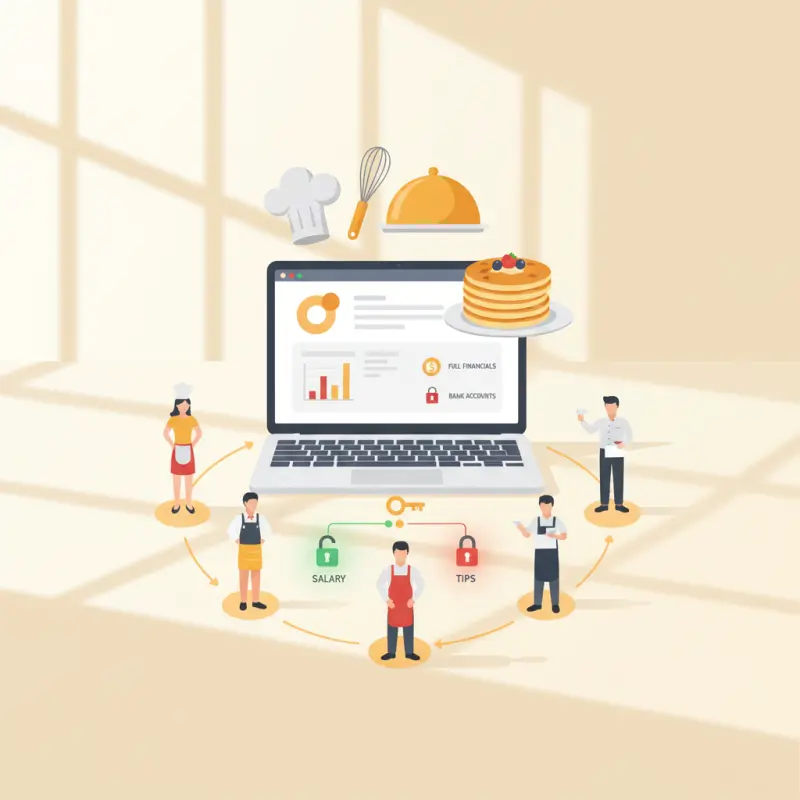
Restaurant accounting and payroll software prevents fraud only when combined with proper staff permission controls. Most Moroccan restaurants lose 3-7% of monthly revenue through fake refunds, time manipulation, and inventory adjustments because they grant universal admin access. A typical 50-seat Casablanca restaurant processing 800,000 MAD monthly can lose 498,000 MAD annually to staff fraud. Smart restaurant accounting and payroll software divides access by job function: cashiers process sales, waiters take orders, managers handle refunds, and only owners access financial reports. OCHI's eight-role permission system maps actual restaurant operations across Morocco's hospitality sector. Restrict your POS operator to sales transactions and delivery drivers to order updates — your chef doesn't need payroll access.
Table of Contents
Every month, Moroccan restaurants lose between 3% and 7% of their revenue to a problem no one talks about — staff fraud enabled by poor permission controls. Your restaurant accounting and payroll software might track every dirham, but if your cashier has admin access, those numbers mean nothing.
Most restaurant owners in Casablanca, Marrakech, and Agadir still hand out broad system access like candy. The waiter who started last week? Admin rights. The part-time cashier? Full refund permissions. The result? Fake refunds, manipulated time sheets, and inventory that vanishes into thin air.
Why Your Restaurant Accounting and Payroll Software Needs Eight Permission Levels
Walk into any restaurant in Morocco and ask who has system access. The answer is usually everyone. This isn't just bad security — it's a direct path to profit loss.
When your cashier can process unlimited refunds, create discounts, and adjust inventory counts, you're not running a business. You're running a trust exercise. And trust exercises don't pay rent in Agadir's competitive restaurant scene.
The Real Cost of "Admin for Everyone"
A typical 50-seat restaurant in Casablanca processes around 800,000 MAD monthly. With unrestricted staff access, here's what disappears:
| Fraud Type | Monthly Loss (MAD) | Annual Impact |
|---|---|---|
| Fake refunds | 12,000 | 144,000 MAD |
| Time clock manipulation | 8,500 | 102,000 MAD |
| Inventory "adjustments" | 15,000 | 180,000 MAD |
| Unauthorized discounts | 6,000 | 72,000 MAD |
That's 498,000 MAD annually — enough to open a second location. All because you gave everyone the same access level.
What Each Role Should Actually Access
Smart restaurant hr software divides permissions by actual job needs. Your chef doesn't need refund access. Your waiter shouldn't see profit margins. Your delivery driver has no business in payroll reports.
OCHI's eight-role system maps real restaurant operations: Admin sees everything. Branch Manager handles their location. POS Operator processes sales. Waiter takes orders. Chef manages kitchen displays. Delivery Boy tracks routes. Cashier handles payments within limits. Staff gets basic access only.
How Granular Permissions Stop Revenue Leaks
Permission controls work like kitchen stations — everyone has their zone. When a waiter can only create orders (not delete them), when a cashier needs manager approval for refunds over 100 MAD, when time clock edits require branch manager sign-off, fraud becomes nearly impossible.
The best restaurant scheduling software builds these controls into daily operations. No extra steps. No complex passwords. Just smart defaults that protect your profits.
Stack audit
What do you currently use?
Tick what you have. We’ll show what OCHI replaces or connects to.
The Numbers: What Staff Time Theft Actually Costs Moroccan Restaurants
Time theft sounds minor until you calculate the damage. In Marrakech's restaurant district, the average server earns 80 MAD per hour. Small manipulations add up fast.
Time Clock Fraud: 15 Minutes Per Shift Adds Up
Employees clock in 15 minutes early and leave 15 minutes late. Harmless? Not quite. For a restaurant with 12 staff working six days a week:
Daily theft: 6 hours × 80 MAD = 480 MAD
Monthly loss: 480 × 26 days = 12,480 MAD
Annual damage: 149,760 MAD
That's two months of rent for a prime location in Agadir. Gone to phantom hours no one worked.
The Buddy Punching Tax: Real Numbers from Restaurant Payrolls
Buddy punching — when employees clock in for absent colleagues — costs even more. Industry data shows 75% of restaurants face this problem. The average buddy punch adds three hours of fake work per incident.
In a 20-person restaurant with buddy punching twice weekly: 6 hours × 80 MAD × 52 weeks = 24,960 MAD annually. Your restaurant workforce management software should block this automatically through individual PINs or biometric scans.
Why Biometric Systems Don't Solve Permission Problems
Fingerprint scanners stop buddy punching but miss the bigger issue. If your staff can still edit time entries later, manipulate shift reports, or approve their own overtime, you've only solved half the problem.
Real protection comes from permission layers — biometrics for clock-in, manager approval for edits, audit trails for every change. Read more about integrated security approaches that actually work.
Case Study: How OCHI's Role-Based System Caught a 12,000 MAD Refund Scheme
A popular seafood restaurant in Casablanca discovered their monthly refunds had tripled. The owner suspected food quality issues. The truth was worse.
The Pattern: Unusual Refund Activity
OCHI's audit logs revealed something strange. Every Thursday night between 9 PM and 11 PM, refunds spiked. Same server. Same terminal. Always cash refunds under 200 MAD — just below the threshold requiring manager approval.
The pattern was invisible in their old system. Generic accounting software showed total refunds but no context. Who processed them? When? For which tables? Without role-based tracking, fraud hides in plain sight.
The Investigation: Following the Digital Trail
The trail was clear. This server created fake orders, served real customers, then refunded the fake orders while pocketing the cash. Thursday nights were busy enough that managers didn't notice.
Over four months: 48 fake refunds × 250 MAD average = 12,000 MAD stolen. The server thought cash refunds left no trace. They didn't know every action in OCHI creates a permanent record tied to their user ID.
The Prevention: How Proper Permissions Stop This
After discovering the scheme, the restaurant implemented three changes: cash refunds now need manager PIN, all refunds require original order number, and servers can only refund their own tables. Refund fraud dropped to zero.
The best payroll software for restaurants doesn't just process wages — it protects them through smart permission design.
Why Restaurant Workforce Management Software Fails Without Integrated Accounting
Most restaurants juggle three or four different systems. Scheduling in one app. Payroll in another. Accounting somewhere else. POS data in a fourth. This fragmentation creates blind spots where money disappears.
The Integration Gap That Costs You Money
When your scheduling software doesn't talk to payroll, employees claim shifts they didn't work. When payroll doesn't connect to your POS, you can't verify if that overtime was real or if the restaurant was even open.
Disconnected systems mean disconnected data. You might catch fraud eventually, but by then the damage is done. The money is gone. The employee has quit. You're left with spreadsheets and suspicions.
Single Dashboard vs. Multiple Logins: The Security Risk
Every additional system is another password to share, another login to manage, another place where permissions get confused. The cashier who shouldn't see payroll data? They probably have the Excel password because someone needed vacation coverage three months ago.
Integrated restaurant accounting and payroll software eliminates these gaps. One login. Role-based access. Everything connected. When your POS feeds directly into payroll and accounting, fraud has nowhere to hide.
Why Your POS Data Should Feed Your Payroll Directly
Your POS knows exactly when service started and ended. It knows which employees were active, what they sold, when they took breaks. Why enter this data twice?
Direct integration means shift times match sales data. If someone claims they worked until midnight but the last order was at 10:30 PM, the system flags it. Automatic. No manual checking required.
Building Your Staff Permission Strategy (Without Buying Separate HR Software)
You don't need expensive restaurant hr software to implement proper controls. You need a clear permission strategy built into your existing operations.
Mapping Your Current Staff to Permission Levels
Start by listing every system action: processing sales, issuing refunds, viewing reports, editing time cards, accessing payroll, changing prices, deleting orders. Then assign each action to the role that genuinely needs it.
Most restaurants discover they've been oversharing access. The part-time waiter viewing food costs? The delivery driver with refund rights? Cut these permissions and watch your margins improve.
The Three-Week Implementation Timeline
Week 1: Audit current access. Document who can do what.
Week 2: Implement new permission levels. Start with high-risk areas like refunds and time edits.
Week 3: Train staff on new limits. Monitor audit logs for confusion or workarounds.
During implementation at votrenom.ochi.ma, most restaurants see attempted permission violations drop 90% after the first week. Employees quickly learn what they can and cannot access.
Measuring Success: KPIs That Matter
Track these metrics monthly: unexplained refunds (should approach zero), time clock adjustments (should require documentation), inventory variances (should match waste logs), and discount usage by employee (should follow set patterns).
When these numbers improve, your bottom line follows. One Rabat restaurant reduced their monthly "shrinkage" from 35,000 MAD to 4,000 MAD just by implementing proper permission controls.
Restaurant accounting and payroll software isn't about features — it's about protection. Every permission you grant is either protecting your profits or giving them away. In Morocco's competitive restaurant market, you can't afford to trust everyone with everything. Build your permission strategy today, before your profits walk out the door tomorrow.
See how OCHI's integrated permission system can protect your restaurant's revenue at ochi.ma/partners.
Frequently Asked Questions
Why does restaurant accounting and payroll software need different permission levels?
Different staff roles require different system access to prevent fraud and maintain security. Cashiers need sales processing but not payroll access, while managers need refund permissions but waiters don't.
How much revenue do restaurants lose without proper staff permissions?
Moroccan restaurants typically lose 3-7% of monthly revenue to staff fraud enabled by unrestricted system access. A 50-seat restaurant can lose up to 498,000 MAD annually through fake refunds and time manipulation.
What permissions should a restaurant cashier have?
Restaurant cashiers should only access sales processing, payment collection, and basic customer lookup functions. They shouldn't have refund permissions, inventory adjustments, or payroll access.
How many permission levels does effective restaurant software need?
Effective restaurant accounting and payroll software requires at least eight distinct permission levels: Admin, Branch Manager, POS Operator, Waiter, Chef, Delivery Driver, Accountant, and Owner roles.
Can restaurant staff share login credentials safely?
No, sharing login credentials eliminates accountability and audit trails. Each staff member needs individual access with permissions matching their specific job responsibilities.
Restaurant owners · Weekly
The guide to running a restaurant in 2026.
One article per week. No commission advice. Just honest operational insight for Moroccan restaurants.

Blog Manager
Comments
No comments yet. Be the first to share your thoughts.