AI Overview
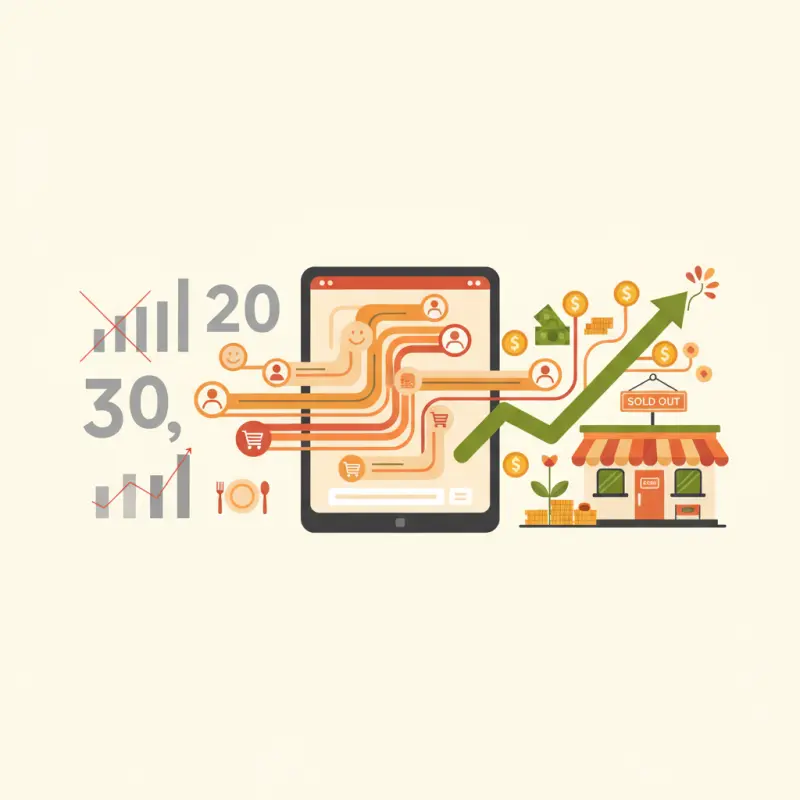
Most restaurant CRM databases fail because they track vanity metrics like contact list size instead of revenue-driving behavior patterns. Your restaurant crm database should focus on purchase frequency patterns, average order value trends, and response rates to different promotional strategies rather than just collecting email addresses. Restaurants in Morocco that track when customers deviate from normal ordering patterns — like Mohamed who typically orders twice weekly but hasn't in 10 days — can intervene before losing revenue. The key shift: segment customers by spending behavior and dining preferences, not demographics. Track which promotions work for high-value customers versus bargain hunters. Start measuring customer lifetime value progression instead of newsletter signup rates.
Table of Contents
Most restaurants in Morocco collect customer data like they're hoarding treasure — emails here, phone numbers there, maybe a birthday if they're feeling ambitious. Yet revenue stays flat while that database grows dustier by the month.
The problem isn't your restaurant CRM database. It's that you're collecting vanity metrics instead of revenue signals. Knowing that Karima from Casablanca visited twice last month means nothing if you don't know her average order value, preferred dining times, or whether she responds better to percentage discounts or free appetizers.
Why Your Restaurant CRM Database Fails (And It's Not the Software's Fault)
Restaurant owners love to blame their CRM software for poor results. The real culprit? They're tracking the wrong things.
Consider this: a typical Moroccan restaurant spends hours collecting customer contact information. They build lists of 5,000 names. They send the same "20% off this weekend" message to everyone. Response rate: 2%. The owner concludes that email marketing doesn't work.
Here's what actually happened. They sent a weekend discount to customers who only order weekday lunches. They offered percentage discounts to price-insensitive VIPs who would have paid full price. They ignored the customers who haven't ordered in 60 days and need a stronger incentive to return.
The Data Collection Trap
Most restaurants obsess over growing their contact list size. They run "sign up for our newsletter" campaigns. They manually enter business cards into spreadsheets. They celebrate reaching 10,000 subscribers.
But subscriber count is a vanity metric. What matters for revenue:
Purchase frequency patterns tell you who's slipping away. If Mohamed typically orders twice weekly but hasn't in 10 days, that's a revenue signal. Average order value trends show you who's worth investing in. The customer who consistently spends 300 MAD deserves different treatment than the one who orders a single 50 MAD item.
Response rates to different offer types reveal customer psychology. Some react to free items. Others want exclusive access. A few just want simplicity. Your CRM system for restaurants should track these preferences automatically.
What Actually Moves the Revenue Needle
A restaurant in Agadir switched from mass campaigns to behavior-based targeting. They identified three simple patterns: new customers need a reason to return within 14 days, regular customers respond to tier progression nudges, and dormant customers require aggressive win-back offers.
Results after three months: 31% increase in repeat visits, 24% higher average order values, and email open rates jumped from 15% to 42%. Same restaurant CRM database, different approach.
Stack audit
What do you currently use?
Tick what you have. We’ll show what OCHI replaces or connects to.
The Three CRM Systems That Work (And When to Use Each)
Points, tiers, and cashback aren't just different names for the same thing. Each serves specific restaurant types and customer behaviors.
Points Systems: Best for Quick-Service Restaurants
Points work when purchase decisions happen fast. Customer sees menu, orders, pays, leaves. The mental math needs to be instant: "I'm at 89 points, one more order gets me a free meal."
Typical structure: 1 point per dirham spent, redeem at 100 points for 10 MAD off. Simple ratios prevent confusion. Redemption happens often enough to maintain engagement but not so often it kills margins.
Real numbers from the market: properly structured points programs see 23% redemption rates and increase visit frequency by 19%. The key is immediate visibility — customers must see their point balance during every interaction.
Tier Systems: Built for Full-Service Restaurants
Full-service restaurants benefit from tier-based programs because the relationship runs deeper. Customers invest time, not just money. They want recognition, not just discounts.
OCHI's 4-tier system follows proven psychology:
| Tier | Threshold | Benefits | Psychology |
|---|---|---|---|
| Bronze | 0 MAD | Birthday bonus | Everyone starts somewhere |
| Silver | 500 MAD/month | 5% points bonus | Achievable first goal |
| Gold | 1,500 MAD/month | 10% bonus + priority seating | Status recognition |
| Platinum | 3,000 MAD/month | 15% bonus + exclusive previews | VIP treatment |
This structure increases repeat visits by 34% compared to no program. More importantly, it creates predictable revenue — Gold and Platinum customers maintain their spending to keep status.
Cashback: The Underused Option
Cashback programs work in price-sensitive markets. Customer spends 100 MAD, gets 5 MAD credited to their account. No points math. No tier calculations. Just money back.
Lower engagement rates (15% vs 23% for points) but higher satisfaction scores. Best for restaurants competing primarily on price or in highly competitive delivery markets.
How to Segment Your Restaurant CRM Database for Maximum ROI
Generic campaigns waste money. Smart segmentation in your restaurant CRM turns the same message into five different revenue streams.
The Five Customer Segments That Drive Revenue
New Customers (0-30 days): They're forming habits. Send a welcome series with a second-visit incentive within 14 days. If they don't return within 30 days, you've likely lost them. Message timing matters more than discount size.
Regular Customers (monthly visits): They know you but aren't committed. Show them what they're missing — tier benefits just out of reach, limited-time menu items, member-only events. Nudge, don't push.
VIP Customers (weekly visits): They're already sold. Give them reasons to feel special: early access to new dishes, birthday surprises that actually surprise, a direct line to management. These customers generate word-of-mouth worth more than any advertisement.
At-Risk Customers (60+ days absent): Something broke the habit. Maybe a bad experience, maybe they moved, maybe competition. Aggressive win-back campaigns with 30-40% discounts can recover 12% of this segment. After 90 days, success rate drops to 3%.
One-Time Customers (single visit, 90+ days): They tried you and didn't return. Either write them off or test extremely aggressive offers (50% off, free appetizer and dessert). Some CRM software for restaurants automatically flags these for removal to keep lists clean.
The Casablanca Restaurant Test Case
A mid-size restaurant with 200 covers per night tested segmented campaigns against their usual blast-to-all approach. Same offers, same budget, different targeting.
Mass email to 4,000 contacts: 15% open rate, 2.1% redemption, 84 orders generated. Segmented campaigns to the same list: 28% average open rate, 5.8% redemption, 232 orders generated. The VIP segment alone (400 contacts) generated 89 orders — more than the entire mass campaign.
Building Your CRM Database the Right Way (Technical Setup Without the Headaches)
Most restaurants build their CRM backwards. They start with software features instead of revenue goals.
Essential Data Fields (Not Nice-to-Have Fields)
Order frequency drives everything else. Track orders per week and per month. Flag changes immediately — a weekly customer who misses two weeks needs attention.
Average order value determines customer worth. But track it over time. A declining AOV often signals dissatisfaction before the customer stops ordering entirely.
Preferred order times reveal customer types. Lunch-only customers need different messaging than dinner regulars. Weekend warriors respond to different offers than weekday workers.
Communication preferences prevent unsubscribes. Some customers want everything. Others only want order confirmations. Respect their choice or lose them entirely.
Integration Points That Actually Matter
Your POS system must sync automatically. Manual data entry kills accuracy and staff morale. Real-time sync means customer points appear immediately, tier progress updates instantly, and purchase patterns stay current.
Online ordering platforms need deep integration. Digital behavior differs from in-person dining. Track both to build complete customer profiles. OCHI's built-in CRM handles this automatically — no third-party connections needed.
Table reservation data adds context. A customer who books VIP tables for eight people has different value than someone who walks in alone. Your restaurant CRM should capture and use this information.
The OCHI Advantage
OCHI includes full CRM functionality without additional cost. Points track automatically. Tiers calculate in real-time. Birthday bonuses send themselves. Everything happens on your branded subdomain (votrenom.ochi.ma), so you own the relationship.
No integration headaches. No monthly CRM fees. No per-customer charges. Just built-in tools that work from day one. The same system handling your orders manages your customer relationships.
The Real Cost of Restaurant CRM Systems in Morocco
Most CRM vendors hide pricing behind "contact us for a quote" forms. Here's what restaurants actually pay:
| CRM Type | Monthly Cost | Setup Fee | Hidden Costs |
|---|---|---|---|
| Basic Standalone | 200-400 MAD | 2,000 MAD | Email sending limits |
| Advanced Standalone | 800-1,500 MAD | 5,000 MAD | Per-seat pricing |
| Enterprise | 3,000+ MAD | 10,000+ MAD | Integration fees |
| OCHI Built-in | 0 MAD | 0 MAD | None |
Standalone systems also mean separate logins, separate training, and separate support contacts. When the POS doesn't talk to the CRM, staff do manual work. When manual work piles up, accuracy suffers. When accuracy suffers, the best CRM for restaurants becomes worthless.
Integrated platforms eliminate these friction points. Your restaurant CRM database lives where your operations happen. Points calculate automatically. Segments update in real-time. Campaigns launch based on actual behavior, not stale data.
The Moroccan restaurant that masters customer relationships wins. Not through expensive software or complex campaigns. But through understanding that behind every order is a person with preferences, patterns, and potential value worth recognizing. Build your database to capture these truths, and revenue follows.
Start building your restaurant CRM database today. Set up your free OCHI account at votrenom.ochi.ma and own your customer relationships from day one.
Frequently Asked Questions
What data should a restaurant CRM database track for better revenue?
Track purchase frequency patterns, average order value trends, response rates to different promotions, and customer lifetime value progression. These metrics predict revenue better than contact information alone.
How do I segment customers in my restaurant CRM database?
Segment by spending behavior and dining preferences, not demographics. Group customers by average order value, visit frequency, preferred dining times, and responsiveness to different discount types.
Why do restaurant CRM databases have low response rates?
Most restaurants send the same promotions to all customers without considering individual preferences or spending patterns. Personalized offers based on customer behavior generate higher response rates.
What's the difference between vanity metrics and revenue signals in restaurant CRM?
Vanity metrics like subscriber count or email opens don't predict revenue. Revenue signals include purchase frequency changes, order value trends, and customer retention patterns that directly impact sales.
How can I improve my restaurant CRM database performance?
Focus on behavioral data over contact collection. Track when customers deviate from normal patterns, measure promotion effectiveness by customer segment, and automate interventions for at-risk customers.
Restaurant owners · Weekly
The guide to running a restaurant in 2026.
One article per week. No commission advice. Just honest operational insight for Moroccan restaurants.

Blog Manager
Comments
No comments yet. Be the first to share your thoughts.