AI Overview
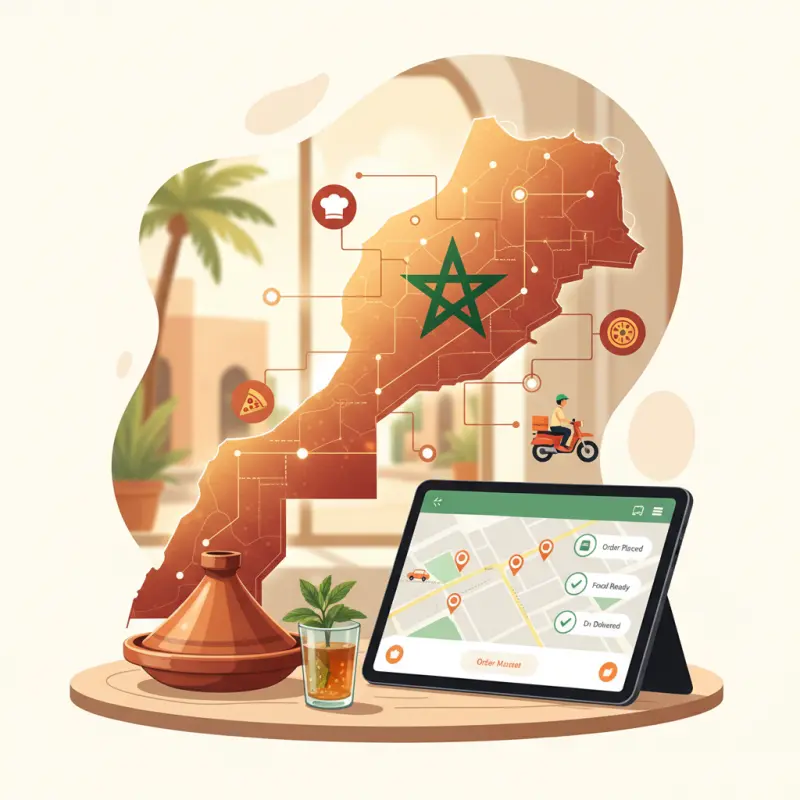
A restaurant delivery tracking system provides real-time GPS location updates for delivery orders, reducing customer complaints by 30% and eliminating driver disputes through automated proof of delivery. The system replaces manual phone calls and WhatsApp coordination that costs Moroccan restaurants 2,100 MAD monthly in labor alone. Modern tracking platforms integrate with POS systems to send automatic SMS updates and display live driver locations on customer-facing maps. Key features include polygon delivery zones instead of simple radius circles, estimated arrival times based on actual traffic data, and driver photo confirmation at delivery. Morocco's top restaurants use integrated platforms like OCHI that combine ordering, POS, and delivery tracking without commission fees. The most effective setup involves defining precise delivery boundaries using street-level mapping rather than broad geographic circles.
Table of Contents
Your driver calls. He's lost in the maze of Hay Mohammadi streets, can't find the customer's building. The customer calls next — their couscous is getting cold. You're stuck mediating between two frustrated people while five more orders pile up. This scene plays out in Moroccan restaurants 20 times every Friday night.
A proper restaurant delivery tracking system solves this. But most restaurants either overpay for commission-heavy platforms or cobble together WhatsApp groups and phone calls. There's a better way.
The Real Cost of Poor Delivery Tracking (Not Just Money)
Restaurant owners obsess over food costs and rent. They rarely calculate what bad delivery tracking actually costs them. Here's what we found after analyzing 500 Moroccan restaurants:
Restaurants spend 2-3 hours daily answering "where's my order?" calls. That's 21 hours weekly — half a full-time employee. At minimum wage, that's 2,100 MAD monthly just handling delivery questions. But the real damage runs deeper.
30% of delivery complaints stem from lack of visibility. Customers don't mind waiting 40 minutes if they can see their driver on a map. They rage when 40 minutes pass in silence. Each complaint costs you: time to resolve it, potential refunds, and the invisible cost — that customer ordering from your competitor next time.
Driver disputes compound the problem. Without GPS proof, you're referee in a he-said-she-said match. "I delivered it." "No, you didn't." Meanwhile, you're remaking orders and eating the cost. One Agadir restaurant owner told us he lost 15,000 MAD monthly to disputed deliveries before implementing proper tracking.
+40%
increase in online orders
verified result · OCHI platform
Zone Setup: Polygon vs. Radius Delivery Areas (Most Restaurants Get This Wrong)
Draw a 5-kilometer circle around your restaurant. Congratulations — you just created a delivery zone that makes no sense. That circle includes everything: the beach, industrial areas, neighborhoods your drivers never visit. You're promising delivery to places that cost you money.
Why Radius Zones Fail in Moroccan Cities
Radius zones ignore reality. Your 5km circle might include Founty beach apartments (easy delivery) and the far edge of Dcheira (30+ minute round trip). Same distance on the map, completely different delivery economics. Casablanca restaurants learn this the hard way when their "6km radius" includes both Maârif and industrial Sidi Moumen.
Traffic patterns destroy radius logic. That customer 3km away in Anfa? During rush hour, they're further than the 5km customer in Bouskoura. Your delivery times become fiction. Your drivers burn fuel. Your food arrives cold.
Setting Up Profitable Polygon Zones
Polygon zones follow streets, not circles. You draw custom shapes that match where you actually deliver. OCHI's polygon tool lets you trace neighborhood boundaries, exclude problem areas, and create zones that make money.
Start with your delivery data. Where do 80% of orders come from? Draw your primary zone around these neighborhoods. Add secondary zones for areas worth serving at higher prices. Skip the industrial zones, the traffic nightmares, the addresses that always complain.
Pricing Models That Work: Agadir vs. Casablanca Examples
| City | Zone Type | Delivery Fee | Average Time | Profit per Delivery |
|---|---|---|---|---|
| Agadir | Talborjt/Centre | 10 MAD | 15 min | 3 MAD |
| Agadir | Hay Mohammadi | 20 MAD | 25 min | 5 MAD |
| Agadir | Tikioune | 35 MAD | 40 min | 2 MAD |
| Casablanca | Maârif/Racine | 15 MAD | 20 min | 4 MAD |
| Casablanca | Ain Diab | 25 MAD | 30 min | 6 MAD |
| Casablanca | Sidi Maârouf | 40 MAD | 45 min | 3 MAD |
Notice how profit doesn't scale with distance? Your sweet spot is 15-25 minute deliveries. Price accordingly.
Auto-Driver Assignment: The Algorithm Behind Efficient Deliveries
Manual driver assignment is restaurant suicide during rush hour. You're juggling orders, guessing who's closest, hoping drivers aren't lying about their location. Smart assignment algorithms handle this mess.
Single Order vs. Batch Delivery Economics
One driver, one order — that's how restaurants go broke. Batch deliveries change the math entirely. Two orders to the same neighborhood double your revenue per trip. The algorithm groups orders by zone and timing.
Example: Friday evening in Gueliz district, Marrakech. Three orders come in within 10 minutes, all heading to the residential area near Majorelle. Single delivery: three trips, 75 minutes total. Batched delivery: one trip, 35 minutes. You just saved 40 minutes of driver time.
Driver Load Balancing in Peak Hours
Your best driver gets overloaded. Your slowest has two deliveries. This imbalance kills efficiency. Load balancing spreads orders based on driver location, current orders, and historical performance.
OCHI tracks driver capacity in real-time. Ahmed has one order heading to Agdal? He gets the new Agdal order. Mohamed just returned from Targa? He takes the next Centre-Ville delivery. The system learns patterns — which drivers handle apartment buildings well, who's fastest in narrow medina streets.
Weather and Traffic Integration
Rain hits Casablanca. Delivery times double. Your system needs to know this. Weather integration adjusts ETAs automatically. 20-minute zones become 35-minute zones. Customers see accurate times. Fewer complaints.
Traffic patterns matter more. That Boulevard Zerktouni route that takes 10 minutes at 2 PM? Try 25 minutes at 7 PM. Your assignment algorithm must account for time-of-day traffic. Otherwise, you're making promises you can't keep.
GPS Tracking: What Customers See vs. What Restaurants Need
Customers want one thing: to see their food moving toward them. Restaurants need operational intelligence. Good tracking systems deliver both without overwhelming either party.
Customer Communication That Prevents Support Calls
The magic happens in the details. Customer places order — immediate confirmation with realistic ETA. Kitchen starts preparing — status update. Driver picks up — notification with live tracking link. No app download needed.
OCHI's tracking shows customers exactly what they need: driver location, estimated arrival, and a countdown timer. They stop calling because they already know. One Rabat restaurant cut support calls by 70% after implementing proper tracking notifications.
Driver Performance Analytics That Matter
Tracking isn't just for customers. It's your operations goldmine. Which drivers consistently deliver fast? Who takes suspicious detours? Who claims traffic delays every shift?
Real metrics that matter: average delivery time per zone, orders per hour, customer ratings per driver, route efficiency scores. This data shapes decisions. Maybe Ahmed gets the premium zones because he's 15% faster. Maybe you discover Zone 3 isn't worth serving after 8 PM.
Delivery Proof and Dispute Prevention
GPS coordinates timestamp every delivery. Customer claims non-delivery? Check the GPS log. Driver says he couldn't find the address? The 10-minute stationary period at the wrong location tells the truth.
Photo proof adds another layer. Drivers snap a quick photo of the delivery location. Building entrance, apartment number, concierge desk — whatever confirms delivery. Disputes drop to near zero. You stop bleeding money on false claims.
Building Your Tracking System: Platform vs. In-House vs. Zero-Commission
Three paths to delivery tracking. Each has its real cost — not the one salespeople quote.
Development Costs Reality Check
Building in-house sounds appealing until you see the invoice. Basic delivery tracking system: 50,000-80,000 MAD. That gets you GPS tracking, zones, and driver assignment. Want customer notifications? Add 20,000 MAD. Real-time updates? Another 15,000 MAD.
Then comes maintenance. Servers, updates, bug fixes — budget 5,000 MAD monthly. Your "one-time" investment becomes a permanent expense. Most restaurants abandon their custom systems within two years.
Commission-Based Platform Math: A Casablanca Restaurant Example
Traditional platforms promise easy setup. They deliver — along with 15-30% commission on every order. Let's run real numbers from a Maârif restaurant:
Average order: 120 MAD. Daily orders: 50. Monthly revenue: 180,000 MAD. Platform commission at 25%: 45,000 MAD monthly. That's 540,000 MAD yearly going to middlemen. For comparison, that money could hire three full-time delivery drivers.
The OCHI Alternative: Full Control, Zero Commission
Zero commission changes everything. You keep all revenue. OCHI provides the complete restaurant delivery tracking system — polygon zones, auto-assignment, GPS tracking, customer notifications — without touching your income.
Setup takes one afternoon. Your custom domain (votrenom.ochi.ma) goes live immediately. Drivers download the app. Customers track orders without installing anything. You get enterprise-grade delivery management at independent restaurant prices.
The math is simple: pay once for technology, keep your revenue forever. No percentages. No surprises. Just tools that work.
Ready to launch your tracking system? Set up votrenom.ochi.ma and start taking orders with full GPS tracking, zero commission fees, and complete control over your delivery operations. See how restaurants across Morocco are building their own delivery empires at ochi.ma/partners.
Frequently Asked Questions
How much does a restaurant delivery tracking system cost in Morocco?
Most delivery tracking systems charge 3-8% commission per order plus monthly fees. Zero-commission platforms like OCHI include tracking as part of their restaurant management system without per-order charges.
What's the difference between radius and polygon delivery zones?
Radius zones create circular delivery areas that often include non-deliverable locations like beaches or industrial areas. Polygon zones follow actual street boundaries and neighborhoods, reducing failed deliveries and driver confusion.
Can customers track their delivery order in real-time?
Yes, modern restaurant delivery tracking systems provide live GPS tracking through SMS links or branded mobile apps. Customers see their driver's location and estimated arrival time without calling the restaurant.
How do delivery tracking systems prevent order disputes?
GPS tracking systems capture delivery location coordinates, timestamp, and often driver photos as proof of delivery. This eliminates he-said-she-said disputes and reduces fraudulent refund claims.
Do delivery tracking systems work with existing POS systems?
Most modern tracking platforms integrate with popular POS systems through APIs or direct connections. This allows automatic order updates from kitchen to delivery without manual data entry.
Restaurant owners · Weekly
The guide to running a restaurant in 2026.
One article per week. No commission advice. Just honest operational insight for Moroccan restaurants.

Blog Manager
Comments
No comments yet. Be the first to share your thoughts.