AI Overview
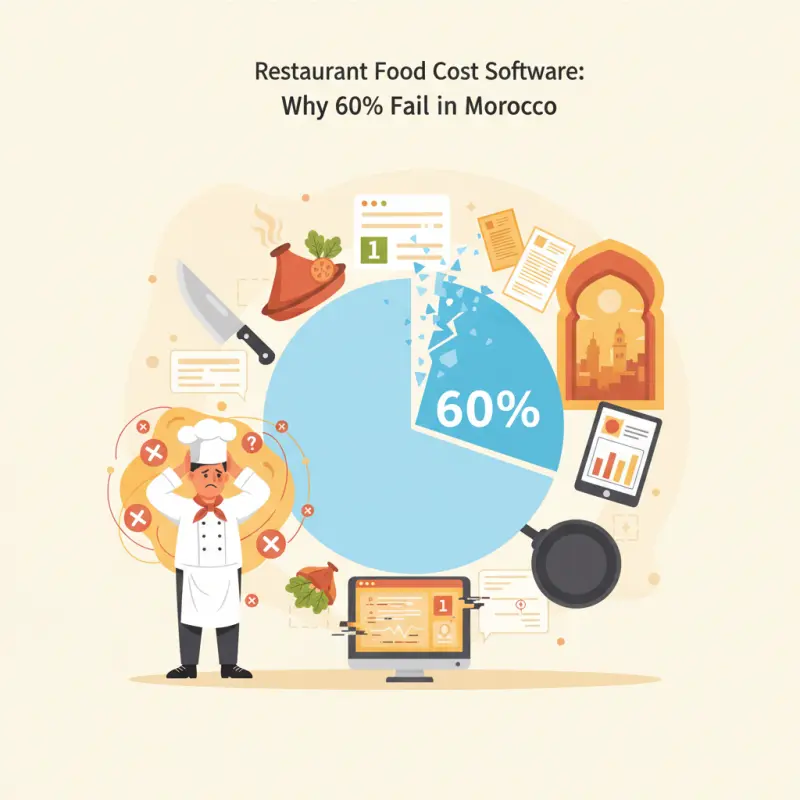
Restaurant food cost software fails in 60% of Moroccan restaurants within six months because systems fight against kitchen workflow instead of supporting it. Traditional restaurant food cost software demands impossible workflows — asking line cooks to pause mid-service to log every ingredient gram used. This creates a staff adoption barrier that kills accuracy. Walk into any Casablanca kitchen during lunch rush and you'll see controlled chaos with orders flying and flames dancing. When prep cooks must stop between orders to update inventory, they skip updates to keep service moving. By week's end, data reflects maybe 40% of actual usage. Inaccurate data creates cascading failures — your system shows 10 kilos of beef in stock while you actually ran out yesterday. Purchase decisions based on bad data lead to emergency orders at premium prices. Choose restaurant management platforms that integrate naturally with existing kitchen workflows rather than disrupting them.
Table of Contents
Your head chef just told you the lamb tagine costs 45 MAD to make — but your books show you're losing money on every order. This disconnect between perceived and actual food costs destroys more Moroccan restaurants than any other operational failure.
Restaurant food cost software promises to solve this. Yet 60% of restaurants abandon their systems within six months, returning to spreadsheets and guesswork. The problem isn't the technology — it's how restaurants implement it.
Why Restaurant Food Cost Software Fails 60% of the Time
Most restaurant software inventory systems become expensive digital paperwork. Owners invest thousands in platforms that promise cost control, then watch their staff ignore the system entirely. The software sits unused while food costs spiral.
The core issue: these systems fight against kitchen workflow instead of supporting it. When your prep cook needs to stop mid-service to log every gram of onions used, the system fails. When your chef can't quickly check stock levels between orders, accuracy dies.
Staff adoption barriers in Moroccan kitchens
Walk into any kitchen in Casablanca during lunch rush. The controlled chaos has its own rhythm — orders flying, flames dancing, plates moving. Now imagine asking your line cook to pause and update inventory after each dish.
Traditional restaurant inventory management software demands this impossible workflow. Staff skip updates to keep service moving. By week's end, your data reflects maybe 40% of actual usage. The software becomes fiction.
The data accuracy problem
Inaccurate data creates a cascade of failures. Your restaurant stock management software shows 10 kilos of beef in stock. Reality: you ran out yesterday. Your sous chef already placed an emergency order at premium prices.
This scenario repeats daily across Morocco. Purchase decisions based on bad data. Menu pricing using imaginary costs. Waste hidden behind estimation errors. The software that promised clarity delivers confusion.
Why recipe costing means nothing without inventory tracking
Your restaurant inventory program calculates perfect recipe costs. Each harira soup should cost 18 MAD to produce. But without real-time inventory depletion, that number means nothing.
Recipe costing without inventory tracking is like navigation without GPS. You know the destination but not your current location. Most restaurants discover they're off course only during monthly inventory counts — far too late to correct.
Food cost calculator
What’s your real margin?
Food cost
29.2%
Gross margin
70.8%
Profit / dish
85 MAD
Healthy · under 30%
Digitize your menu with OCHIThe Real Cost of Manual Food Tracking in Casablanca Restaurants
Manual tracking hides massive profit leaks. Restaurants using paper systems or basic spreadsheets typically operate with 23% food waste — nearly a quarter of all purchases spoil, expire, or disappear.
For a mid-size restaurant in Casablanca purchasing 200,000 MAD monthly in ingredients, that's 46,000 MAD vanishing. Not from theft or catastrophic spoilage — from the thousand small failures that manual systems can't catch.
23% average waste rate in manual operations
This 23% breaks down predictably. Over-ordering contributes 8% — buying ingredients "just in case" because you lack accurate usage data. Spoilage adds another 7% from poor rotation and forgotten inventory. The remaining 8% disappears through portion inconsistency and prep waste.
Each percentage point of waste reduction equals pure profit. Cut waste from 23% to 18% and you've added 10,000 MAD monthly to your bottom line — without selling a single extra meal.
Hidden costs: time, spoilage, over-ordering
| Hidden Cost Category | Monthly Impact (200K MAD inventory) | Annual Loss |
|---|---|---|
| Manager time on manual counts | 40 hours @ 50 MAD = 2,000 MAD | 24,000 MAD |
| Emergency orders (10% premium) | 3,000 MAD average | 36,000 MAD |
| Spoilage from poor rotation | 14,000 MAD (7% of purchases) | 168,000 MAD |
| Over-portioning without controls | 8,000 MAD (4% variance) | 96,000 MAD |
| Total Hidden Costs | 27,000 MAD | 324,000 MAD |
Labor hours lost to inventory guesswork
Your manager spends every Sunday counting stock. Six hours walking freezers, weighing produce, estimating levels. Another four hours building purchase orders based on gut feeling plus last week's sales.
Ten hours weekly of your highest-paid staff's time — devoted to guesswork. That's 520 hours annually that could focus on training, quality improvement, or customer service. Instead, they're counting chickpeas.
Gram-Level Tracking Changes Everything
The restaurant industry accepts "close enough" as standard. A handful of rice here, an extra splash of oil there — minor variances that compound into major losses. This acceptance of imprecision costs the average restaurant 2,000 MAD monthly.
Precision matters because small variances multiply. If each plate of couscous uses 20 grams extra semolina, and you serve 50 plates daily, that's one kilo of waste per day. At 15 MAD per kilo, you're losing 450 MAD monthly on one ingredient in one dish.
Why "close enough" costs you 2,000 MAD monthly
Restaurant food cost software that tracks in "units" or "portions" perpetuates this problem. How much chicken is in "one portion"? Does your morning chef's portion match your evening chef's? These systems institutionalize imprecision.
Gram-level tracking eliminates ambiguity. When your system knows you used exactly 180 grams of lamb for that tagine, not "about one portion," you get true costs. Multiply this precision across every ingredient, every dish, every day — that's where profit lives.
Recipe standardization vs. chef creativity
Chefs resist standardization, viewing it as creativity's enemy. But precision tracking actually enhances creativity by revealing true costs. Your chef can still innovate — now with full knowledge of each experiment's financial impact.
A chef in Agadir discovered his signature seafood pastilla variation cost 15 MAD more than the standard version. With that knowledge, he adjusted portions slightly and created a premium option. Creativity guided by data, not constrained by it.
The compound effect of precise measurements
Precision compounds. Accurate ingredient tracking enables accurate recipe costing. Accurate costing allows optimal menu pricing. Optimal pricing drives proper purchasing. Each step builds on the previous accuracy.
This compound effect transforms operations. Restaurants using gram-level tracking report 15-30% waste reduction within 90 days. Not through dramatic changes — through thousands of tiny improvements that precise data enables.
OCHI's Inventory System in Action — Real Waste Reduction
A seafood restaurant in Agadir's marina district struggled with 25% food waste. Fresh fish spoilage, over-ordering, and portion inconsistency drained profits despite strong sales. They needed more than restaurant inventory management software — they needed a system that worked with their workflow.
OCHI's approach differs: real-time POS integration means every sale automatically depletes inventory. No manual updates during service. Gram-level ingredient tracking reveals true usage patterns. Low-stock alerts prevent emergency orders. The result: waste dropped to 12% in 90 days.
25% to 12% waste reduction — the 90-day process
Month one focused on baseline data. The restaurant tracked every gram without changing operations. OCHI's system revealed surprising patterns — Tuesday fish deliveries often spoiled by Friday, certain dishes used 30% more oil than recipes specified.
Month two implemented controls. Automatic reorder points based on real usage data. Recipe adjustments to match actual preparation. Staff training on the waiter panel for accurate order entry. Small changes guided by precise data.
Month three optimized. With accurate data flowing, patterns emerged. Thursday deliveries reduced spoilage. Prep quantities matched actual demand. The 13% waste reduction translated to 58,500 MAD monthly savings on their 450,000 MAD food spend.
Automatic reorder points that actually work
OCHI's reorder system learns from your actual usage, not theoretical pars. It knows you use 12 kilos of tomatoes on average Fridays, but only seven on Mondays. It factors in lead times, shelf life, and seasonal patterns.
The marina restaurant set minimum levels for each ingredient based on two days' average usage. When fresh fish stocks hit the minimum, purchase orders generate automatically. No more stockouts. No more panic buying. Just smooth, predictable operations.
Integration with POS for real-time cost tracking
Every sale updates inventory instantly through POS integration. Sell a fish tagine, and OCHI deducts exactly 200g white fish, 50g olives, 150g tomatoes, and every other ingredient. Your food costs stay current to the minute.
This real-time visibility transforms decision-making. The Agadir restaurant discovered lunch specials were losing money after 2 PM when ingredient costs shifted. They adjusted pricing by daypart and restored profitability without reducing portions.
Building Your Food Cost Control System
Implementation determines success. The best restaurant food cost software fails without proper rollout. Start small, build habits, then expand. This graduated approach ensures adoption while delivering quick wins.
Week 1: Baseline your current waste
Count everything. Weigh all ingredients. Track every spoiled item. Document portions actually served versus recipe specifications. This baseline reveals your true starting point — often shocking but always valuable.
Use your existing methods for this week. Don't change operations yet. Just observe and document. Most restaurants discover they're wasting 20-30% more than they believed. That shock motivates change.
Week 2-4: Staff training on accurate logging
Train one station at a time. Start with prep staff — they control initial portions. Show them how accurate logging helps predict needs and prevents shortages. Make the system their ally, not their supervisor.
OCHI's kitchen display system (KDS) makes logging natural. As orders complete, inventory updates automatically. Staff see stock levels on the same screens they use for orders. The system fits their workflow rather than disrupting it.
Month 2: Automated reorder implementation
With accurate usage data from month one, set intelligent reorder points. Start conservatively — better to adjust upward than deal with spoilage. Factor in your delivery schedules and storage capacity.
Monitor the automated suggestions before fully trusting them. OCHI's system shows recommended orders with reasoning. Review these for two weeks, adjust parameters as needed, then let automation handle routine reordering.
Month 3: Recipe optimization based on data
Now you have real data on actual versus theoretical usage. That "250g" steak averages 280g after trimming. Your chef adds extra spices to the morning prep. These variances aren't problems — they're reality.
Adjust your recipes to match reality, or train to meet targets. Either approach works — but now you're choosing based on data, not guessing. Most restaurants find a middle ground: standardizing high-cost ingredients while allowing flexibility on low-impact items.
The path from 25% waste to 12% isn't magic — it's measurement. When you know exactly what you're losing and where, solutions become obvious. The right restaurant food cost software doesn't just track inventory. It transforms how you think about every ingredient, every dish, every dirham.
Ready to see what precision tracking can do for your restaurant's profits? Explore OCHI's complete inventory management system at ochi.ma/partners — where your restaurant gets the tools that actually reduce waste.
Frequently Asked Questions
Why do most restaurant food cost software systems fail?
Most restaurant food cost software systems fail because they fight against kitchen workflow instead of supporting it. Staff skip updates to keep service moving, creating data accuracy problems that make the software unreliable.
What percentage of restaurants abandon their food cost software?
60% of restaurants abandon their food cost software systems within six months, returning to spreadsheets and guesswork. The problem isn't the technology — it's poor implementation and workflow integration.
How does inaccurate food cost data affect restaurants?
Inaccurate food cost data leads to purchase decisions based on wrong information, menu pricing using imaginary costs, and hidden waste. This creates emergency ordering at premium prices and destroys profit margins.
What makes restaurant inventory management software successful?
Successful restaurant inventory management software integrates naturally with existing kitchen workflows. It allows quick stock checks between orders without disrupting service flow or requiring complex data entry procedures.
How can Moroccan restaurants improve food cost control?
Moroccan restaurants can improve food cost control by choosing software that works with their kitchen's natural rhythm. Focus on platforms that require minimal staff training and provide real-time data without workflow disruption.
Restaurant owners · Weekly
The guide to running a restaurant in 2026.
One article per week. No commission advice. Just honest operational insight for Moroccan restaurants.

Blog Manager
Comments
No comments yet. Be the first to share your thoughts.