AI Overview
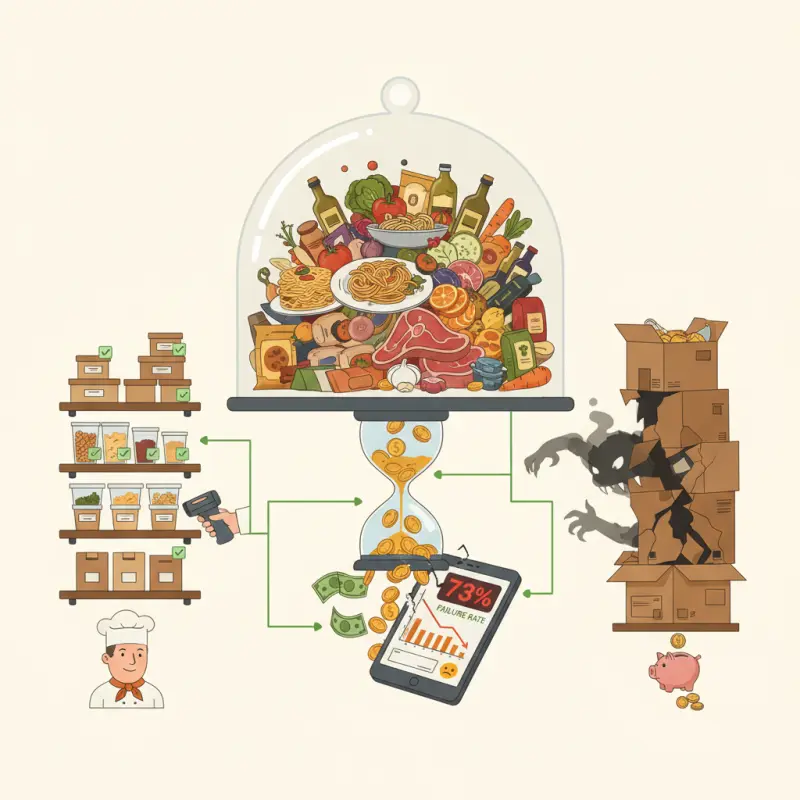
Poor inventory control causes 73% of restaurant failures, with Moroccan establishments losing 22-35% of ingredients to waste, theft, and over-ordering. A restaurant inventory control system replaces manual tracking that costs businesses 180 hours monthly and creates 15-20% accuracy loss. Restaurant Andalusia in Casablanca lost 4,800 MAD monthly from over-ordering perishables using only clipboard tracking. Manual systems force staff to spend six hours daily counting stock, writing orders, and reconciling deliveries instead of serving customers. Automated inventory systems integrate with POS data, track ingredient usage in real-time, and generate purchase orders based on actual consumption patterns. Start by digitizing your three highest-cost ingredients to immediately reduce waste and free up cash flow.
Table of Contents
Why 73% of Restaurant Failures Start in the Storage Room
Every restaurant owner in Morocco knows the feeling. You walk into your storage room Monday morning and find expired produce, missing inventory, and order sheets that don't match reality. What most don't know: this chaos kills more restaurants than bad food ever will.
The numbers tell a brutal story. The average Moroccan restaurant loses between 22% and 35% of ingredients to waste, theft, and over-ordering. That's not a typo. For a mid-sized restaurant in Casablanca buying 50,000 MAD of ingredients monthly, that's 11,000 to 17,500 MAD vanishing into thin air. Every month.
Take Restaurant Andalusia near Hassan II Boulevard. Their owner discovered they were losing 4,800 MAD monthly just from over-ordering perishables. Not theft. Not spoilage. Just ordering tomatoes when they already had three crates in the walk-in. Their restaurant inventory control system consisted of a clipboard and good intentions. It wasn't enough.
The ripple effect destroys more than margins. When you're bleeding inventory, you tie up cash in excess stock. You can't pay suppliers on time. Your menu pricing becomes guesswork. Staff morale drops as they navigate the chaos. Eventually, the weight of operational inefficiency crushes even restaurants with loyal customers and great food.
Stack audit
What do you currently use?
Tick what you have. We’ll show what OCHI replaces or connects to.
The Manual Inventory Trap: Why Pen and Paper Cost You 180 Hours Monthly
Restaurant owners defend manual inventory with three words: "It works fine." Let's examine what "fine" actually costs.
The Hidden Time Tax
Your staff spends six hours daily on inventory tasks. Counting stock before service. Writing purchase orders. Reconciling deliveries. Updating recipe cards. Calculating food costs. Six hours. Every day. That's 180 hours monthly — the equivalent of a full-time employee doing nothing but paperwork.
Manual systems average 15% to 20% accuracy loss. Human error compounds. Someone miscounts. Handwriting gets misread. Orders get duplicated. By month's end, your numbers are fiction. You're making thousand-dirham decisions based on data that's 80% accurate at best.
The opportunity cost hurts most. While your manager counts chickpeas in the storage room, who's training new servers? Who's greeting VIP guests? Who's spotting the small problems before they become big ones? Time spent on manual restaurant stock management software tasks is time stolen from growing your business.
Why "Good Enough" Inventory Never Is
Most restaurants accept 80% inventory accuracy as normal. "Close enough," they say. "We've always done it this way." This thinking is restaurant suicide in slow motion.
At 80% accuracy, you don't know if that missing 20% walked out the back door or spoiled in the cooler. You can't identify which dishes hemorrhage profit. You can't negotiate with suppliers because you don't know your true usage. You're running blind, hoping experience and intuition compensate for missing data. They don't.
Restaurant Inventory Control System: The 90-Day Implementation Roadmap
Switching from clipboards to digital tracking feels overwhelming. It doesn't have to be. Here's a proven roadmap that works for Moroccan restaurant operations.
Week 1-2: Audit Your Current Disaster
Start with brutal honesty. Count everything manually one last time. Every spice jar. Every frozen shrimp. Every napkin. This baseline measurement shows where you stand.
Track waste sources for 14 days. Create categories: expired, damaged, theft, over-production, other. Weigh waste daily. Note patterns. Which days generate most waste? Which items spoil repeatedly? This data becomes your benchmark.
Calculate the true cost of your current system. Include staff hours, waste value, over-ordering costs, and stockout losses. Most owners discover they're losing 15,000 to 30,000 MAD monthly. That number motivates change.
Week 3-8: System Selection and Setup
Moroccan restaurants need specific features. Arabic language support matters when your kitchen staff speaks Darija. Supplier integration saves hours on ordering. Multi-branch support helps growing restaurants maintain consistency. Your restaurant software inventory must handle grams and kilograms, not just units.
OCHI's platform addresses these needs directly. Track ingredients down to the gram. Build recipe cards that automatically deduct inventory. Set low-stock alerts by item and branch. Access a built-in supplier directory. Generate purchase orders with one click. The system speaks Arabic, French, and English — your team works in their preferred language.
Staff training happens in phases. Start with managers learning the system basics. Then train receiving staff on logging deliveries. Kitchen staff learn recipe logging next. Finally, everyone understands their daily tasks. Schedule training during slow afternoon hours. Keep service running smoothly.
Week 9-12: Optimization and ROI Measurement
Fine-tune alert thresholds based on actual usage patterns. Set reorder points that prevent stockouts without creating excess. Adjust par levels as you learn your true consumption rates.
Measure waste reduction weekly. Most restaurants see 15% to 30% improvement within 90 days. Track specific categories. Celebrate small wins with staff. Make inventory accuracy everyone's responsibility.
Build your ROI calculation framework. Compare current costs against baseline. Include time savings, waste reduction, and prevented stockouts. Document everything. This data justifies the investment and guides future improvements.
Case Study: How Restaurant Al Waha Cut Waste by 27% in 90 Days
Al Waha, a 120-seat restaurant in Agadir's tourist district, struggled with inventory chaos. Their problems sound familiar: 8,200 MAD monthly waste, 12 hours daily spent on inventory tasks, constant stockouts of popular items, and suppliers demanding cash on delivery due to payment delays.
Implementation started rough. Senior staff resisted change. "We've used clipboards for 20 years," they argued. The chef worried about recipe secrets. Servers didn't understand why inventory mattered to them. The first week felt like stepping backward.
Week two brought breakthrough. The receiving supervisor discovered they'd been double-ordering rice for months. The chef saw his actual food costs for the first time — several dishes lost money. The restaurant inventory program revealed patterns invisible to human observation.
After 90 days, the numbers told a new story. Monthly waste dropped to 5,980 MAD — a 27% reduction. Daily inventory tasks shrank to four hours. Stockouts became rare. Suppliers offered better terms based on consistent payment. The system paid for itself in five weeks through waste reduction alone.
| Metric | Before OCHI | After 90 Days | Improvement |
|---|---|---|---|
| Monthly Waste | 8,200 MAD | 5,980 MAD | 27% reduction |
| Daily Inventory Hours | 12 hours | 4 hours | 67% reduction |
| Stock Accuracy | ~75% | 94% | 25% improvement |
| Monthly Stockouts | 18 items | 3 items | 83% reduction |
The Real ROI of Restaurant Inventory Management Software in Morocco
Investment decisions need hard numbers. Here's when inventory software makes financial sense for different restaurant sizes.
Break-Even Analysis by Restaurant Size
Small restaurants serving under 50 covers daily break even when software reduces waste by 1,800 MAD monthly. That's typically a 10% to 15% waste reduction — achievable within 60 days. Factor in four hours of daily time savings, and the investment pays dividends immediately.
Medium restaurants (50 to 150 covers) need 4,200 MAD monthly savings to break even. Most achieve this through a combination of waste reduction, better supplier negotiations, and eliminated stockouts. The larger ingredient volume means small percentage improvements yield big results.
Large restaurants serving over 150 covers break even at 8,000 MAD monthly savings. These operations see massive returns. Multi-branch coordination alone saves thousands. Centralized purchasing power negotiates better prices. Standardized recipes ensure consistency across locations.
OCHI's Zero-Commission Advantage
Traditional ordering platforms take 15% to 25% commission on every order. OCHI takes zero. This matters for inventory ROI calculations.
When you reduce waste by 5,000 MAD monthly using OCHI's restaurant inventory management software, you keep all 5,000 MAD. On commission-based platforms, you'd lose 750 to 1,250 MAD of those savings to platform fees. Your improvements fund their profits.
OCHI charges a predictable monthly fee. No surprises. No percentage cuts. Your operational improvements stay in your pocket. Combined with integrated inventory tracking, recipe management, and supplier tools, the platform pays for itself through efficiency gains alone.
Ready to cut your restaurant waste by 25%? Set up your free OCHI inventory system at votrenom.ochi.ma and start tracking every ingredient down to the gram. See how other Moroccan restaurants transformed their operations, or explore the full platform at ochi.ma/partners.
The best inventory system isn't the most complex or expensive. It's the one your team actually uses. Start simple. Measure everything. Let the numbers guide you to profitability.
Frequently Asked Questions
What percentage of restaurant inventory is typically wasted in Morocco?
Moroccan restaurants lose 22-35% of ingredients to waste, theft, and over-ordering. This represents 11,000-17,500 MAD monthly for mid-sized restaurants spending 50,000 MAD on ingredients.
How much time do restaurants spend on manual inventory management?
Manual inventory systems require 180 hours monthly of staff time. This includes six hours daily spent counting stock, writing orders, reconciling deliveries, and calculating food costs.
What accuracy rate do manual restaurant inventory systems achieve?
Manual inventory tracking averages 15-20% accuracy loss due to miscounts, illegible handwriting, and duplicated orders. Human error compounds over time.
How does poor inventory control affect restaurant cash flow?
Inventory waste ties up cash in excess stock, delays supplier payments, and makes menu pricing guesswork. This operational inefficiency can crush restaurants despite loyal customers and quality food.
What features should a restaurant inventory control system include?
Effective systems integrate with POS data, track real-time ingredient usage, generate automatic purchase orders, and provide waste analytics. They should eliminate manual counting and reduce human error.
Restaurant owners · Weekly
The guide to running a restaurant in 2026.
One article per week. No commission advice. Just honest operational insight for Moroccan restaurants.

Blog Manager
Comments
No comments yet. Be the first to share your thoughts.