AI Overview
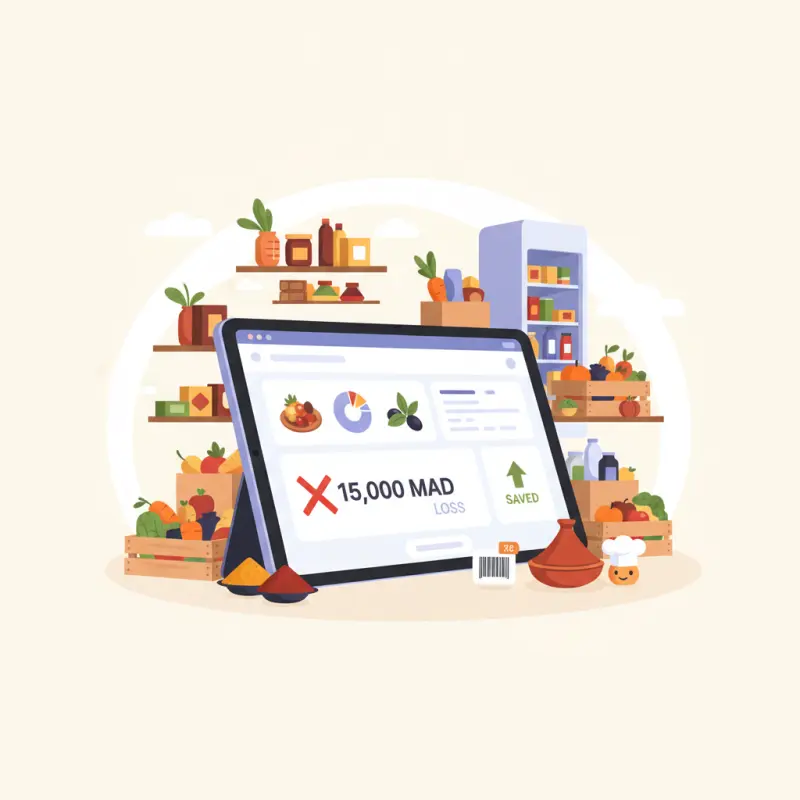
Restaurant inventory management software prevents monthly losses of 15,000 MAD by tracking inventory in real-time, standardizing portions, and catching supplier discrepancies immediately. Traditional spreadsheet methods miss over-portioning during lunch rushes, expired ingredients, and recipe drift that increases food costs by 2-3% monthly. Casablanca restaurants using proper restaurant inventory management software report catching short deliveries, reducing spoilage through automated alerts, and maintaining consistent portion sizes across shifts. The software integrates with POS systems to track ingredient usage per dish, enabling accurate menu costing and profitability analysis. Restaurant owners can identify which menu items operate at true costs versus perceived margins, often discovering popular dishes that lose money. Track every gram of ingredient usage and set automated reorder points based on actual consumption patterns rather than guesswork.
Table of Contents
The 30% Food Cost Problem Most Restaurants Accept as "Normal"
Your restaurant loses 15,000 MAD every month to inventory mismanagement. That's not a typo. A typical 50-seat restaurant in Casablanca accepting 30% food costs as "industry standard" is bleeding money through gaps only proper restaurant inventory management software can plug.
The bleeding happens quietly. A case of tomatoes ordered twice because Chef Mohammed and your supplier both thought the other hadn't placed the order. Mint tea leaves spoiling in storage because no one tracked the previous week's oversupply. Your signature tagine recipe using 20% more meat than costed because portions aren't standardized. These aren't dramatic failures — they're Tuesday.
Why Your Current Spreadsheet Method Costs You 12,000 MAD Monthly
That Excel file your manager updates weekly? It's lying to you. By the time numbers hit the spreadsheet, you've already lost money to expired products, over-portioning, and supplier price creep nobody noticed. Restaurant stock management software catches these losses in real-time, not after your monthly P&L reveals another disappointing margin.
Consider what happens during a typical Thursday lunch rush. Your line cook grabs ingredients without weighing. Your supplier delivers 10% less than invoiced, but nobody catches it until inventory day. Your bartender free-pours that 45 MAD cocktail with 60 MAD worth of alcohol. Each incident seems minor. Together, they cost you 400 MAD daily — that's 12,000 MAD monthly vanishing into thin air.
The Three Hidden Costs Beyond Spoilage
Spoilage gets the attention, but three silent killers hurt more. First: recipe drift. Without gram-level tracking, your food costs float up 2-3% monthly as portions grow. Second: supplier accountability. When you can't prove short deliveries or quality issues with data, you eat the loss. Third: menu engineering blindness. You keep serving that vegetable couscous at 35 MAD because you don't know it costs 31 MAD to make after recent price increases.
Restaurant inventory control software transforms these unknowns into actionable data. You see exactly which items hemorrhage margin, which suppliers consistently short-deliver, and which recipes need repricing.
Stack audit
What do you currently use?
Tick what you have. We’ll show what OCHI replaces or connects to.
What Restaurant Inventory Management Software Actually Does (Beyond Counting Stock)
Forget basic counting. Modern restaurant software inventory predicts next week's needs based on historical patterns, weather data, and local events. It flags when your olive oil supplier's prices creep up 15% over three months. It tells you that switching from imported to local almonds would save 2,800 MAD monthly without compromising quality.
Recipe Costing That Updates With Market Prices
Your harira soup recipe hasn't been recosted since Ramadan 2023. Since then, tomato prices jumped 20%, lentils increased 15%, and saffron nearly doubled. A proper restaurant inventory program automatically recalculates recipe costs when ingredient prices change, keeping your margins honest.
OCHI's recipe builder tracks ingredients down to the gram, linking directly to current supplier prices. When tomato costs spike, you see the exact impact on every dish using tomatoes — from your 45 MAD harira to your 120 MAD seafood paella. No surprises at month-end.
Supplier Performance Analytics You're Not Getting
Which supplier consistently delivers late on Fridays? Who shorts you on weight most often? Whose quality dropped after they switched sources? Without data, you're guessing. With proper tracking, patterns emerge that save thousands monthly.
| Supplier Issue | Monthly Cost Impact | Detection Without Software | Detection With Software |
|---|---|---|---|
| 5% short weights | 2,500 MAD | Rarely caught | Same-day alerts |
| Price creep (2% monthly) | 3,200 MAD | Quarterly review | Real-time tracking |
| Quality variance | 1,800 MAD (waste) | Chef complaints | Delivery ratings |
The Purchase Order Automation Most Platforms Hide Behind Paywalls
Tuesday morning. You need to order from six suppliers before noon. Most platforms make you pay extra for purchase order features. OCHI includes full purchase order management — create, send, track, and automatically update stock when deliveries arrive. No premium tier. No add-on fees.
The Gram-Level Tracking Requirement Most Software Can't Handle
Here's what Silicon Valley doesn't understand about Moroccan restaurants: you don't buy harissa by the jar. You buy it by weight from Souk El Had. Your olives come in varying sizes. Your meat portions depend on the cut. American-designed restaurant inventory management software assumes standardized units that don't exist in local markets.
Why "Per Unit" Tracking Fails in Moroccan Restaurants
When your software only tracks "units," you lose precision. A "unit" of chicken could be 1.2kg from your Tuesday supplier or 900g from your Thursday backup. That 300g difference? It's 15 MAD per bird, multiplied by 50 orders daily. You just lost 750 MAD because your system can't handle weight variations.
Local market realities demand flexibility. Your supplier sells preserved lemons by the piece Monday, by weight Wednesday, and by the bucket during peak season. Restaurant stock management software built for McDonald's can't handle this. You need tools designed for how Moroccan restaurants actually operate.
The OCHI Difference: Tracking Harissa by the Gram, Not the Jar
OCHI's inventory system handles multiple units per ingredient. Buy saffron by the gram, track usage by the pinch, cost recipes by the serving. Purchase olive oil by the 5L container, portion by the tablespoon, track waste by the milliliter. This granularity catches the small leaks that become floods.
Real example: tracking couscous by weight instead of "bags" revealed a Marrakech restaurant was losing 200g per 5kg bag to moisture and handling. That's 4% waste hidden by imprecise tracking — recovered simply by measuring accurately.
Real Implementation: How Restaurant Dar Nakhla Cut Waste by 25% in Agadir
Dar Nakhla, a 70-seat seafood restaurant near Agadir Marina, hemorrhaged money through inventory chaos. Three different suppliers for the same products. No portion control. Zero waste tracking. Their 35% food cost seemed unchangeable — until they implemented proper restaurant inventory control software.
Month One: The Baseline Reality Check
The first month hurt. OCHI's system revealed Dar Nakhla threw away 18,000 MAD worth of seafood monthly. Not from spoilage — from over-prep. Their kitchen prepped for 200 covers daily but averaged 140. That optimism cost 600 MAD in discarded fish every single day.
Supplier analysis showed more pain. They paid 15% above market rate for vegetables because they split orders between three vendors, losing bulk pricing. Their olive oil "deal" from a friend's cousin? Actually 20% more expensive than market rate after factoring in inconsistent quality.
Month Three: Where the Savings Actually Came From
By month three, food costs dropped from 35% to 28%. The savings came from mundane changes: consolidated suppliers, tighter prep lists, and gram-accurate portions. Their signature grilled fish platter — previously portioned "by eye" — now used consistent 220g portions. This alone saved 4,000 MAD monthly without a single customer complaint.
The purchase order system eliminated double-orders and forgotten items. Automated low-stock alerts meant no more emergency supplier runs at premium prices. Simple changes, massive impact.
The Unexpected Benefit: Staff Training Time Cut by 40%
New line cooks previously needed two weeks to learn portion sizes. With digital recipe cards showing exact weights and photos, training time dropped to three days. The system became the trainer, enforcing consistency across shifts.
The True Cost Breakdown: What You'll Actually Pay (And Save)
Let's talk real numbers. Traditional restaurant software inventory runs 2,000-5,000 MAD monthly. Add training, setup, and integration fees — you're looking at 15,000 MAD just to start. But here's what vendors don't advertise: the real cost isn't the software.
Platform Costs vs. Commission Losses: The Math Most Owners Miss
A restaurant doing 300,000 MAD monthly through delivery platforms pays 90,000 MAD in commissions (30%). That's your entire inventory software budget for three years — gone in one month. OCHI's zero-commission model means those savings fund your entire tech stack with money left over.
| Cost Category | Traditional Platform | OCHI Platform | Monthly Difference |
|---|---|---|---|
| Software fees | 3,500 MAD | Included | 3,500 MAD saved |
| Delivery commissions (300K revenue) | 90,000 MAD | 0 MAD | 90,000 MAD saved |
| Integration costs | 5,000 MAD setup | 0 MAD | 5,000 MAD saved |
| Training | 2,000 MAD | Free support | 2,000 MAD saved |
Why "Free" Inventory Software Costs More Than Paid Solutions
That free inventory app? It's free because you're the product. Limited features force upgrades. No support means lost productivity. Missing integrations create data silos. "Free" software charging 30% delivery commission costs infinitely more than paid solutions.
OCHI includes full inventory management — recipe costing, supplier tracking, purchase orders, multi-branch stock movements — inside the platform. No modules to buy. No features to unlock. Just tools that work from day one at votrenom.ochi.ma.
Restaurant inventory management software isn't about counting chickens. It's about knowing exactly why your Tuesday profit margins beat Thursday's, which supplier relationships actually serve you, and where every dirham goes. The question isn't whether you need it — it's how much money you'll lose before you get it. See what OCHI can do for your restaurant at ochi.ma/partners.
Frequently Asked Questions
How much money can restaurant inventory management software save monthly?
Restaurant inventory management software typically saves 12,000-15,000 MAD monthly for a 50-seat restaurant by preventing over-portioning, catching supplier discrepancies, and reducing spoilage through real-time tracking.
What makes restaurant inventory management software better than Excel spreadsheets?
Restaurant inventory management software tracks inventory in real-time rather than weekly updates, automatically catches portion drift and supplier discrepancies, and integrates with POS systems to track ingredient usage per dish.
Can restaurant inventory software track ingredient usage per recipe?
Yes, restaurant inventory management software tracks gram-level ingredient usage per recipe, preventing recipe drift and maintaining consistent food costs across all shifts and staff members.
Does restaurant inventory software work with existing POS systems?
Most restaurant inventory management software integrates with popular POS systems to automatically deduct ingredients when dishes are sold, providing real-time inventory updates and accurate cost tracking.
Restaurant owners · Weekly
The guide to running a restaurant in 2026.
One article per week. No commission advice. Just honest operational insight for Moroccan restaurants.

Blog Manager
Comments
No comments yet. Be the first to share your thoughts.