AI Overview
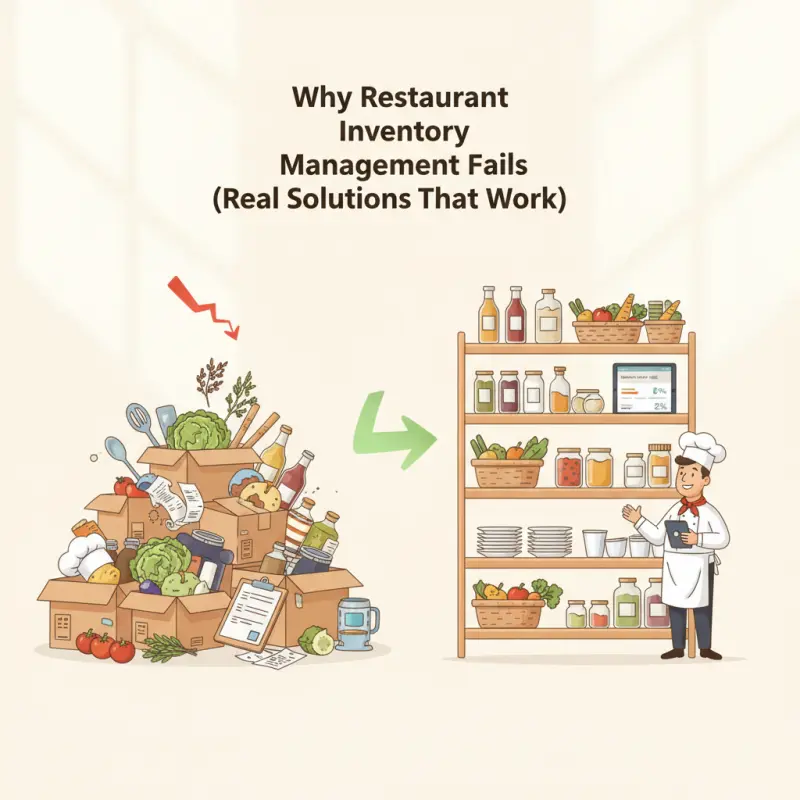
Most restaurant inventory management fails because it counts units instead of tracking actual usage and waste patterns. Traditional inventory methods create an illusion of control while restaurants lose an average of 25% of food costs to waste, theft, and over-portioning. A mid-size restaurant in Casablanca purchasing 100,000 MAD monthly loses 25,000 MAD to invisible waste. Modern restaurant stock management software tracks grams, not guesses, providing visibility into where every dirham goes from delivery to plate. Restaurants using proper tracking systems typically reduce waste from 25% to 15%, saving 120,000 MAD annually on 100,000 MAD monthly purchases. The key difference lies between counting what's in storage versus tracking what actually reaches customers. Start by measuring portion weights for your three highest-cost ingredients to identify over-portioning patterns immediately.
Table of Contents
Why Most Restaurant Inventory Management Fails (And It's Not What You Think)
Walk into any restaurant kitchen in Casablanca at closing time and you'll see the same scene: a tired chef counting boxes, scribbling numbers on a clipboard, convinced they're tracking inventory. They're not. They're creating an expensive illusion of control while their actual food costs bleed money through a dozen invisible wounds.
The problem isn't laziness or lack of care. It's that traditional restaurant inventory management confuses activity with accuracy. Counting units tells you what's in your freezer. It doesn't tell you that your tagine recipes use 20% more meat than costed, or that your prep cooks routinely over-portion vegetables because "it looks better." Real inventory control tracks grams, not guesses — and most restaurants discover this truth only after months of unexplained losses.
Restaurant owners think they need more discipline. What they actually need is visibility into where every dirham of ingredients goes, from delivery truck to customer plate. The difference between counting and tracking is the difference between hoping and knowing.
Stack audit
What do you currently use?
Tick what you have. We’ll show what OCHI replaces or connects to.
The 25% Rule: How Much Money Walks Out Your Kitchen Door
Here's the number that should keep restaurant owners awake: the average Moroccan restaurant loses 25% of food costs to waste, theft, and over-portioning. Not 25% of profits — 25% of every dirham spent on ingredients. For a mid-size restaurant in Casablanca buying 100,000 MAD of ingredients monthly, that's 25,000 MAD vanishing into thin air.
| Monthly Food Purchases | Waste at 25% | Annual Loss | With 15% Waste | Annual Savings |
|---|---|---|---|---|
| 50,000 MAD | 12,500 MAD | 150,000 MAD | 7,500 MAD | 60,000 MAD |
| 100,000 MAD | 25,000 MAD | 300,000 MAD | 15,000 MAD | 120,000 MAD |
| 200,000 MAD | 50,000 MAD | 600,000 MAD | 30,000 MAD | 240,000 MAD |
Those aren't theoretical numbers. They're based on actual waste audits from restaurants using proper restaurant stock management software to track every gram. The painful truth: most of this waste is preventable with the right systems.
The Hidden Costs Your Spreadsheet Can't See
Beyond direct waste, poor inventory control creates compound losses. Overordering ties up cash and fills limited storage space. Items expire before use because no one tracked dates. Your chef makes emergency supplier runs at premium prices because the system showed stock that didn't exist. Staff spend hours on manual counts that could be automated.
One Agadir seafood restaurant discovered they were spending 3,000 MAD monthly on emergency orders alone — paying 40% premiums for same-day delivery of items they should have ordered normally. Their "inventory system" was a WhatsApp group where staff posted photos of empty shelves.
Restaurant Stock Management Software: Gram-Level vs. Guesswork
Most restaurant software inventory systems fail because they're either too complex (requiring a degree to operate) or too simple (basic spreadsheets that track "bags" instead of actual usage). The reality of Moroccan cuisine demands precision. Your harira recipe doesn't use "some lentils" — it uses exactly 50 grams per portion. Your saffron costs 30 MAD per gram. Guessing means losing money.
Real restaurant inventory management software deducts ingredients at the gram level as orders flow through your POS. Sell ten tagines? The system automatically deducts 2.5 kg of meat, 800g of vegetables, 50g of preserved lemons. No manual entry. No end-of-day guesswork. Just real numbers tied to real sales.
This precision matters more in Morocco than almost anywhere. Our cuisine relies on expensive spices, specific cuts of meat, and seasonal ingredients with volatile prices. A "pinch" of saffron varies by cook — but 0.5 grams is always 0.5 grams. Track grams, track dirhams.
What Actually Works in Restaurant Software Inventory
Effective inventory systems share three characteristics. First, they integrate with your POS for automatic deduction — no double entry. Second, they track at the ingredient level, not the dish level. Third, they connect to suppliers for reorder alerts based on actual usage patterns.
OCHI's inventory module handles this through recipe management that breaks every menu item into ingredients, then tracks those ingredients through purchase, storage, preparation, and sale. Low stock alerts prevent outages. Purchase order integration removes manual reordering. The result: less waste, fewer emergencies, better margins.
Building Your Restaurant Inventory Program: Start With These Three Items
The fastest way to fail at inventory control is trying to track everything on day one. Instead, identify your three highest-cost ingredients and track only those for the first month. For most Moroccan restaurants, that's protein (meat or seafood), cooking oil, and your primary vegetable.
Start simple. Track purchases, track usage through recipes, track waste. After 30 days, you'll have real data on where money disappears. Then add three more items. Build the habit before building the system. Success comes from consistency, not complexity.
The Marrakech Restaurant Case Study
Dar Moha, a 150-seat restaurant in Marrakech, cut waste from 28% to 15% in four months by starting with just olive oil, lamb, and tomatoes. These three items represented 40% of food costs but took minutes to track daily. They discovered their lamb portions averaged 20% over recipe specs — an easy fix that saved 8,000 MAD monthly.
Once they proved the system worked, they expanded to track 20 core ingredients, then integrated supplier ordering through their restaurant inventory management software. Today they track 80 items automatically, with waste holding steady at 14%. The difference funds their expansion to a second location.
Your Next Step: Set Up Inventory Tracking This Week
Stop waiting for the perfect moment or the perfect system. Choose your three highest-cost ingredients and start tracking them this week. Use whatever works — a notebook, a spreadsheet, or restaurant stock management software that grows with you. The key is starting, not perfecting.
If you're ready for a system that handles gram-level tracking, recipe management, and automatic deductions, OCHI's inventory module integrates with your existing operations. Set up your recipes once, then let the system track every gram as orders flow. No more guessing. No more waste. Just clear visibility into where every dirham goes.
The best restaurant inventory program is the one you actually use. Whether that's pen and paper or sophisticated software, the math remains the same: every percentage point you cut from waste drops straight to your bottom line. In a business where 5% profit margins are considered healthy, reducing waste from 25% to 15% can double your profits.
See how gram-level inventory tracking can transform your restaurant's profitability. Join OCHI today at votrenom.ochi.ma.
Frequently Asked Questions
What percentage of food costs do restaurants typically lose to waste?
The average Moroccan restaurant loses 25% of food costs to waste, theft, and over-portioning. Restaurants using proper inventory tracking typically reduce this to 15% or lower.
Why does traditional restaurant inventory management fail?
Traditional methods count units in storage but don't track actual usage, portion sizes, or waste patterns. This creates an illusion of control while missing where money actually disappears.
How much money can proper inventory management save restaurants?
A restaurant spending 100,000 MAD monthly on ingredients can save 120,000 MAD annually by reducing waste from 25% to 15% through proper tracking systems.
What should restaurants track instead of just counting inventory?
Track actual usage by weight, portion consistency, waste patterns, and the flow from delivery to customer plate. Focus on grams and dirhams, not just unit counts.
How can restaurants start improving inventory management immediately?
Begin by weighing portions for your three highest-cost ingredients to identify over-portioning patterns. This reveals immediate waste sources without complex systems.
Restaurant owners · Weekly
The guide to running a restaurant in 2026.
One article per week. No commission advice. Just honest operational insight for Moroccan restaurants.

Blog Manager
Comments
No comments yet. Be the first to share your thoughts.