AI Overview
Restaurant management system pricing isn't about the monthly software fee — it's about commission losses that can reach 240,000 MAD annually. Most restaurant owners in Morocco focus on visible costs like 2,000 MAD monthly software fees while losing 15-30% of revenue through commission-based platforms. A mid-sized restaurant in Casablanca processing 200 daily orders loses more through commissions than they'd spend on management software in five years. Traditional delivery platforms like Talabat and Glovo charge 15-30% per order, while manual pricing errors cost another 3-5% monthly. Zero-commission platforms eliminate these losses entirely, keeping 100% of revenue with the restaurant. Calculate your current commission costs before comparing software pricing.
Table of Contents
Restaurant management system pricing kills more restaurants than bad food ever could. While owners obsess over software that costs 2,000 MAD per month, they're bleeding 20,000 MAD monthly through commission fees and pricing mistakes they don't even see.
The math is brutal: a mid-sized restaurant in Casablanca processing 200 orders daily through commission-based platforms loses 15-30% of revenue before covering a single expense. That's 120,000 to 240,000 MAD annually — enough to hire two full-time staff or renovate the entire dining room.
The Real Cost Isn't the Software — It's What You're Losing Daily
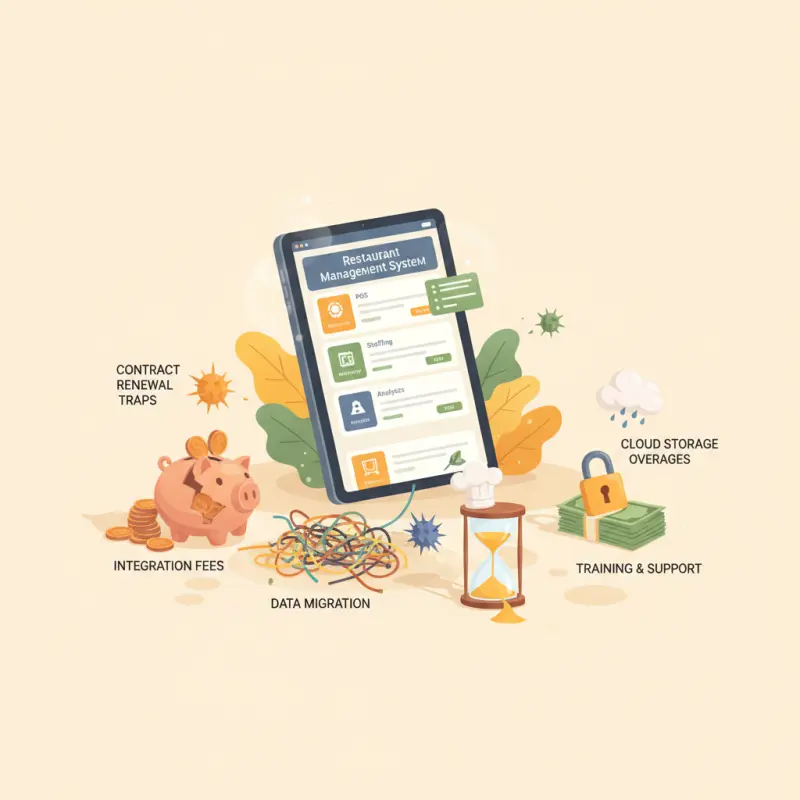
Restaurant owners fixate on visible costs. They see a 1,500 MAD monthly software fee and hesitate. Meanwhile, invisible losses compound daily through three profit killers most never calculate.
Commission fees hit first. Every order through traditional platforms surrenders 15-30% immediately. Process 1,000 orders at 100 MAD average? You just paid 20,000 MAD in commissions at 20% — ten times your restaurant management software cost.
Menu pricing mistakes cut deeper. Without proper restaurant pricing software, most establishments underprice signature items by 15-20%. A tagine that should sell for 85 MAD gets priced at 70 MAD because nobody tracked the recent lamb price increase. Multiply that gap across 50 menu items and 30 daily orders — you're losing 22,500 MAD monthly.
Manual errors complete the damage. Staff miscalculations, forgotten modifiers, wrong portion sizes. Studies show manual restaurant menu management systems leak 3-5% of revenue through human error. For a restaurant grossing 300,000 MAD monthly, that's another 15,000 MAD vanishing.
Commission Fees: The Silent Profit Killer
Traditional online menu ordering systems operate on a deceptively simple model. They bring customers, you pay commission. What starts at "just 15%" quickly escalates.
| Platform Type | Commission Rate | Monthly Cost (1,000 orders × 100 MAD) |
|---|---|---|
| Basic Delivery Apps | 15-20% | 15,000 - 20,000 MAD |
| Premium Platforms | 25-30% | 25,000 - 30,000 MAD |
| OCHI Model | 0% | 0 MAD |
OCHI charges zero commission because the economics work differently. Restaurants pay a flat fee for the technology — not a percentage of their success. Your 100th order costs the same as your 1,000th.
Menu Pricing Mistakes Cost More Than Software
A restaurant in Marrakech discovered they'd been losing 8% margin for six months. Their signature lamb mechioui's cost had crept from 45 MAD to 52 MAD per portion, but the menu price stayed at 75 MAD. Their profit per dish dropped from 30 MAD to 23 MAD — a 23% margin reduction nobody noticed.
Without real-time cost tracking, pricing becomes guesswork. Supplier prices fluctuate weekly. Portion sizes drift. New staff use extra ingredients. Your carefully calculated 65% gross margin becomes 57% without anyone noticing.
Smart restaurant menu management software recalculates automatically. When tomato prices spike 20% in summer, your salad prices adjust. When you negotiate better meat prices, your margins improve instantly.
Food cost calculator
What’s your real margin?
Food cost
29.2%
Gross margin
70.8%
Profit / dish
85 MAD
Healthy · under 30%
Digitize your menu with OCHIThe 28-35% Food Cost Formula Every Restaurant Owner Gets Wrong
The restaurant industry preaches the 28-35% food cost rule religiously. Most owners check their percentage monthly and feel satisfied when they hit 32%. They're measuring wrong.
True food cost includes waste, theft, comps, and staff meals. The formula most use — (Beginning Inventory + Purchases - Ending Inventory) / Sales — misses crucial variables. Real cost runs 3-5% higher than calculated cost.
Why Your Current Calculations Are Off
Static pricing assumes costs stay constant. A restaurant pricing their couscous at 45 MAD based on January wheat prices loses money when costs jump 15% by June. Manual systems can't track these shifts fast enough.
Labor costs hide in plain sight. That seemingly profitable 35 MAD soup requires 15 minutes of prep. At 20 MAD hourly labor cost, you just added 5 MAD nobody calculated. Your 28% food cost is actually 42% all-in.
Portion control varies by cook. Chef Ahmed uses 180g of meat. New hire Sara uses 220g. Same dish, different cost. Without standardized restaurant menu management systems, margins fluctuate wildly.
The OCHI Recipe Builder Advantage
OCHI's recipe builder links directly to supplier pricing. Update chicken cost once — every dish using chicken recalculates automatically. No manual spreadsheet updates. No forgotten items.
Real-time margin tracking shows profitability per dish, not just food cost. A dish with 25% food cost but requiring 30 minutes of specialized labor might generate less profit than a 35% food cost item prepared in five minutes.
Inventory integration ensures accuracy. When you receive 50kg of tomatoes at a new price, every tomato-based dish updates. Your menu prices reflect reality, not last month's costs.
Smart Pricing Psychology That Increases Average Order Value
Expensive restaurant management system pricing often ignores revenue optimization. They track costs obsessively but miss opportunities to increase check averages through proven psychology.
Anchoring effects work in Moroccan restaurants just as they do globally. Place a 450 MAD premium tagine at the top of your menu. Suddenly, the 180 MAD option seems reasonable, not expensive. Average order value climbs 12-15%.
The 0.99 Myth in Restaurant Pricing
Charm pricing (ending in 9) works for retail. Restaurants are different. Research shows diners perceive round numbers as higher quality. Price your grilled fish at 120 MAD, not 119 MAD. You signal confidence and quality.
Bundle pricing drives profits. A 15 MAD mint tea seems expensive alone. Bundle it with a 65 MAD main for 75 MAD — customers perceive value while you increase margins. Smart online menu ordering systems highlight these combinations automatically.
Total Cost of Ownership: Software vs. Commission Models
Numbers expose the truth. A Rabat restaurant owner shared his comparison after switching from commission-based to software-based ordering.
Small Restaurant (50 orders/day)
| Model | Monthly Revenue (50 orders × 30 days × 80 MAD) | Platform Cost | Net Revenue |
|---|---|---|---|
| Commission (20%) | 120,000 MAD | 24,000 MAD | 96,000 MAD |
| Software Fee | 120,000 MAD | 1,500 MAD | 118,500 MAD |
| Difference | — | — | +22,500 MAD |
Growing Restaurant (200+ orders/day)
Scale amplifies the gap. At 200 daily orders averaging 100 MAD, commission platforms extract 120,000 MAD monthly at 20%. The same restaurant using OCHI pays 1,500 MAD. The math becomes undeniable.
Hidden costs compound the difference. Commission platforms often charge extra for marketing placement, faster payment processing, or premium support. Software models include everything upfront.
Why Zero-Commission Systems Win Long-Term
OCHI represents a fundamental shift in restaurant technology economics. Instead of taking a percentage of success, the platform charges for tools that create success.
The Economics of Restaurant Technology
Commission rates creep upward. What starts at 15% becomes 20%, then 25%. Platforms know switching costs trap restaurants. Each percentage point increase directly reduces owner profits.
Price control stays with restaurants using software models. You set prices based on your costs and market, not platform requirements. During Ramadan, increase prices 10% to match demand. During slow season, run promotions without paying higher commission on discounted items.
Customer relationships belong to you. Commission platforms own the customer data, email lists, and ordering history. With OCHI's model, customers order from yourrestaurant.ochi.ma — building your brand, not theirs.
A restaurant in Agadir switched from commission-based ordering after calculating their five-year cost at 4.2 million MAD. Their OCHI investment over the same period: 90,000 MAD. They used the savings to open a second location.
Restaurant management system pricing conversations usually end at monthly fees. Smart owners look deeper — at commission percentages eating revenue, pricing mistakes destroying margins, and ownership of customer relationships. The real question isn't what software costs. It's what staying with your current system costs.
See how OCHI's zero-commission model transforms restaurant economics at ochi.ma/partners.
Frequently Asked Questions
How much does restaurant management system pricing typically cost in Morocco?
Restaurant management software in Morocco ranges from 800 to 3,000 MAD monthly, depending on features and restaurant size. However, commission fees from delivery platforms cost 10-20 times more than the software itself.
What are the hidden costs in restaurant management system pricing?
The biggest hidden cost is commission fees from delivery platforms, which take 15-30% per order. A restaurant processing 1,000 monthly orders at 100 MAD average pays 20,000 MAD in commissions — far exceeding software costs.
How do commission fees compare to restaurant management software costs?
Commission fees dwarf software costs. While restaurant management software costs 1,500-2,500 MAD monthly, commission fees can reach 20,000-30,000 MAD monthly for the same volume.
Should restaurants choose expensive management software or commission-based platforms?
Zero-commission restaurant management systems save more money long-term. Paying 2,000 MAD monthly for software beats losing 20,000 MAD monthly in commissions.
How can restaurants calculate their true restaurant management system pricing?
Add monthly software costs plus commission fees from all platforms. Most restaurants discover commission fees are 10-15 times higher than direct software costs, making zero-commission solutions the clear choice.
Restaurant owners · Weekly
The guide to running a restaurant in 2026.
One article per week. No commission advice. Just honest operational insight for Moroccan restaurants.

Blog Manager
Comments
No comments yet. Be the first to share your thoughts.