AI Overview
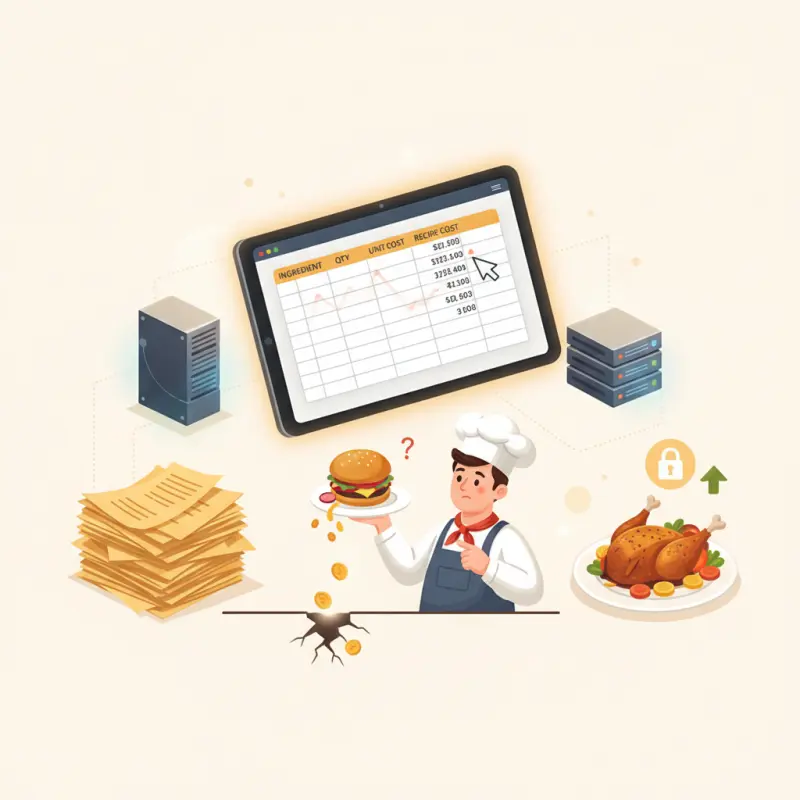
Restaurant menu costing software eliminates hidden losses from recipe inconsistency and portion drift that can cost restaurants thousands monthly. A Casablanca coffee shop lost 15,030 MAD monthly from baristas using just 2 extra grams of coffee per cup. Another restaurant's signature tajine bled 8 MAD per order because three chefs used different recipes for the same dish. Menu costing software locks down exact measurements and tracks real-time ingredient usage against standard recipes. OCHI's integrated system connects recipe costs directly to online orders, ensuring every sale reflects true margins rather than theoretical food cost percentages. Most restaurants know their overall food cost but can't explain daily profit variations. Track portion control digitally to prevent micro-variations from multiplying into major losses across every ingredient, dish, and shift.
Table of Contents
Your most profitable menu item might be losing money on every order. A Casablanca restaurant discovered their signature tajine — ordered 50 times daily — was bleeding 8 MAD per plate because three different chefs used three different recipes.
This isn't about bad management. It's about invisible costs that compound. Without restaurant menu costing software, you're flying blind while your margins evaporate one order at a time.
Your Menu is Bleeding Money — Four Hidden Cost Traps
The numbers tell a brutal story. Most restaurant owners know their food cost percentage but can't explain why Tuesday's profit differs from Saturday's. The culprit? Four cost traps that hide in plain sight.
The 2-Gram Problem That Costs 15,000 MAD Monthly
A specialty coffee shop in Casablanca noticed their coffee expenses creeping up despite stable sales. The investigation revealed each barista was using 2 grams extra coffee per cup — barely noticeable to the eye.
The math was shocking: 2g × 300 cups daily × 30 days × 1.67 MAD per gram = 15,030 MAD monthly. That's a full employee's salary vanishing into espresso cups.
This isn't carelessness. Without precise portion control tracked by your restaurant menu management system, these micro-variations multiply across every ingredient, every dish, every shift.
When Your "Profitable" Tajine Loses 8 MAD Per Order
Three chefs, three recipes for the same dish. Chef Ahmed uses imported saffron. Chef Youssef substitutes with local spices. Chef Fatima adds extra almonds because "customers love them."
Recipe drift kills margins faster than any other factor. That bestselling lamb tajine showing a 35% food cost on paper? It's actually running at 43% because nobody's cooking from the same playbook.
OCHI's recipe builder locks down exact measurements per variation. When integrated with your online menu ordering system, every order reflects true costs — not theoretical ones.
Stack audit
What do you currently use?
Tick what you have. We’ll show what OCHI replaces or connects to.
The 28% Food Cost Myth — Why This Industry Standard Fails Small Restaurants
Every restaurant guide preaches the same gospel: keep food costs between 28-35%. This benchmark comes from American chain restaurants with centralized purchasing power and standardized everything.
Your neighborhood restaurant in Agadir operates in a different universe. The economics don't translate.
Your Rent Changes Everything
A beachfront café in Agadir pays 40,000 MAD monthly rent. A similar café in the residential Talborjt area pays 8,000 MAD. Should they target the same food cost percentage?
| Location Type | Monthly Rent | Optimal Food Cost % | Why It Works |
|---|---|---|---|
| Agadir Beach | 40,000 MAD | 22-25% | High rent demands higher margins |
| Residential Area | 8,000 MAD | 35-40% | Lower overhead allows competitive pricing |
| Food Truck | 2,000 MAD | 45-50% | Minimal fixed costs enable volume play |
Your restaurant pricing software needs to factor in your specific cost structure — not industry averages from another continent.
Labor vs. Food Cost Trade-offs
Buying pre-cut vegetables costs 5 MAD more per kilo. "Waste of money," says conventional wisdom. But if it saves your chef 90 minutes of prep time, that's 90 minutes for actual cooking.
A Marrakech restaurant switched to pre-prepped ingredients for their lunch rush. Food costs rose 3% but they served 40 more covers daily. The math favored convenience.
Smart restaurant menu costing software calculates total dish cost — not just ingredients. Labor, utilities, and time all factor into true profitability.
Restaurant Menu Costing Software That Actually Works — Features That Matter
Most restaurants still use Excel sheets passed down like family recipes. These templates work until they don't — usually when you need them most.
Recipe Builder vs. Excel — The True Time Cost
Excel seems free until you calculate the hours. Updating prices across 60 menu items when chicken prices jump 15%? That's four hours of copy-paste gymnastics.
Worse: when your head chef leaves, those intricate spreadsheet formulas leave too. One Rabat restaurant lost three months recreating their costing system after their chef departed with the master file.
OCHI's recipe builder stores everything centrally. New chef? Same recipes. Price changes? Automatic updates across your restaurant menu management software.
Real-Time Cost Updates vs. Monthly Reviews
Restaurant Dar Essalam in Fès discovered their Ramadan special was losing money — two weeks after Ramadan ended. Monthly cost reviews meant 500 orders sold below cost.
Modern restaurant pricing software tracks costs as suppliers update prices. When tomatoes spike 30% in winter, your menu prices can adjust before you lose money — not after.
This real-time tracking integrates with your online menu ordering system. Digital menus update instantly. No reprinting. No manual changes.
Integration With Your Online Menu Ordering System
Standalone costing software creates double work. You update recipes in one system, prices in another, then manually sync your online ordering platform. Errors multiply at each step.
When your restaurant menu management system connects directly to costing, changes flow automatically. Update ingredient cost once. Menu prices recalculate. Online ordering reflects new pricing. See how OCHI connects all pieces at ochi.ma/partners.
The 4-Item Audit — Finding Your Profit Killers in 30 Minutes
You don't need to analyze every menu item. Four strategic audits reveal 80% of profit leaks.
Step 1: Calculate Current Food Cost Per Item
Start simple. For each ingredient: (Quantity Used × Unit Cost) ÷ Portion Yield = Ingredient Cost per Serving.
Example for Chicken Pastilla:
- Chicken: 200g × 45 MAD/kg = 9 MAD
- Almonds: 50g × 120 MAD/kg = 6 MAD
- Phyllo: 4 sheets × 2 MAD = 8 MAD
- Spices & others: 4 MAD
- Total: 27 MAD food cost
Common mistake: forgetting cooking oil, garnishes, or sides included with the dish. These "minor" ingredients add 5-10% to true cost.
Step 2: Rank by Volume × Loss
Your truffle burger might lose 20 MAD per order, but if you sell two monthly, it's not your problem. Focus on high-volume items first.
Formula: Monthly Units Sold × (Menu Price - True Cost) = Total Impact
That vegetable couscous losing "only" 3 MAD but selling 300 times monthly? That's 900 MAD vanishing — more than your premium items combined.
Step 3: The Fix-or-Remove Decision Matrix
Not every unprofitable item needs removal. A Casablanca brasserie discovered their loss-leading soup brought customers who ordered profitable mains. The soup stayed.
Decision framework:
- Raises average check by 30%+ → Keep and optimize portions
- Customer favorite with small loss → Raise price 5-10%
- Low volume + low margin → Remove or redesign completely
- High complexity + low profit → Simplify or eliminate
One Tangier restaurant transformed their worst performer — a complex seafood platter losing 15 MAD per order — into a simplified version with 22% margins. Same price point, smarter ingredients.
Menu engineering isn't about spreadsheets. It's about understanding which items drive your business and which drain it. The right restaurant menu costing software shows you the difference before losses compound.
Your menu tells your restaurant's story. Make sure it's profitable. Transform your menu into a profit engine with OCHI at ochi.ma/partners.
Frequently Asked Questions
How does restaurant menu costing software prevent recipe drift?
Menu costing software locks down exact ingredient measurements and portions for each recipe. It tracks when actual usage deviates from standard recipes, alerting managers to inconsistencies that can cost thousands monthly.
What is the typical ROI of implementing menu costing software?
Most restaurants recover their software investment within 2-3 months by identifying hidden portion creep and recipe inconsistencies. Even small variations like 2 grams extra coffee per cup can cost 15,000 MAD monthly.
Can menu costing software integrate with existing POS systems?
Yes, modern menu costing platforms integrate with POS systems and online ordering platforms. This connects real-time sales data with actual ingredient costs for accurate profit tracking per order.
How accurate are the food cost calculations in menu costing software?
Quality menu costing software calculates costs down to the gram based on current supplier prices. It accounts for prep waste, cooking losses, and portion variations that manual calculations often miss.
What's the difference between theoretical and actual food costs?
Theoretical food cost uses recipe cards and assumes perfect portioning. Actual food cost includes real-world variations, waste, and inconsistencies that can inflate costs by 5-15% above theoretical calculations.
Restaurant owners · Weekly
The guide to running a restaurant in 2026.
One article per week. No commission advice. Just honest operational insight for Moroccan restaurants.

Blog Manager
Comments
No comments yet. Be the first to share your thoughts.