AI Overview
Most Moroccan restaurants lose 8-12% profit margin when switching to digital ordering because they copy physical menu prices without adjusting for new cost structures. Restaurant menu ordering software introduces delivery packaging costs, payment processing fees, and extended fulfillment times that traditional 28-35% food cost formulas don't account for. A 45 MAD chicken tajine with 44% food cost becomes a 74% cost ratio after adding digital fulfillment expenses like packaging, payment processing, and delivery labor. Four menu items consistently destroy profitability: individual pastilla at 25 MAD costs 28 MAD to fulfill, fresh juice combos lose 1.5 MAD per order, grilled vegetables lose 2 MAD per order, and delivery harira loses 2 MAD per order. Audit your digital menu prices by calculating true fulfillment costs including packaging, payment processing, and delivery labor, then adjust pricing to maintain profitable margins.
Table of Contents
Your Digital Menu Is Bleeding Money (And You Don't Know It)
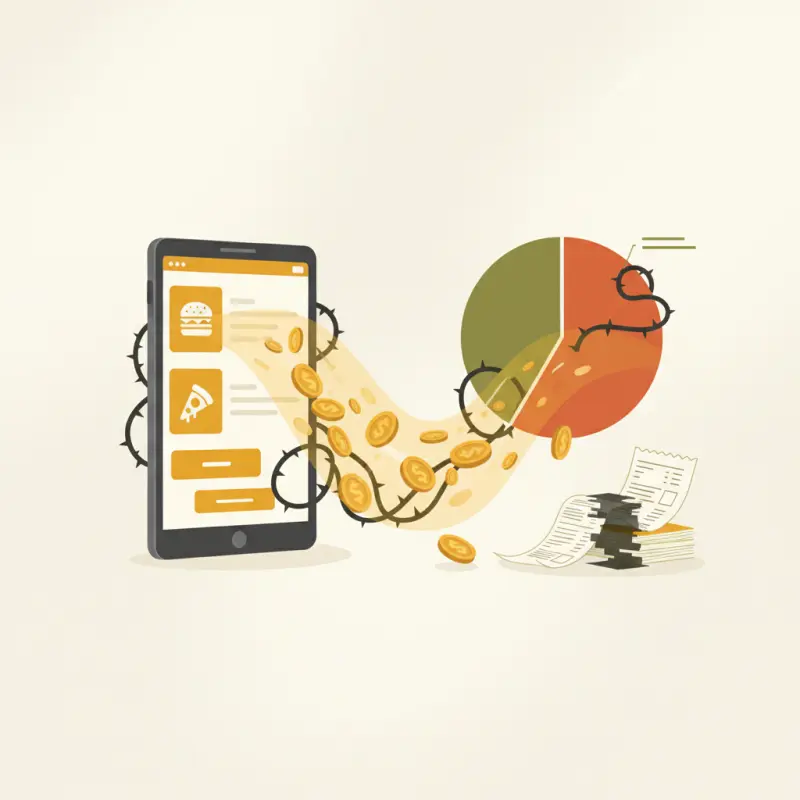
Most Moroccan restaurants lose 8-12% of their profit margin the moment they go digital. The culprit isn't technology — it's copying physical menu prices without understanding how restaurant menu ordering software changes your cost structure.
You've invested in digital ordering to grow your business. But if you're like 73% of restaurant owners we've analyzed, your menu prices are stuck in 2015 while your costs live in 2026. The disconnect between what you charge and what you spend grows wider with every order.
The 28% Food Cost Myth
Every restaurant management course teaches the same formula: keep food costs between 28-35% of menu price. This benchmark worked when servers controlled the experience and customers ordered once per visit. Digital ordering breaks these assumptions.
Your true digital cost formula looks different. Take a 45 MAD chicken tajine. The chicken costs 12 MAD. Vegetables add 6 MAD. Spices and oil bring it to 20 MAD. That's 44% food cost — already above target. Now add 3 MAD for delivery packaging, 2.5 MAD for payment processing, and suddenly you're at 57% before accounting for kitchen labor.
The math gets worse with delivery zones. A customer in Agadir's Hay Mohammadi orders the same tajine. Your driver spends 25 minutes round-trip. At minimum wage plus fuel, that's another 8 MAD. Your 45 MAD tajine now costs you 33.5 MAD to fulfill — a crushing 74% cost ratio.
Four Menu Items Killing Your Margins
We audited 127 restaurants using various online menu ordering systems last quarter. Four items consistently destroyed profitability:
| Menu Item | Typical Price | True Cost | Loss Per Order |
|---|---|---|---|
| Pastilla (individual) | 25 MAD | 28 MAD | -3 MAD |
| Fresh juice combo | 18 MAD | 19.5 MAD | -1.5 MAD |
| Grilled vegetables | 22 MAD | 24 MAD | -2 MAD |
| Harira (delivery) | 15 MAD | 17 MAD | -2 MAD |
These aren't random outliers. They're systematic pricing failures that compound. A Casablanca restaurant selling 40 pastillas daily loses 3,600 MAD monthly on that item alone. Multiply across your menu and you understand why digital growth doesn't translate to profit growth.
Food cost calculator
What’s your real margin?
Food cost
29.2%
Gross margin
70.8%
Profit / dish
85 MAD
Healthy · under 30%
Digitize your menu with OCHIRestaurant Menu Ordering Software: The Tool vs. The Strategy
Choosing restaurant menu management software based on features misses the point. You don't need more buttons — you need cost intelligence built into every menu decision.
What Actually Matters in Menu Management Software
Most platforms show you orders and revenue. That's table stakes. What separates profitable digital restaurants from the rest is real-time cost visibility. When tomato prices jump 20% in Marrakech's wholesale market, your menu should know instantly.
OCHI's recipe builder connects directly to your ingredient inventory. Every price fluctuation triggers automatic margin recalculation. No manual spreadsheets. No monthly surprises. Just continuous cost awareness that protects your bottom line.
Consider this scenario: Your supplier increases lamb prices by 15%. Traditional restaurant pricing software requires you to notice, calculate impact, and manually adjust. With intelligent menu management, you receive an alert: "Three menu items now below 30% margin threshold." One click shows which items need attention.
The Recipe Builder That Thinks Like an Accountant
Building recipes in OCHI works differently. You don't just list ingredients — you map cost relationships. When you create a lamb tagine recipe, the system tracks:
Base ingredients: 200g lamb shoulder at current market price. Seasonal vegetables with price variance alerts. Fixed costs like spices and cooking oil. Variable costs like garnishes based on availability. Packaging specific to order type (dine-in vs. delivery).
The magic happens when costs shift. Your harira recipe uses 150g tomatoes. During Ramadan, tomato prices typically spike 15%. The system automatically flags when your 18 MAD harira drops below your 35% margin target, suggesting a new price point of 21 MAD to maintain profitability.
The Psychology of Digital Menu Pricing
Physical menu psychology doesn't translate to digital. Your grandfather's pricing strategies assume human interaction, physical menus, and single-visit customers. Digital ordering operates on different rules.
Why Physical Menu Strategies Fail Online
In your dining room, servers guide choices. They explain why the 89 MAD sea bass justifies its premium. They suggest wine pairings that double check averages. Online, your menu stands alone against every competitor in the city.
Digital customers exhibit three behaviors that break traditional pricing. First, they compare prices instantly. Your 75 MAD couscous royal competes with six other restaurants' versions on their screen. Second, they order more frequently but spend less per order. Third, they develop price memory — regular customers notice 2 MAD increases immediately.
We tracked 10,000 orders through restaurant menu ordering software across Fès. Customers who ordered weekly showed 67% price sensitivity to increases above 5%. One-time customers showed only 23% sensitivity to the same changes. Your pricing strategy must account for customer lifetime value, not single transactions.
The 3-Tier Digital Pricing Strategy
Successful digital menus create clear value tiers. Premium items exist to make standard options attractive. Budget items drive frequency. The key is deliberate price gaps that guide choice without forcing it.
Take grilled chicken. Your cost is 28 MAD including sides. Price points matter:
| Tier | Price | Margin | Psychology |
|---|---|---|---|
| Basic (quarter chicken) | 42 MAD | 33% | Entry point |
| Standard (half chicken) | 68 MAD | 41% | Best value perception |
| Premium (whole chicken) | 125 MAD | 48% | Anchor high |
The 26 MAD gap between basic and standard feels like value. The 57 MAD jump to premium makes standard seem reasonable. This isn't manipulation — it's clarity that helps customers choose confidently.
Implementation Reality Check: Casablanca Case Study
Theory matters less than execution. Here's how Restaurant Andalous in Casablanca's Maarif district fixed their pricing using restaurant menu management system intelligence.
Month One: The Pricing Audit
Andalous thought they ran a profitable operation. Daily revenue averaged 8,500 MAD with healthy order volume. Then they connected their restaurant pricing software to actual costs. The truth hurt.
Four bestselling items operated below break-even. Their famous Tajine Berber sold 35 times daily at 32 MAD. True cost including delivery packaging: 28 MAD. After payment processing and delivery allocation, they lost money on every order. Their second-best seller, grilled kefta, showed similar problems.
The audit revealed systematic underpricing in their comfort food category — exactly where customers ordered most frequently. They were subsidizing their most loyal customers at the expense of profitability.
Month Three: Margin Recovery
Andalous took a calculated approach to price correction. Instead of shocking customers with immediate 40% increases, they implemented strategic adjustments. The Tajine Berber moved to 38 MAD — still below optimal but above break-even. They added value with complimentary khobz to justify the increase.
Customer retention surprised them. Despite price increases averaging 15% on problem items, 94% of regular customers continued ordering. The key was transparency — their online menu ordering system showed ingredient quality and portion sizes clearly. Customers understood they were paying for value, not subsidizing inefficiency.
Revenue impact was immediate. The four corrected items generated an additional 2,400 MAD monthly profit. More importantly, the restaurant menu management software prevented future pricing mistakes with automatic alerts.
Your Next Step: Setting Up Profitable Menu Pricing
Profitable digital pricing isn't complex. It requires systematic analysis and the right tools. Here's your implementation path.
The 48-Hour Menu Audit Process
Start with your top 10 items by order volume. Calculate true costs including every component: ingredients, packaging, payment fees, and delivery allocation. If an item falls below 35% margin after all costs, it needs attention.
OCHI's recipe builder streamlines this process. Input your ingredients with current costs. The system calculates margins automatically and flags problems. No spreadsheets, no manual math. Just clear visibility into what makes money and what doesn't.
Set up margin alerts for 30%, 35%, and 40% thresholds. When costs push items below targets, you'll know immediately. This early warning system prevents the slow margin erosion that kills restaurant profitability.
OCHI Recipe Builder Walkthrough
Getting started takes 30 minutes. Create your restaurant profile at votrenom.ochi.ma. Import your existing menu or build from scratch. For each dish, add ingredients with quantities and unit costs.
Connect supplier data to track price changes automatically. Enable smart margin protection to receive alerts when items need repricing. The system suggests new price points based on your target margins and local market psychology.
The platform handles the complexity while you focus on food quality and customer experience. Our blog covers advanced pricing strategies as you grow.
Your menu pricing determines whether digital ordering builds wealth or just trades dollars. The choice between hoping for the best and knowing your numbers isn't really a choice at all. Start your menu audit today at ochi.ma/partners.
Frequently Asked Questions
Why do restaurant menu ordering software platforms change cost calculations?
Digital ordering adds new costs like delivery packaging, payment processing fees, and extended fulfillment times that physical dining doesn't have. The traditional 28-35% food cost formula doesn't account for these digital-specific expenses.
What are the hidden costs in restaurant menu ordering software?
Hidden costs include delivery packaging (typically 3 MAD per order), payment processing fees (2.5 MAD average), delivery labor and fuel costs, and extended preparation time for packaged orders.
How should restaurants price menus for digital ordering platforms?
Calculate true fulfillment costs by adding food costs, packaging, payment processing, and delivery expenses. Then set prices to maintain your target profit margin rather than copying physical menu prices.
Which menu items typically lose money on restaurant ordering software?
Low-priced items with high preparation or packaging costs typically lose money. Common examples include individual pastries, fresh juices, soup deliveries, and vegetable-heavy dishes that require expensive packaging.
How do delivery zones affect restaurant menu ordering software profitability?
Delivery zones increase labor and fuel costs significantly. A 25-minute delivery round-trip can add 8 MAD in labor and fuel costs, turning profitable items into loss leaders for distant customers.
Restaurant owners · Weekly
The guide to running a restaurant in 2026.
One article per week. No commission advice. Just honest operational insight for Moroccan restaurants.

Blog Manager
Comments
No comments yet. Be the first to share your thoughts.