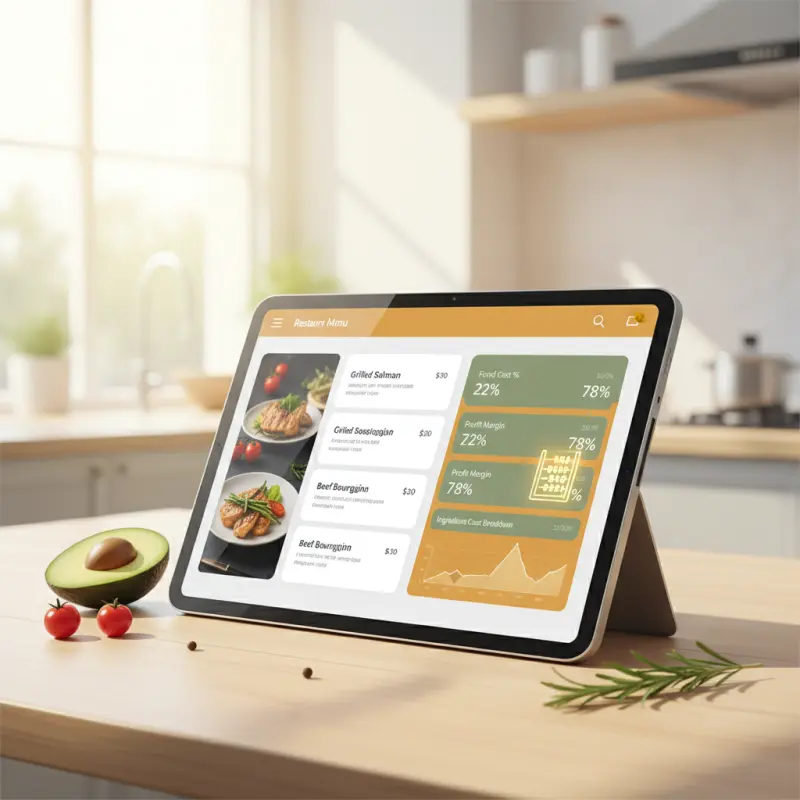
AI Overview
Restaurant menu software should calculate food costs first, design second. Most platforms focus on visual templates while ignoring the critical math that determines profitability. Moroccan restaurants face unique cost challenges including import duties on specialty ingredients and seasonal price fluctuations in local markets. The standard 28-35% food cost rule becomes complex when dealing with cultural expectations of generous portions and volatile supplier pricing. Effective restaurant menu software tracks ingredient costs in real-time, calculates actual margins per dish, and alerts operators when market changes affect profitability. Many operators discover their bestselling items are money-losers only after months of losses. Professional restaurant management platforms integrate cost tracking with menu design, ensuring every menu change reflects current supplier pricing. Choose software that monitors your bottom line as carefully as your brand image.
Table of Contents
Why Your Restaurant Menu Software Should Calculate Food Costs (Not Just Look Pretty)
Your restaurant menu software probably has 47 font options and zero profit tracking. While you're choosing between Helvetica and Arial, your lamb tagine is quietly losing 15 dirhams per plate — and the software doesn't even notice.
Most restaurant owners in Morocco discover their menu problems the hard way. A Marrakech bistro owner recently told us he spent 18,000 dirhams on "premium" menu design software, only to realize six months later that his bestselling dishes were his biggest money losers. The software could animate QR codes but couldn't calculate basic food costs.
Food cost calculator
What’s your real margin?
Food cost
29.2%
Gross margin
70.8%
Profit / dish
85 MAD
Healthy · under 30%
Digitize your menu with OCHIWhy Most Restaurant Menu Software Misses the Point
Walk into any restaurant tech conference and you'll see the same demos: sleek interfaces, Instagram-worthy templates, augmented reality previews. Nobody talks about the math that matters — whether your grilled sardines at 65 MAD actually cover the 31 MAD in ingredients, labor, and overhead.
The disconnect is staggering. Your online menu ordering system knows your customer's dietary preferences but not your supplier's latest price hike. It can translate your menu into 12 languages but can't tell you that yesterday's olive oil delivery just pushed your Mediterranean salad into negative margins.
Restaurant menu management software evolved backwards. Instead of starting with the financial foundation and adding design later, developers built pretty shells with no engine. It's like buying a sports car with no speedometer — looks great until you need to know if you're actually moving forward.
The 28-35% Food Cost Rule (And When to Break It)
Every culinary school teaches the golden rule: keep food costs between 28% and 35% of menu price. But Moroccan restaurants face unique challenges that make this benchmark more nuanced. Import duties on specialty ingredients, seasonal price swings in local markets, and the cultural expectation of generous portions all push against standard formulas.
How to Calculate Your Real Food Cost Percentage
Start with the basics. Take your harira soup priced at 45 MAD. List every ingredient: 200g tomatoes (3 MAD), 150g lentils (2.5 MAD), 100g chickpeas (2 MAD), spices and herbs (1.5 MAD), 50g beef (4 MAD). Raw ingredient cost: 13 MAD. Add 10% for cooking oil, gas, and water: 14.30 MAD. Factor 5% waste for vegetable peeling and trimming: 15.02 MAD.
That's 33.4% food cost — within range. But wait. Add the 20 minutes of prep time at 25 MAD hourly labor: 8.33 MAD. Now you're at 51.8%. Your restaurant menu management system should flag this automatically, not leave you to discover it during monthly reviews.
When 40% Food Cost Actually Makes Sense
A Casablanca steakhouse runs 42% food cost on their signature ribeye — and profits handsomely. How? The 380 MAD price point attracts high-spending customers who order 120 MAD bottles of wine at 80% margin. The steak is a calculated loss leader that drives overall check average above 600 MAD per person.
High-volume items follow different rules too. If you're selling 200 chicken shawarmas daily at 38% food cost, the sheer volume often compensates for thinner margins. But selling five lamb shoulders weekly at the same percentage? That's a path to closure.
Four Warning Signs Your Menu is Bleeding Money
Real numbers from real kitchens tell the story better than any theory. Let's examine what a 120-seat restaurant in Agadir discovered when they finally audited their food costs after two years of "intuitive" pricing.
Atlas Restaurant's Wake-Up Call
| Menu Item | Menu Price (MAD) | Actual Cost (MAD) | Food Cost % | Monthly Loss (MAD) |
|---|---|---|---|---|
| Beef Bourguignon | 180 | 78 | 43% | 4,200 |
| Seafood Pastilla | 95 | 41 | 43% | 5,600 |
| Lamb Mechoui | 220 | 89 | 40% | 3,800 |
| Mixed Grill | 160 | 71 | 44% | 14,400 |
Total monthly loss from just these four items: 28,000 MAD. The mixed grill alone — ordered 120 times monthly — hemorrhaged money with every plate. Their beautifully designed digital menu never raised an alarm. Their restaurant pricing software would have caught this on day one.
How Restaurant Menu Management Software Should Actually Work
Forget the font libraries. Modern restaurant menu software needs three core capabilities: recipe tracking, supplier integration, and automatic recalculation. When tomato prices spike 30% in August, your system should instantly flag every affected dish.
Recipe Builder That Tracks Supplier Price Changes
OCHI's recipe builder links directly to your supplier invoices. Upload yesterday's delivery receipt and watch food costs update across 40 menu items in seconds. No manual spreadsheet updates. No monthly surprises.
The platform compares prices across multiple suppliers automatically. Your usual vendor charges 45 MAD per kilo for sea bass? The system alerts you that Supplier B offers 38 MAD with same-day delivery. These small wins compound — one Rabat seafood restaurant saved 19,000 MAD monthly just through automated price comparison.
Pricing Psychology Built Into the Software
Menu engineering isn't guesswork. Your restaurant menu management software should categorize every item using proven frameworks. Stars (high popularity, high profit) get prime menu placement. Dogs (low popularity, low profit) need reimagining or removal.
Real data from your votrenom.ochi.ma subdomain reveals patterns. That 145 MAD tagine outsells the 155 MAD version by 3:1, despite identical margins. The software suggests 149 MAD as the sweet spot — capturing volume without sacrificing perception.
Stop Designing Menus. Start Engineering Profits
Your menu is a financial document that happens to list food. Treat it that way. The most successful restaurants in Morocco run their menus like investment portfolios — balancing high-margin beverages against loss-leading appetizers, tracking performance daily, adjusting prices based on data rather than intuition.
OCHI builds profit protection into every feature. Recipe costs update automatically when suppliers change prices. Margin alerts flag problem dishes before they drain your bank account. The same platform that creates your beautiful online menu ordering system also guards your bottom line. Set up your branded menu at votrenom.ochi.ma and discover which items actually make money.
Frequently Asked Questions
What should restaurant menu software track besides design?
Restaurant menu software should track ingredient costs, calculate food cost percentages, monitor supplier price changes, and alert you when dishes become unprofitable. Design features are secondary to profit tracking.
How does restaurant menu software calculate food costs?
Professional restaurant menu software connects to your inventory system, tracks ingredient prices, calculates portion costs, and applies overhead factors. It updates margins automatically when supplier prices change.
Why do Moroccan restaurants need specialized menu cost tracking?
Moroccan restaurants face unique challenges including import duties on specialty ingredients, seasonal price swings in local markets, and cultural expectations of generous portions that affect standard food cost calculations.
What's the ideal food cost percentage for restaurant menus?
The standard target is 28-35% of menu price, but this varies based on cuisine type, local market conditions, and operational model. Your software should track your specific margins, not just industry averages.
Can restaurant menu software prevent money-losing dishes?
Yes, quality restaurant menu software alerts you when ingredient price changes push dishes into negative margins. It prevents the common problem of bestselling items that actually lose money.
Restaurant owners · Weekly
The guide to running a restaurant in 2026.
One article per week. No commission advice. Just honest operational insight for Moroccan restaurants.

Blog Manager
Comments
No comments yet. Be the first to share your thoughts.