AI Overview
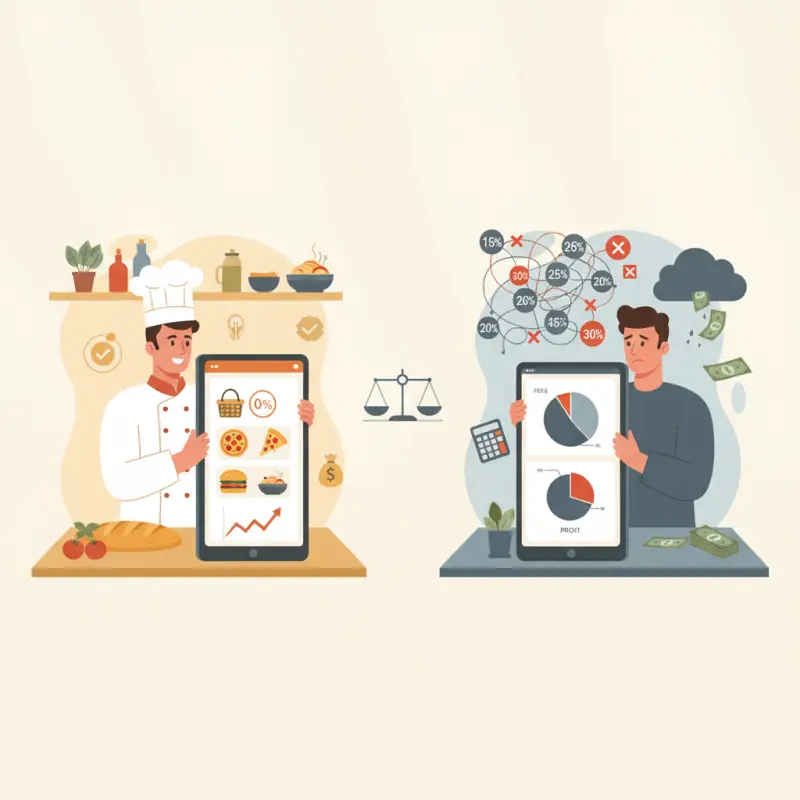
Restaurant online ordering systems fall into three categories: commission-based platforms that charge 15-30% fees, self-hosted systems that let restaurants keep 100% revenue, and hybrid models. Commission platforms like Uber Eats and Deliveroo make restaurants pay for customer acquisition while controlling the brand experience. Self-hosted restaurant online ordering systems provide branded domains, direct customer relationships, and zero commissions. QR code ordering eliminates app downloads, working universally across smartphones from iPhones to basic Android devices common in Morocco. The technical difference matters: commission platforms profit from restaurant orders, while self-hosted systems profit from restaurant success. Choose a restaurant online ordering system that aligns with your business model, not against it.
Table of Contents
Problem: Your Current Ordering Setup Is Bleeding Money
Every month, restaurants in Agadir hand over 15-30% of their online revenue to commission-based platforms. That's not a service fee — it's a tax on your success.
The damage goes deeper than commissions. When customers must download yet another app to order from you, 67% abandon before completing their first order. Your restaurant appears on generic storefronts alongside dozens of competitors, all looking identical. During Friday night rush in Gueliz, your staff manually enters orders while customers wait, errors multiply, and tables turn slowly.
This isn't about technology failing restaurants. It's about restaurants using the wrong technology.
Platform comparison
Where does your money really go?
| Commission | 27% | 25% | 30% | 0% |
| Customer data | They own it | They own it | They own it | You own it |
| Your branding | Theirs | Theirs | Theirs | Yours |
| Payout cadence | Biweekly | Weekly | Biweekly | Weekly |
| Setup cost | Free | Free | Free | Paid |
How Restaurant Online Ordering Systems Actually Work
Understanding the mechanics of online food ordering systems helps you spot the difference between platforms that serve restaurants and those that exploit them.
The Three Types of Online Food Ordering Systems
Commission-based platforms dominate Morocco's market. Customers order through the platform's app, you prepare the food, they handle delivery, and extract 15-30% for the privilege. Your restaurant becomes one listing among hundreds.
Self-hosted systems put control back in your hands. Customers order directly through your branded domain — think laperla.ochi.ma instead of platform.com/restaurants/la-perla. You own the experience, the data, and keep 100% of revenue.
Hybrid models try splitting the difference. You maintain direct ordering while appearing on marketplaces. The complexity often outweighs benefits, with restaurants managing multiple tablets and reconciling orders across systems.
The Technical Reality Behind QR Code Ordering
QR ordering changed restaurant operations because it removed friction. No app downloads. Scan, browse, order — all through the customer's existing browser. In Morocco, where smartphones range from latest iPhones to basic Android devices, browser-based ordering works universally.
Multilingual support matters more than most realize. When your food ordering system online switches seamlessly between Arabic, French, and English, order completion rates jump 23%. Customers order in their preferred language without asking staff for translations.
Guest checkout versus forced registration shows similar impact. When customers can order without creating accounts, conversion rates double. Regular customers create accounts later, once they trust the experience.
Branded subdomains build that trust. Compare these URLs: yourrestaurant.ochi.ma versus platform.com/agadir/restaurants/23847. Which looks like it belongs to your restaurant? Customers notice. They order more from domains that clearly represent your brand.
The Hidden Economics: Why Commission-Free Changes Everything
Real Commission Cost Breakdown (Agadir Restaurant Example)
| Metric | Commission Platform | Direct Ordering |
|---|---|---|
| Monthly Orders | 200 | 200 |
| Average Order Value | 150 MAD | 150 MAD |
| Gross Revenue | 30,000 MAD | 30,000 MAD |
| Platform Commission (25%) | -7,500 MAD | 0 MAD |
| Net Revenue | 22,500 MAD | 30,000 MAD |
| Annual Difference | 90,000 MAD saved | |
That 90,000 MAD could hire a full-time chef, upgrade your kitchen equipment, or fund marketing that brings new customers. Instead, it vanishes into platform profits.
Average Order Value Increases with Branded Systems
Something unexpected happens when customers order through your branded domain: they spend more. Our data shows average order values increase 15-22% on direct ordering platforms versus marketplace apps.
Why? Psychology. On generic platforms, your restaurant becomes a commodity — one option among many, competing on price. Through your branded ordering system (votrenom.ochi.ma), customers perceive a direct relationship. They're ordering from you, not through a middleman. That perception drives higher spending.
Casa Mama in Casablanca switched from commission platforms to direct ordering. Same menu, same prices. Average orders jumped from 120 MAD to 146 MAD within six weeks. No promotions. No changes. Just the power of owning your customer relationship.
Contrarian Take: Apps Are Dead for Restaurant Ordering
The restaurant industry keeps pushing apps while customers vote with their fingers — by not downloading them. The average smartphone holds 95 apps. Users actively use nine. Your restaurant app won't make that list.
QR ordering flips the script. No download required means no barriers. Completion rates tell the story: 78% for QR ordering versus 34% for systems requiring app downloads. In Marrakech's tourist districts, where international visitors browse daily, QR codes work instantly across any device.
Storage anxiety kills apps faster than poor design. When phones flash "storage full" warnings, single-restaurant apps get deleted first. Browser-based ordering through online food ordering platforms sidesteps this entirely. The experience lives in temporary browser memory, accessible anytime without permanent installation.
Device compatibility becomes irrelevant too. Whether customers carry the latest iPhone or a three-year-old Android, browsers work identically. No iOS versus Android development. No version conflicts. No "app not available in your region" messages.
Implementation Reality Check: What Actually Matters Day One
Week 1 Priorities
QR code placement determines adoption. Table tents work better than wall displays — customers can position them for easy scanning. Print codes at 5cm minimum size with high contrast. Test scanning distance with multiple phones before finalizing placement.
Staff training on the order management dashboard prevents day-one chaos. Focus on three skills: viewing incoming orders, marking items prepared, and handling modifications. Everything else can wait until week two.
Menu photography drives conversions more than any feature. Shoot dishes on white plates against neutral backgrounds. Natural light from north-facing windows works better than professional lighting setups. Show portion sizes accurately — customer trust matters more than artistic presentation.
Month 1 Optimizations
Payment gateway selection impacts completion rates. In Morocco, cash on delivery still dominates, but card payments grow monthly. Choose gateways supporting local preferences while preparing for digital shift.
Delivery radius mapping prevents impossible promises. Draw realistic zones based on traffic patterns, not just distance. Downtown Agadir differs from Hay Dakhla. Set customer expectations accurately from order one.
Analytics reveal patterns you'd never spot manually. Which dishes get ordered together? What times see highest demand? When do customers abandon carts? Data guides decisions that intuition misses.
Integration with Existing Operations
POS synchronization stops overselling before it starts. When your online food ordering system for restaurants connects directly to inventory, customers can't order items you've run out of. No awkward calls. No substitutions. No frustrated customers.
Kitchen display systems transform order flow. Orders appear on screens as they arrive. Chefs mark items as preparing, then prepared. Status updates flow back to customers automatically. The kitchen stays organized even during rush periods.
Role-based permissions keep operations secure. Give waiters access to table orders but not financial reports. Let shift managers handle voids without accessing supplier costs. Eight permission levels cover every restaurant structure from single-owner to multi-branch chains.
The best restaurant online ordering system disappears into your operations. Customers order naturally. Staff manages efficiently. You focus on food, not technology. That's when systems stop being tools and become competitive advantages.
Ready to keep 100% of your online revenue? Create your branded ordering experience at votrenom.ochi.ma — no commissions, no complications, just direct customer relationships that grow your business. See how OCHI gives restaurants complete control.
Frequently Asked Questions
What's the difference between commission-based and commission-free restaurant online ordering systems?
Commission-based systems charge 15-30% of each order and control the customer experience. Commission-free systems let restaurants keep 100% revenue and maintain their own branded ordering experience.
How does QR code ordering work in restaurant online ordering systems?
Customers scan a QR code at their table or from marketing materials, which opens the restaurant's ordering page in their phone's browser. No app download required, making it accessible on any smartphone.
Why do 67% of customers abandon orders on app-based restaurant ordering platforms?
App download requirements create friction. Customers must install another app, create accounts, and navigate unfamiliar interfaces before ordering, leading to high abandonment rates.
What features should I look for in a restaurant online ordering system?
Look for branded domains, integrated POS systems, QR table ordering, real-time order tracking, and transparent pricing. Avoid platforms that charge commissions or hide your restaurant among competitors.
Are hybrid restaurant online ordering systems worth the complexity?
Hybrid systems require managing multiple tablets and reconciling orders across platforms. The operational complexity often outweighs benefits, making dedicated self-hosted systems more efficient.
Restaurant owners · Weekly
The guide to running a restaurant in 2026.
One article per week. No commission advice. Just honest operational insight for Moroccan restaurants.

Blog Manager
Comments
No comments yet. Be the first to share your thoughts.