AI Overview
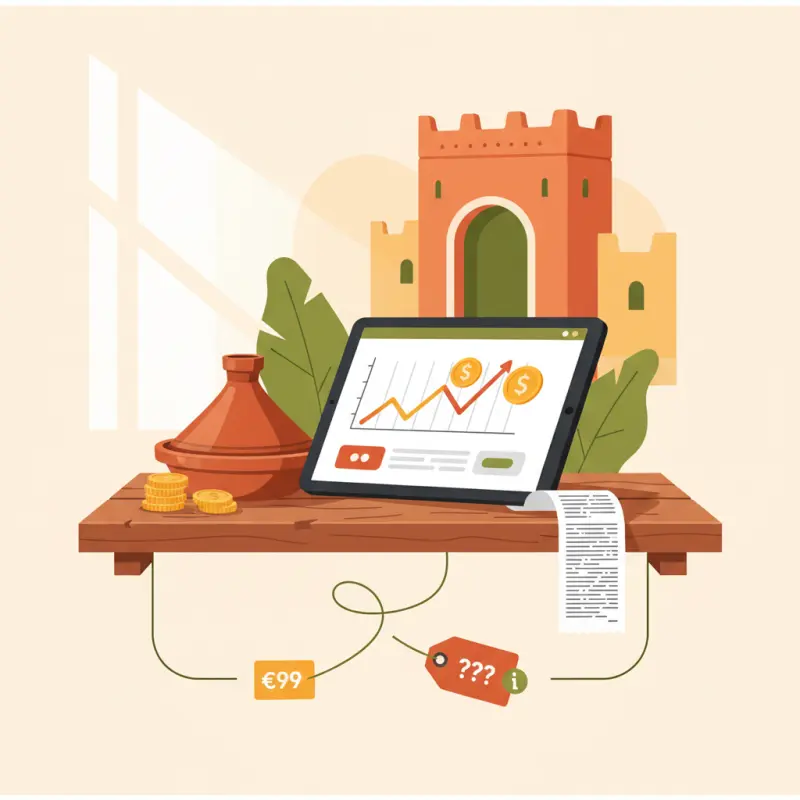
Restaurant POS software price structures in Morocco hide significant costs behind low monthly fees. Commission-based systems charge 3% to 15% per order, costing Casablanca restaurants an average of 15,000 MAD annually in hidden fees. A system advertised at 500 MAD monthly often costs 3,000 MAD once you add online ordering integration, delivery management, analytics, and payment processing fees. Fixed-price platforms break even around 67 orders monthly at 150 MAD average order value. Beyond that threshold, commission fees compound rapidly — a restaurant processing 500 orders monthly saves 9,750 MAD with fixed pricing versus 15% commission rates. Traditional platforms like Toast and Square charge transaction fees plus monthly subscriptions, while newer models offer all-inclusive pricing. Calculate your total cost of ownership by including all required modules, not just the base subscription fee.
Table of Contents
The average restaurant in Casablanca loses 15,000 MAD annually to hidden POS fees they never saw coming. Most owners discover these costs only after signing contracts — when commission percentages, transaction fees, and mandatory add-ons start eating into their margins.
The Real Cost of "Free" and "Low-Cost" POS Systems
Restaurant POS software price structures hide their true costs behind attractive monthly fees. A system advertised at 500 MAD per month often costs three times that amount once you factor in the complete picture.
The commission model presents the biggest trap. Traditional platforms charge between 3% and 15% on every order processed through their online menu ordering system. For a restaurant processing 30,000 MAD in monthly orders, that's 900 to 4,500 MAD disappearing — on top of the base subscription.
Commission-Based vs. Fixed-Price Models
Commission platforms scale their fees with your success. Fixed-price systems charge the same whether you process 10 orders or 1,000. The math becomes clear when you run the numbers:
| Monthly Orders | Average Order Value | 15% Commission Cost | Fixed Fee (1,500 MAD) | Savings with Fixed |
|---|---|---|---|---|
| 100 | 150 MAD | 2,250 MAD | 1,500 MAD | 750 MAD |
| 200 | 150 MAD | 4,500 MAD | 1,500 MAD | 3,000 MAD |
| 500 | 150 MAD | 11,250 MAD | 1,500 MAD | 9,750 MAD |
The break-even point hits around 67 orders per month at 150 MAD average. Beyond that, commission fees compound into significant losses.
The Add-On Trap
Base POS pricing rarely includes what restaurants actually need to operate. A restaurant menu management system requires multiple modules working together. Each comes with its own price tag.
Online ordering integration adds 300 to 1,500 MAD monthly. Delivery zone management costs another 500 to 2,000 MAD. Advanced analytics run 250 to 1,000 MAD. Payment processing takes 2.9% plus 3 MAD per transaction. A "500 MAD" system quickly becomes 3,000 MAD or more.
OCHI includes all operational features in one platform — POS, online ordering, delivery management, analytics, and restaurant menu management software. No module fees. No surprise charges.
Stack audit
What do you currently use?
Tick what you have. We’ll show what OCHI replaces or connects to.
Why Restaurant POS Software Price Should Follow Your Revenue Model
Most restaurants choose POS pricing based on current cash flow rather than business model. This backwards approach costs them thousands in the long run.
High-Volume vs. High-Ticket Establishments
A coffee shop in Marrakech processing 50 MAD orders can't afford 15% commission on each transaction. Their margins evaporate. Fixed pricing protects their profitability regardless of order volume.
Fine dining establishments work differently. They process fewer orders at higher values — perhaps 20 orders daily at 500 MAD each. Commission fees hurt less, but they still add up to 45,000 MAD annually at 15%.
Fast-casual restaurants face the toughest choice. They need volume to succeed but can't sacrifice margin to achieve it. A fixed-fee model with zero commission becomes the only sustainable path.
Growth Stage Considerations
Startup restaurants often choose commission models thinking they'll save money during slow months. This traps them as they grow. Success means higher fees — exactly when they need capital for expansion.
Multi-location operations multiply the problem. Commission platforms charge per location, often with no volume discounts. Three branches mean triple the percentage lost to fees.
Established restaurants should calculate total cost over 36 to 60 months. Include price increases, new feature costs, and transaction volume growth. The numbers often shock owners who never modeled long-term expenses.
The Menu Pricing Connection Most POS Vendors Ignore
Your POS choice directly impacts menu profitability. Without integrated restaurant pricing software, you're flying blind on food costs and margins.
Recipe Costing Integration
Manual recipe costing consumes two to four hours weekly for a 50-item menu. Ingredient price changes require recalculating every affected dish. Most restaurants skip this work, operating on outdated cost assumptions.
Automated systems track ingredient costs in real time. When chicken prices rise 10%, your recipe costs update automatically. You see exactly which menu items now fall below the 28% to 35% food cost benchmark.
OCHI's recipe builder connects directly to inventory management. Set ingredient costs once. The system recalculates recipe costs across all items whenever prices change.
Dynamic Pricing Capabilities
Seasonal ingredients create pricing challenges. A restaurant in Agadir might pay 20 MAD per kilogram for tomatoes in summer, 40 MAD in winter. Without dynamic pricing tools, they either lose margin or alienate customers with constant menu reprints.
Multi-location consistency matters too. Customers expect similar prices across your branches. Manual coordination leads to errors and inconsistency. Centralized pricing through your restaurant menu management system ensures accuracy.
Menu engineering data reveals which items drive profit versus those that merely drive volume. You might discover your popular tagine generates traffic but your grilled fish delivers the margin. This insight shapes promotional strategy.
What a Zero-Commission Restaurant Management System Actually Costs
OCHI operates on transparent, fixed pricing. No commission on orders. No percentage of your success. Here's the complete breakdown for Moroccan restaurants.
Total Monthly Investment
Platform access includes every feature — POS, online ordering at yourbrand.ochi.ma, kitchen display, delivery management, inventory tracking, and analytics. Payment processing runs at direct processor rates with no markup. We charge what Stripe or PayPal charges, nothing more.
Training happens through video tutorials and live support. No billable hours. No implementation fees. Updates roll out automatically. New features arrive at no extra cost.
ROI Scenario: Mid-Size Restaurant in Casablanca
Consider a restaurant processing 200 orders monthly at 150 MAD average — 30,000 MAD in revenue. Traditional platforms take 15% commission, costing 4,500 MAD monthly.
With OCHI's fixed pricing, they keep that 4,500 MAD. Over 12 months, that's 54,000 MAD saved. Enough to renovate the dining room or launch a second location.
Break-even typically happens within 30 to 45 days. After that, every saved dirham goes straight to your bottom line.
Making the Decision: Total Cost of Ownership Calculator
Restaurants in Rabat, Fès, and Tangier use this framework to evaluate true POS costs over 24 months.
Monthly Volume Scenarios
Low volume operations (under 100 orders) need careful analysis. Fixed fees might exceed commission costs during slow seasons. But most restaurants quickly surpass this threshold.
Medium volume (100 to 500 orders) represents the sweet spot. Commission fees already exceed reasonable fixed pricing. The math clearly favors zero-commission models.
High volume (500+ orders) makes the decision obvious. Commission platforms could cost 10,000 to 30,000 MAD monthly. No fixed fee comes close to these amounts.
Hidden Cost Checklist
Training time varies by system complexity. Budget three to five days for staff to reach full productivity. Data migration from existing systems takes one to three days depending on menu size.
Hardware requirements depend on your operation. Tablets for waiters, kitchen displays, receipt printers — budget 15,000 to 30,000 MAD for a complete setup. These last three to five years with proper care.
Integration costs hit hardest with accounting software, third-party delivery platforms, and loyalty programs. Verify compatibility before committing. OCHI integrates with QuickBooks, Xero, and major payment gateways without extra fees.
The real restaurant POS software price includes everything — base fees, commissions, add-ons, hardware, training, and integrations. Smart operators calculate the complete picture before choosing. Those who don't pay the difference for years.
See exactly what zero-commission pricing means for your restaurant at ochi.ma/partners.
Frequently Asked Questions
What is the average restaurant POS software price in Morocco?
Restaurant POS software in Morocco ranges from 500 to 3,000 MAD monthly. Base fees start low but hidden costs like commission percentages, transaction fees, and mandatory add-ons triple the actual expense.
How much do commission-based POS systems cost restaurants?
Commission-based systems charge 3% to 15% per order. A restaurant processing 30,000 MAD monthly loses 900 to 4,500 MAD in commission fees alone, plus the base subscription cost.
When do fixed-price POS systems become cheaper than commission-based ones?
Fixed-price systems break even around 67 orders monthly at 150 MAD average order value. Beyond that point, commission fees exceed fixed monthly costs significantly.
What hidden costs should restaurants expect in POS pricing?
Hidden costs include online ordering integration (300-1,500 MAD), delivery management (500-2,000 MAD), analytics (250-1,000 MAD), and payment processing fees (2.9% plus 3 MAD per transaction).
How can restaurants avoid POS software hidden fees?
Choose all-inclusive platforms that bundle POS, online ordering, delivery, and analytics in one fixed price. Request total cost breakdowns including all required modules before signing contracts.
Restaurant owners · Weekly
The guide to running a restaurant in 2026.
One article per week. No commission advice. Just honest operational insight for Moroccan restaurants.

Blog Manager
Comments
No comments yet. Be the first to share your thoughts.