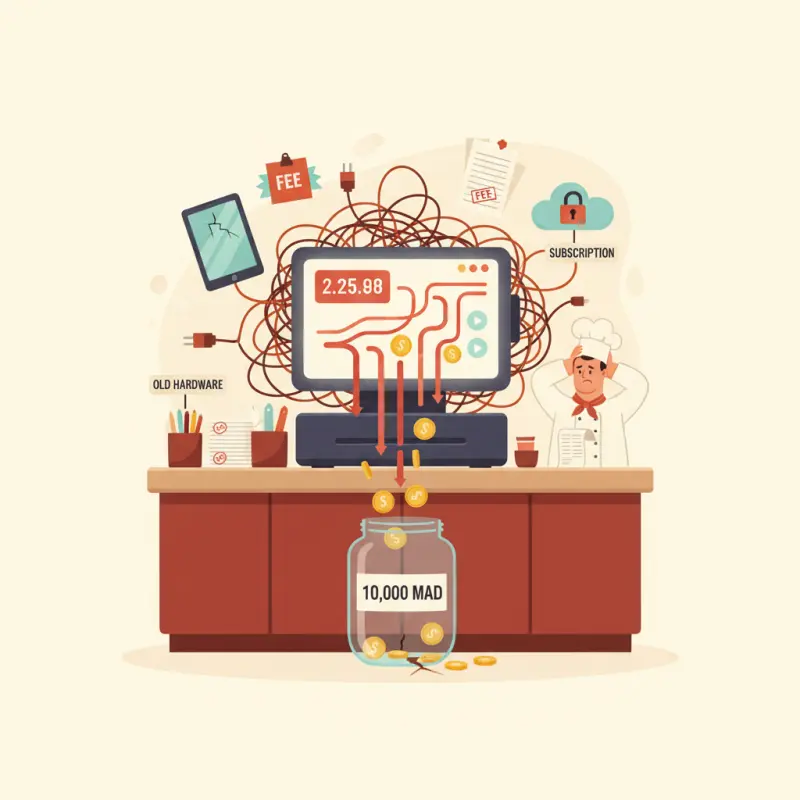
Restaurant POS Systems: Hidden Costs That Drain 10K MAD Monthly
Blog Manager
··6 min read
AI Overview
Restaurant pos systems marketed as "free" cost Moroccan restaurants an average of 10,300 MAD monthly through hidden transaction fees, integration costs, and manual labor overhead. Traditional restaurant pos systems charge 2.9% per card transaction, plus installation fees of 3,000 MAD, monthly software costs of 500 MAD, and support incidents at 200 MAD each. A Casablanca seafood restaurant tracked metrics after upgrading to an integrated platform: order accuracy jumped from 87% to 98% in week one, while table turnover increased significantly within the first month. Commission-free platforms like OCHI eliminate transaction fees entirely, offering transparent pricing that includes real-time tracking and kitchen display systems. Calculate your current system's hidden costs by tracking transaction fees, integration expenses, and staff time spent on manual reconciliation to identify potential savings.
Table of Contents
For restaurant owners
Start your restaurant in 60 minutes.
From signup to your first real order — no commission, no setup fee, no sales call.
The Real Cost of Your Current System (Even If It's "Free")
That handwritten order pad costs you 12,000 MAD per month. Not in paper and pens — in missed orders, calculation errors, and the 20 minutes your staff spends reconciling receipts every night instead of prepping for tomorrow.
Restaurant owners in Morocco evaluate restaurant pos systems like they're buying a refrigerator: upfront price, maybe the warranty, done. They miss the operational costs that compound daily. A "free" system charging 2.9% per card transaction processes 100,000 MAD monthly? That's 2,900 MAD vanishing before you count integration fees, downtime losses, or staff overtime from manual workarounds.
The Hidden Mathematics of POS Pricing
Traditional restaurant pos systems hide their true cost in layers. The terminal costs 15,000 MAD. Installation adds 3,000. Monthly software runs 500. Transaction fees take 2.5%. Support calls bill at 200 MAD per incident. Menu updates? Another 500 each time.
Modern cloud-based systems flip this model. OCHI charges zero commission on orders. Zero transaction fees. One transparent price covers everything — from real-time order tracking to kitchen display systems. When a restaurant in Agadir switched from a legacy terminal to an integrated platform, they discovered their "expensive" 30,000 MAD system was actually saving them 8,000 MAD monthly in hidden fees alone.
What "Free" Actually Costs You Per Month
Cost Category
"Free" POS System
Integrated Platform
Transaction Fees (100K MAD/month)
2,900 MAD
0 MAD
Third-Party Integrations
1,500 MAD
Included
Manual Reconciliation (labor)
2,400 MAD
Automated
Lost Orders/Errors (estimated)
3,000 MAD
500 MAD
Menu Update Fees
500 MAD
Self-service
Total Hidden Costs
10,300 MAD
500 MAD
The True ROI Timeline: When Better Systems Pay for Themselves
A seafood restaurant in Casablanca tracked their metrics after upgrading. Week one: order accuracy jumped from 87% to 98%. Month one: table turnover increased 15% with faster payment processing. Month three: labor costs dropped 12% from automated reporting. Month six: they opened a second location using the same system — no new training needed.
The payback period for quality restaurant pos systems averages four months in Morocco. Not because of the fancy features. Because they eliminate the thousand small inefficiencies that bleed restaurants dry.
Stack audit
What do you currently use?
Tick what you have. We’ll show what OCHI replaces or connects to.
POS Architecture: Why Your Choice Today Determines Your Growth Tomorrow
Choose wrong today, and you'll migrate systems within 18 months. That's not a prediction — it's the industry average when restaurants pick based on price alone. Architecture determines everything: can you add delivery tomorrow? Open a second branch? Handle Ramadan rush without crashing?
Legacy Systems vs. Cloud-Based: The Technical Reality
Legacy terminals store data locally. Power cut in Marrakech? Your sales history vanishes. Internet down? You're writing orders on napkins. Cloud-based systems like OCHI sync constantly. Lose connection? The system switches to offline mode, then syncs when you're back online. Your data lives in multiple secure locations — accessible from anywhere, protected from local disasters.
Cloud architecture enables features legacy systems can't touch. Real-time analytics across branches. Automatic backups every five minutes. Remote menu updates from your phone. Software updates that happen overnight without disrupting service.
Integrated Platforms vs. Best-of-Breed: The Hidden Complexity Tax
Some restaurants cobble together solutions: POS from vendor A, delivery from vendor B, inventory from vendor C. Each integration costs money. Each vendor blames the others when things break. Staff juggles three logins, three interfaces, three support numbers.
Integrated platforms consolidate everything. OCHI combines POS, online ordering, delivery management, and customer loyalty in one system. Same interface whether you're taking table orders or managing delivery zones. One support team who actually understands your entire operation.
API-First Design: Why This Technical Detail Affects Your Daily Operations
Modern restaurant pos systems expose APIs — letting you connect accounting software, marketing tools, or custom apps. OCHI provides webhook events for 18 different actions, from new orders to inventory updates. A pizzeria in Agadir built a custom dashboard showing real-time sales across their three locations. Total development time: one weekend.
The Four POS Models That Actually Work in Morocco
Forget the 50-system comparison charts. In Morocco's restaurant market, four models handle 95% of real-world needs. Each fits specific operational styles and growth plans.
The Traditional Terminal Model: When It Still Makes Sense
Fixed terminals still work for single-location restaurants with stable menus and minimal delivery. They're bulletproof — a tagine restaurant in Fès has used the same terminal for eight years. But they lock you into that location, that workflow, that limitation.
Tablet-Based Systems: The Sweet Spot for Most Independent Restaurants
iPad-based systems balance flexibility and reliability. Waiters carry orders to tables. Managers check reports from home. The hardware costs less than traditional terminals, and cloud sync means you're never tied to one device.
Mobile-First Platforms: For Delivery-Heavy Operations
Delivery-focused restaurants need mobile-first thinking. Orders flow from customer phones to kitchen screens to driver apps. OCHI's delivery management includes polygon zones for precise coverage, batch order optimization, and real-time GPS tracking. Everything designed for speed and accuracy when 70% of orders leave your restaurant.
Integrated Restaurant Management Platforms: The New Standard
The newest model treats POS as one component of a complete system. Online ordering, table management, kitchen displays, and analytics work as one. When a customer orders through your QR code, the order appears instantly in the kitchen, updates inventory, triggers loyalty points, and schedules the pickup time — no manual steps.
Feature Priority Matrix: What You Need Now vs. What You'll Wish You Had
Restaurant pos systems dazzle with feature lists. AI-powered this, blockchain that. Most restaurants need five core features working perfectly, not 50 features working sometimes.
Week One Essentials: The Non-Negotiables
Order taking. Payment processing. Basic reporting. If these three don't work flawlessly from day one, nothing else matters. OCHI's touch-friendly interface trains new staff in 30 minutes. Split bills, modify orders, process refunds — the basics that happen 100 times daily.
Month Six Features: When Operations Get Complex
After six months, you'll need inventory tracking, staff scheduling, and customer data. The breakfast café that seemed simple? Now tracking egg usage across three dish variations. The casual dining spot? Building email lists for slow Tuesday promotions.
Year Two Requirements: Scaling Without System Migration
Growth brings complexity. Multi-location management. Centralized purchasing. Performance analytics by location, by server, by dish. Systems lacking these features force painful migrations just when business is taking off.
The OCHI Model: How Modern Platforms Eliminate Feature Gaps
OCHI includes advanced features from day one, activated when you need them. QR table ordering sits dormant until you're ready. Webhook integrations wait quietly. Multi-branch controls appear when you expand. Pay once, grow into the features as your business evolves.
Implementation Reality Check: The 30-60-90 Day Truth
POS companies promise "setup in minutes." Reality: transitioning restaurant pos systems takes planned phases to avoid disrupting service.
Pre-Implementation: The Data Audit Nobody Talks About
Before touching new hardware, audit your current data. Menu items with all variations. Active customer accounts. Historical sales patterns. Supplier contacts. Most restaurants discover their data is messier than expected — better to clean it before migration than after.
Week One: Realistic Staff Training Expectations
Train in waves. Start with managers and tech-comfortable staff. They become internal trainers for the second wave. Run parallel systems for three days — old system official, new system shadow mode. By day four, flip them. Keep the old system accessible for questions.
Month Two: When Integration Problems Surface
Real issues emerge under pressure. The Friday night rush reveals slow receipt printing. Month-end shows reporting gaps. This is normal. Document everything. Good vendors fix these quickly — OCHI's support runs 24/7 because restaurant problems don't wait for business hours.
Month Three: Measuring Success Beyond "It Works"
After 90 days, measure what matters. Average transaction time down 30 seconds? That's two extra table turns nightly. Order accuracy up 10%? That's fewer remakes and happier customers. The Moroccan restaurant that measures these metrics consistently outperforms the one that stops at "the system works."
Modern restaurant pos systems aren't about the technology. They're about what the technology enables: faster service, accurate data, and time to focus on food instead of fighting with terminals. The right system pays for itself by eliminating the inefficiencies you've accepted as normal.
See how OCHI brings everything together — POS, ordering, and operations — at ochi.ma/partners.
Frequently Asked Questions
What are the hidden costs of restaurant POS systems in Morocco?
Hidden costs include transaction fees averaging 2.9% per card payment, integration fees of 1,500 MAD monthly, manual reconciliation labor costing 2,400 MAD, and lost orders from errors estimated at 3,000 MAD monthly. These costs can total over 10,000 MAD per month for a restaurant processing 100,000 MAD in transactions.
How much do transaction fees cost restaurants using traditional POS systems?
Transaction fees typically range from 2.5% to 2.9% per card payment. A restaurant processing 100,000 MAD monthly pays 2,900 MAD in transaction fees alone, not including additional processing or integration costs.
Do commission-free restaurant POS systems really save money?
Yes, commission-free systems eliminate transaction fees entirely and include integrations in one transparent price. Restaurants switching to platforms like OCHI report savings of 8,000 MAD monthly in eliminated fees while improving order accuracy from 87% to 98%.
What should Moroccan restaurants look for in a modern POS system?
Look for zero commission structures, included integrations for delivery and inventory management, real-time order tracking, kitchen display systems, and transparent pricing with no hidden fees. Cloud-based systems offer better reliability and automatic updates.
Restaurant owners · Weekly
The guide to running a restaurant in 2026.
One article per week. No commission advice.
Just honest operational insight for Moroccan restaurants.
Blog Manager
Comments
No comments yet. Be the first to share your thoughts.