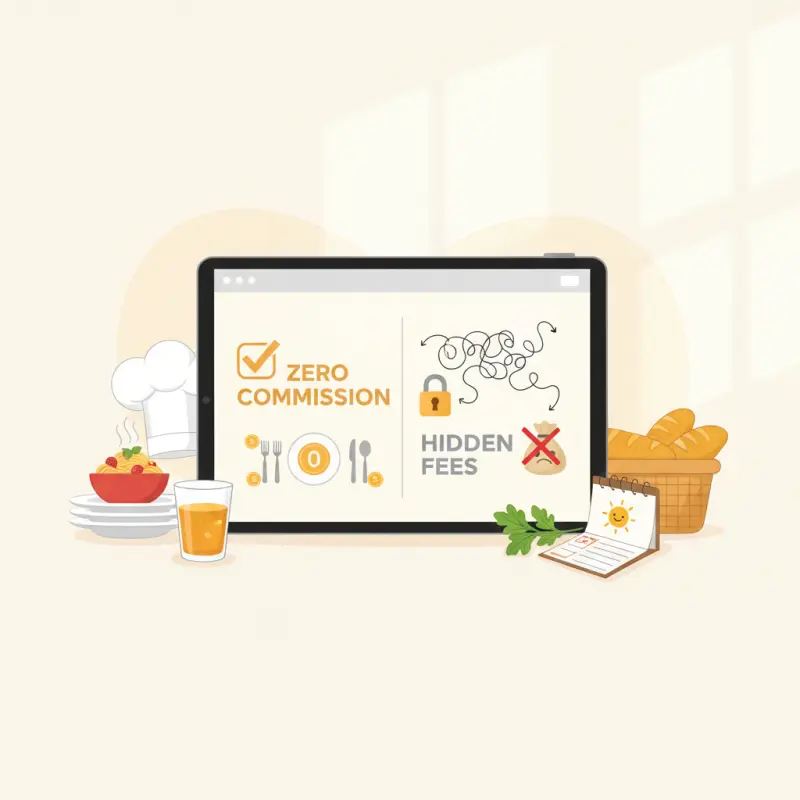
What Free Restaurant Programs Actually Include (And Don't)
Understanding what "free" actually delivers requires reading past marketing headlines into terms of service documents. Most platforms follow predictable patterns in their feature restrictions.
Online Ordering System Free:
The Reality Check
Basic online ordering typically includes menu display, cart functionality, and order notifications. What's missing: customer data ownership, marketing tools, loyalty programs, multi-language support, and custom branding. The "free" system works — until you need to grow.
| Feature |
Typical "Free" Tier |
Required Paid Tier |
Monthly Cost |
| Basic Orders |
✓ |
- |
0 MAD |
| Custom Domain |
✗ |
Professional |
500 MAD |
| Loyalty Program |
✗ |
Premium |
1,200 MAD |
| Multi-Branch |
✗ |
Enterprise |
3,000 MAD |
| API Access |
✗ |
Enterprise |
3,000 MAD |
Restaurant Management Software Free:
Feature Comparison
POS functionality in free tiers covers basic transactions. Missing pieces include shift management, detailed reports, cash reconciliation, and integration with kitchen operations. A "restaurant management software free" solution handles today's orders but can't provide yesterday's insights or tomorrow's forecasts.
Free Table Reservation System:
Capacity Limits
Reservation platforms cap bookings at 20-30 per month on free plans. For a busy Marrakech restaurant, that's two days of capacity. The "free restaurant reservation system" becomes a paid necessity the moment you gain traction.
The True Cost Calculator:
Free vs. Zero-Commission
Numbers expose the illusion of free platforms. When commission fees enter the equation, "free" becomes the most expensive option available.
Monthly Revenue: 50,000 MAD Scenario
A neighborhood restaurant in Agadir generating 50,000 MAD monthly through online orders faces these real costs:
Traditional "free" platform with 15% commission: 7,500 MAD monthly fees. Annual cost: 90,000 MAD.
Zero-commission platform at 500 MAD monthly: 6,000 MAD annual cost.
Savings with zero-commission: 84,000 MAD yearly.
High-Volume Restaurant: 150,000 MAD Scenario
Scale amplifies the difference. A popular Casablanca restaurant processing 150,000 MAD monthly loses 22,500 MAD to commissions — nearly a quarter-million dirhams annually. That's renovation money, expansion capital, or staff bonuses redirected to platform fees.
Why Zero Commission Beats "Free" Every Time
The math is unforgiving. Commission-based models punish success — the more you sell, the more you pay. Fixed-fee or zero-commission models align platform success with restaurant growth. Your victories don't come with escalating costs.
OCHI's Approach: Actually Free Restaurant Management
OCHI delivers what others promise: complete restaurant management without hidden fees, commissions, or feature gates. Every restaurant gets the full platform from day one.
Complete System: POS, Ordering, Delivery, Analytics
The OCHI platform includes POS operations, kitchen display systems, online ordering, QR table ordering, delivery management, inventory tracking, and business intelligence. No feature requires an upgrade. No function hides behind a paywall. The same tools powering enterprise restaurants in Casablanca work for family bistros in Agadir.
Your Brand, Your Domain:
restaurant.ochi.ma
Every restaurant receives a branded subdomain — yourbrand.ochi.ma — maintaining identity while leveraging OCHI's infrastructure. Customers order directly from your digital storefront. Your brand stays front and center.
OCHI's zero-commission structure means menu prices equal customer prices. No markup. No percentage fees. A 100 MAD tagine costs customers 100 MAD, and restaurants keep every dirham. This transparency builds trust with customers while maximizing restaurant margins.
Red Flags When Evaluating Free Restaurant Programs
Smart evaluation prevents expensive mistakes. These warning signs indicate future problems hiding behind "free" offers.
Questions That Expose Hidden Costs
Ask these questions before committing to any platform:
What percentage of revenue do you take?
Which features require paid upgrades?
Can I export my complete data anytime?
What are the SMS and email costs?
Do you markup delivery fees?
Vague answers or deflection reveal platforms planning to monetize your success through hidden charges.
Warning Signs of Freemium Traps
Beware platforms that limit orders, transactions, or customers on free tiers. These artificial constraints force upgrades at the worst moment — when business is growing. Also watch for "free trials" that auto-convert to expensive plans, and platforms that advertise features only available at enterprise tiers.
Due Diligence Checklist for Casablanca Restaurant Owners
Before signing up, verify: commission structure (including future changes), data portability options, integration costs, training requirements, and contract termination terms. Read user reviews from restaurants your size in your market. Contact current users directly when possible.
The restaurant industry runs on tight margins. Technology should expand those margins, not consume them through commissions and hidden fees. Real value comes from platforms that grow with your success without taking an increasing share of it. See what true zero-commission ordering looks like at ochi.ma/partners.