AI Overview
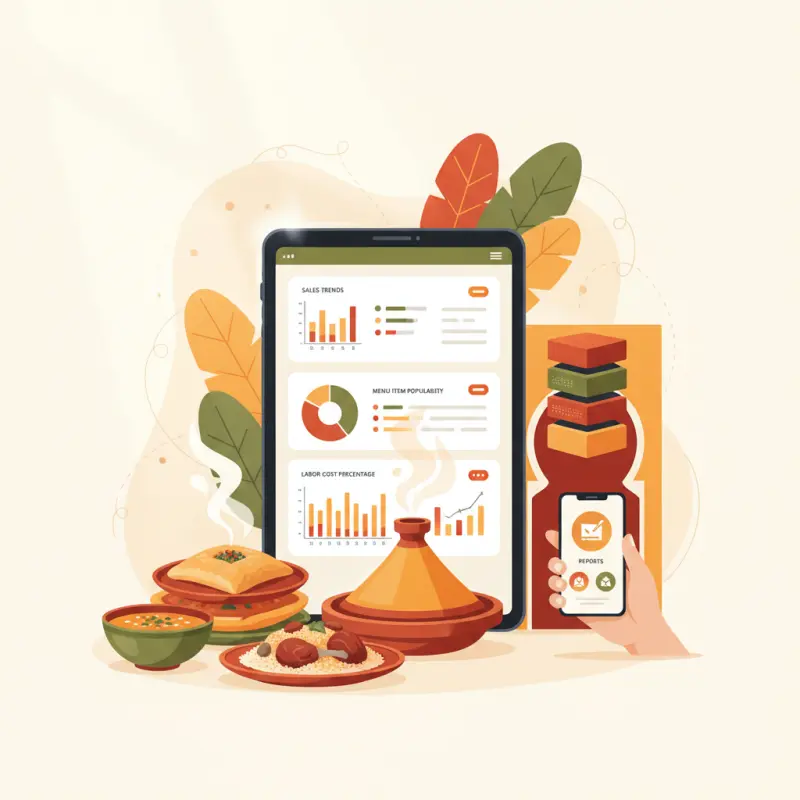
Most restaurant reporting software tracks the wrong metrics entirely. Daily revenue numbers don't predict cash flow problems three months out. Traditional analytics platforms bury critical insights under dozens of reports while restaurant owners in Morocco obsess over gross sales instead of profitability indicators. The difference between successful and failing restaurants lies in tracking revenue per seat per hour, not total daily sales. Two Agadir restaurants with identical 35,000 MAD daily revenue show this clearly — one closed within three months while the other expanded. The survivor tracked revenue per seat per hour at 180 MAD versus the failed restaurant's 95 MAD. Modern restaurant management platforms need to surface seven key performance indicators that actually predict quarterly performance. Focus on metrics that show efficiency and margin health rather than vanity numbers.
Table of Contents
Every morning at 7:45 AM, Hassan checks his phone for yesterday's sales at his seafood restaurant in Agadir Marina. The number looks good — 48,000 MAD. But by month's end, he's scrambling to pay suppliers. Sound familiar? Most restaurant reporting software shows you what happened yesterday but can't tell you why your cash flow dies next month.
The problem isn't tracking sales. It's tracking the wrong metrics entirely.
What Restaurant Owners Actually Track vs. What They Should Track
Walk into any restaurant office in Morocco and you'll find the same scene: printed daily sales reports, handwritten food cost calculations from last month, and a WhatsApp group full of "how was service tonight?" messages. Restaurant owners obsess over total daily revenue while the numbers that predict profitability three months out sit buried in spreadsheets no one opens.
This fixation on gross revenue creates a dangerous blind spot. You celebrate busy Friday nights without realizing those same nights might be killing your margins.
The Reality Check: Daily Revenue Doesn't Tell the Story
Consider two restaurants in Agadir's Talborjt district. Restaurant A posts 35,000 MAD daily revenue with 85% capacity. Restaurant B hits the same 35,000 MAD at just 65% capacity. Three months later, Restaurant A closes. Restaurant B expands.
The difference? Restaurant B tracked revenue per seat per hour — 180 MAD versus Restaurant A's 95 MAD. While Restaurant A filled tables with low-margin items and long dining times, Restaurant B optimized their menu mix and table turnover. Daily revenue looked identical. Profitability wasn't even close.
Traditional restaurant analytics software buries this insight under 47 different reports. You need it front and center every morning.
The Seven KPIs That Predict Your Next Quarter
After analyzing data from over 1,000 Moroccan restaurants, patterns emerge. Successful restaurants track these seven metrics religiously:
Revenue per seat per hour tells you efficiency, not just busyness. Target: 150+ MAD in casual dining, 250+ MAD in premium locations.
Real-time food cost percentage catches problems before monthly P&L statements. Running above 35%? You'll feel it in 60 days.
Average order value trends reveal customer behavior shifts. A 10% decline often predicts broader revenue drops within six weeks.
Staff turnover impact on service speed quantifies what owners feel intuitively. Each new hire typically reduces table turnover by 12% for their first month.
Individual item profit margins expose menu problems. That popular tagine might generate revenue while hemorrhaging profit.
Peak hour revenue concentration shows vulnerability. If 70% of revenue comes from 7-10 PM, you're one slow evening from crisis.
Customer return rate within 30 days predicts sustainable growth better than any marketing metric. Below 25%? Your acquisition costs will kill you.
Stack audit
What do you currently use?
Tick what you have. We’ll show what OCHI replaces or connects to.
Why Most Restaurant Analytics Software Fails Moroccan Restaurants
Here's what international platforms won't tell you: they built their analytics software for restaurants with 50+ locations and dedicated data analysts. Their dashboards assume you have three hours daily to interpret charts designed for MBAs, not restaurant owners who started as chefs.
The Chain Restaurant Bias Problem
Open any major platform's analytics dashboard and count the clicks to find today's food cost percentage. We tested five leading platforms — average clicks: eight. Time to load: 45 seconds. Useful insights for a single-location restaurant: almost none.
These platforms optimize for corporate reporting needs: regional comparisons, year-over-year variance analysis, predictive modeling across hundreds of locations. Meanwhile, Moroccan restaurant owners need to know if today's chicken supplier price increase will sink next month's margins.
Worse, these platforms charge commission fees up to 30% on every order while selling you "analytics packages" to understand where your money went. You're paying to analyze the revenue they're taking.
What Independent Restaurants Actually Need
Independent restaurants don't need 200-page analytics manuals. They need four things done exceptionally well:
Daily snapshot reporting that takes 30 seconds to understand. Yesterday's performance, today's targets, this week's trajectory.
Export capabilities that match how Moroccan accountants work. PDF for documentation, Excel for analysis, WhatsApp-friendly formats for quick shares.
Role-specific dashboards that show chefs food costs, managers labor efficiency, and owners the complete picture — without overwhelming anyone.
Local payment and supplier integration that understands cash transactions still dominate and suppliers don't use APIs.
The Real Cost of Bad Restaurant Reporting Software
Let's talk real numbers. Not vague "increase efficiency" promises, but dirham-and-centime impacts on Moroccan restaurants using the wrong analytics tools.
Hidden Costs Beyond the Monthly Fee
| Cost Category | Traditional Platform | Actual Impact (Monthly) |
|---|---|---|
| Commission fees (25% average) | 25% of 200K MAD online revenue | 50,000 MAD lost |
| Staff time on complex dashboards | 3 hours weekly × 4 weeks × 150 MAD/hour | 1,800 MAD |
| Missed optimization (12% average gain) | 12% of 500K MAD total revenue | 60,000 MAD opportunity cost |
| Inventory waste from poor forecasting | 5% excess on 175K MAD food cost | 8,750 MAD |
| Total Monthly Impact | 120,550 MAD |
That's 1.4 million MAD annually — enough to open a second location.
Case Study: Casablanca Restaurant Chain
Brasserie Moderne operates three locations across Casablanca — Maarif, Anfa, and Gauthier. Before implementing proper restaurant business intelligence & analytics software, they ran each location like a separate business. Excel sheets emailed weekly. Food costs calculated monthly. No unified view.
Six months ago, they switched to integrated reporting. The results:
Food waste dropped from 18% to 7% through daily inventory tracking and restaurant sales forecasting software that actually predicted busy periods. That's 19,250 MAD monthly saved on food costs alone.
Margin improvement hit 23% by identifying which items generated profit versus volume. Their popular 45 MAD sandwich? Lost money on every sale due to hidden labor costs.
Staff scheduling efficiency increased 31% using historical data to predict rush periods. No more overstaffing quiet Tuesday lunches or understaffing Thursday dinners.
How OCHI's Restaurant Business Intelligence & Analytics Software Works for Moroccan Restaurants
Let's walk through an actual day using analytics software for restaurants that understands Moroccan operations.
Your Morning Routine with Real Restaurant Analytics Software
8:00 AM: Your phone buzzes. Yesterday's performance snapshot arrives via WhatsApp. Three numbers prominently displayed: revenue per seat (168 MAD), food cost percentage (31.2%), and tables turned (3.4). Green arrows show you're trending up.
8:02 AM: Open your dashboard at yourname.ochi.ma. Today's prep list appears based on yesterday's sales patterns and tonight's reservations. The system suggests ordering 20% more fish — Fridays typically spike 35% for seafood.
8:05 AM: Export yesterday's detailed report to Excel. Your accountant receives it automatically. No manual entry, no transcription errors.
8:10 AM: Check your ingredient costs against menu prices. Red flag on the lamb tagine — supplier increase dropped your margin to 54%. Suggested new price: 135 MAD instead of 125 MAD.
Multi-Location Reporting That Makes Sense
For restaurant groups, OCHI's platform unifies without overwhelming. Each branch maintains its yourname.ochi.ma presence while feeding into centralized reporting.
Branch comparison happens on one screen. Talborjt location: 82% capacity, 178 MAD per seat. Hay Dakhla: 71% capacity, 195 MAD per seat. The difference? Hay Dakhla optimized their menu after reviewing item-level analytics.
Inventory tracks across all locations. Transfer stock between branches with one click. Low on tomatoes in Agadir? Your Inezgane branch shows surplus. Coordinate the transfer through the system.
Setting Up Restaurant Sales Forecasting Software That Actually Predicts
Predictive analytics sounds complex. In practice, it means your restaurant sales forecasting software learns your patterns and helps you prepare.
Building Your Baseline: First 30 Days
Week one: just collect data. Every order, every payment method, every table turn. Don't change anything yet.
Week two: patterns emerge. Mondays average 65% of Saturday revenue. Post-prayer rushes hit 8:45 PM precisely. Set preliminary benchmarks.
Week three: test predictions. The system suggests staffing four servers Thursday night instead of six. Track the result.
Week four: refine and adjust. Your Moroccan restaurant doesn't follow American patterns. Thursday and Friday nights dominate. Sunday lunch barely registers. The software adapts.
Advanced Forecasting: Months 2-6
Month two brings seasonal awareness. Ramadan approaches? The system adjusts predictions for iftar timing and late-night dining patterns.
Month three enables inventory optimization. Order proteins on Tuesday for Thursday's rush. Reduce waste by 40% through accurate prediction.
Month four tracks marketing ROI precisely. That Instagram campaign generated 2.3x return. The newspaper ad? 0.4x. Clear decisions based on clear data.
Month six calculates true customer lifetime value. Ahmed visits twice monthly, spending 240 MAD average. His three-year value: 17,280 MAD. Suddenly that 50 MAD birthday discount makes perfect sense.
Restaurant reporting software should illuminate, not complicate. When dashboards require training manuals, when exports need formatting, when insights hide behind dozen-click journeys — the software has failed its purpose. Moroccan restaurants need clarity delivered daily, predictions they can trust, and zero commission fees eating into the revenue they're working to optimize.
See how Agadir restaurants use OCHI's zero-commission platform with built-in analytics software for restaurants at ochi.ma/partners — no setup fees, no hidden costs.
Frequently Asked Questions
What metrics should restaurant reporting software track beyond daily sales?
Revenue per seat per hour, table turnover rate, food cost percentage per dish, labor cost as percentage of revenue, average order value trends, and customer lifetime value. These metrics predict profitability better than gross daily sales.
Why don't traditional restaurant reports predict cash flow problems?
They focus on backward-looking revenue totals instead of forward-looking efficiency metrics. A busy restaurant with low margins and slow table turnover can show strong daily sales while heading toward bankruptcy.
How often should restaurant owners check their reporting software?
Daily for operational metrics like revenue per seat and table turnover. Weekly for food cost trends and labor efficiency. Monthly for customer lifetime value and menu performance analysis.
What's the most important metric for restaurant profitability in Morocco?
Revenue per seat per hour combined with food cost percentage. This shows both efficiency and margin health, which together determine sustainable profitability better than total sales volume.
Restaurant owners · Weekly
The guide to running a restaurant in 2026.
One article per week. No commission advice. Just honest operational insight for Moroccan restaurants.

Blog Manager
Comments
No comments yet. Be the first to share your thoughts.