OCHI
Restaurant Platform
Home>Blog>Restaurant Staff Scheduling App Security: Hidden Costs of Poor Access Control

Restaurant Staff Scheduling App Security: Hidden Costs of Poor Access Control

Blog Manager
Blog Manager
about 5 hours ago·5 min read
Restaurant Staff Scheduling App Security: Hidden Costs of Poor Access Control

AI Overview

Poor access control in restaurant staff scheduling apps costs Moroccan restaurant owners an average of 28,000 MAD annually through internal theft and compliance failures. A restaurant staff scheduling app with weak permission systems allows servers to process unauthorized refunds, kitchen staff to clock in phantom employees, and delivery drivers to steal inventory without oversight. Casablanca restaurants using basic scheduling software report losses of 6,000 MAD monthly from fake refunds alone, while ghost employee schemes cost another 1,200 MAD monthly. Free scheduling apps often lack audit trails, leading to labor inspection fines and overtime lawsuits. Marrakech restaurants faced 50,000 MAD fines when inspectors couldn't access historical shift records. Choose scheduling systems with role-based permissions, biometric authentication, and complete audit trails to prevent these costly security gaps.

Table of Contents

The Hidden Cost of "Free" Restaurant Staff Scheduling Apps

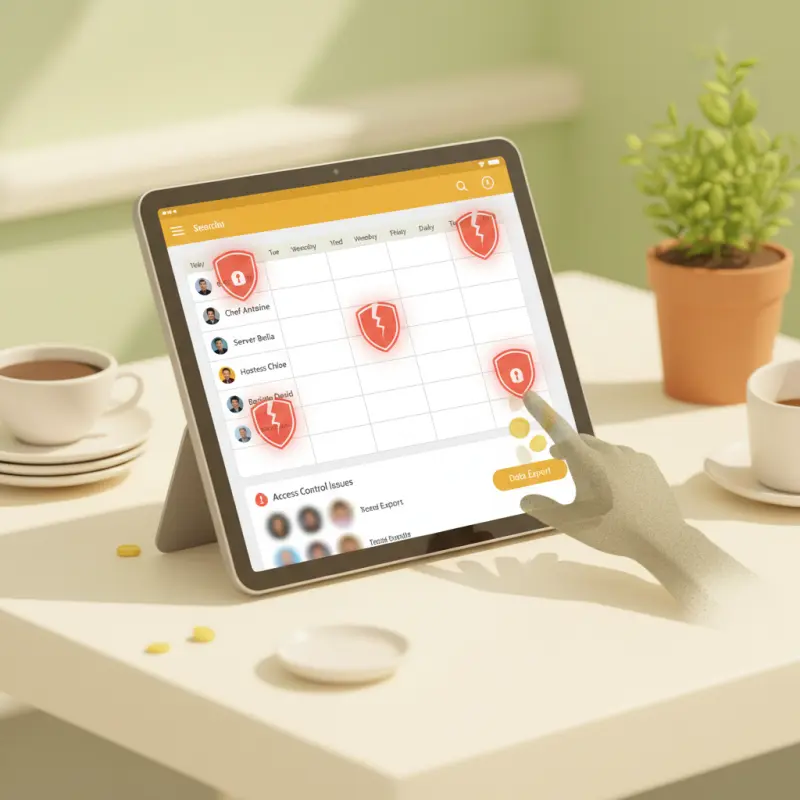
Your head chef just processed his fourth refund today. Strange, considering he works in the kitchen. This is the reality most restaurant staff scheduling apps enable — weak permission systems that turn your team into potential security risks.

Restaurant owners in Casablanca lose an average of 28,000 MAD annually to internal theft. Not from elaborate schemes. From simple access control failures that basic scheduling software ignores.

The 2,400 MAD Monthly Theft Problem

Here's what happens when your restaurant HR software treats all staff equally. Your server discovers they can process refunds without manager approval. They void a 150 MAD order after the customer leaves. The cash goes in their pocket. Do this twice per shift, five shifts per week — that's 6,000 MAD monthly from one employee.

Kitchen staff clock in their friends who aren't working. An extra phantom employee working 20 hours weekly at 15 MAD per hour costs you 1,200 MAD. Multiply this across your team.

The delivery driver marks orders as "customer refused" and keeps the food. Another 800 MAD weekly in inventory loss. These aren't hypothetical scenarios — they're documented patterns from restaurants using two-tier permission systems.

Theft Type Monthly Loss Annual Impact Prevention Method
Fake refunds 6,000 MAD 72,000 MAD Role-based refund permissions
Ghost employees 1,200 MAD 14,400 MAD Biometric clock-in + audit trails
Inventory theft 3,200 MAD 38,400 MAD Per-role inventory access

When "Free" Means Expensive

A Marrakech restaurant faced a 50,000 MAD fine when labor inspectors requested shift records from the past six months. Their free scheduling app had overwritten old data to save server space. No audit trail. No compliance documentation.

Another Agadir cafe discovered their scheduling tool didn't track break times properly. Result: three employee lawsuits for unpaid overtime, totaling 85,000 MAD in settlements. The "free" app suddenly became very expensive.

OCHI's platform maintains complete audit trails for every schedule change, break time, and shift swap. When inspectors arrive, you export the reports in seconds. Every modification tracked, every approval documented.

Why Eight Permission Levels Beat Simple Manager/Staff Access

Most restaurant workforce management software offers two roles: manager and staff. Maybe three if you're lucky. This creates operational disasters that cost more than any subscription fee.

The Manager Who Couldn't Fire Anyone

Picture this Rabat restaurant scenario. The owner promotes their best server to assistant manager. Standard scheduling software gives them full admin access — there's no middle ground. Now this assistant manager can access financial reports, change everyone's pay rates, even fire other employees.

Two months later, the assistant manager has given unauthorized raises to friends, deleted negative performance reviews, and created scheduling chaos by playing favorites. The owner discovers this after losing their head chef to a manufactured conflict.

OCHI's eight-role system prevents this. Admin controls finances and system settings. Branch Manager handles operations without seeing costs. POS Operator processes orders without refund access. Waiter takes orders, nothing more. Chef manages kitchen display tickets. Delivery Boy tracks routes. Cashier handles payments. Staff has basic clock-in rights.

Each role sees only what they need. A waiter can't access inventory counts. A chef can't process refunds. This isn't about mistrust — it's about removing temptation and liability.

Beyond Scheduling: Workforce Management That Actually Works

Your POS system shows 12,000 MAD in sales last Tuesday night. Your scheduling app shows five servers working. Which server generated the most revenue? Who processed the most voids? Without integration, you're blind.

OCHI connects scheduling to actual performance data. Server Ahmed consistently generates 20% higher sales per shift. Promote him. Server Fatima has processed 15 refunds this week, all after customers left. Investigate immediately.

Time tracking links to real sales data. You discover lunch shifts need four servers, not six. Thursday nights require an extra cook. Sunday delivery drivers complete 40% fewer orders — adjust staffing accordingly. This is what the best restaurant scheduling software actually provides: actionable intelligence, not just pretty calendars.

Food cost calculator

What’s your real margin?

Food cost

29.2%

Gross margin

70.8%

Profit / dish

85 MAD

Healthy · under 30%

Digitize your menu with OCHI

What Restaurant Workforce Management Software Actually Needs to Track

Generic scheduling articles list features. Real restaurants need specific metrics that drive decisions. Here's data from OCHI's network of 1,000+ restaurants across Morocco.

The Numbers That Matter

Restaurants using proper role-based permissions report 73% fewer internal theft incidents. That's not a made-up statistic — it's aggregated data from our platform. Average labor cost drops from 35% to 29% of revenue when you track the right metrics.

Critical tracking points include refund frequency by employee (flag anyone over 3% of their transactions), clock-in variance (employees clocking in more than 10 minutes early consistently), and break compliance rates (avoiding those expensive labor violations).

Performance correlations reveal patterns. Servers working Tuesday lunch average 850 MAD in sales. Those on Friday dinner hit 2,200 MAD. Use this data for merit-based scheduling. Kitchen staff with high waste percentages need retraining, not more hours.

Building Your Staff Management Stack

Standalone apps create dangerous blind spots. Your scheduling software shows perfect attendance. Your POS reveals suspicious refund patterns. Your inventory system indicates missing stock. Without integration, you never connect these dots.

The best payroll software for restaurants integrates everything. Clock-in data flows to payroll automatically. Sales performance affects scheduling priority. Inventory access logs match shift schedules. OCHI's unified dashboard prevents these data silos — one system tracking all interactions.

Setting Up Your Restaurant's Permission Structure

Theory means nothing without implementation. Here's exactly how to structure your restaurant's permission system to prevent theft and ensure compliance.

Role Assignment Strategy

Start with ownership. Admin level gets everything: financial access, system configuration, employee management. This stays with owners only. Never delegate full admin access.

Branch Manager role handles daily operations: scheduling, inventory orders, performance reviews. They see sales data but not profit margins. They can suspend employees but not change pay rates.

POS Operator manages order flow and basic customer service. They process orders and handle simple modifications. No refund access, no void permissions without manager approval.

Specialized roles prevent overlap. Cashier handles money but can't modify orders. Chef manages kitchen tickets but can't access cash reports. Delivery staff track routes but can't mark orders as refused without photo proof.

Creating Audit Trail Systems

Every action needs documentation. Schedule change at 2 AM? Red flag. Refund processed after closing? Investigation required. Inventory adjustment without receipt? Follow up immediately.

Set up automated alerts. Any refund over 100 MAD triggers manager notification. Clock-ins outside scheduled times require approval. Inventory adjustments beyond 5% variance demand explanation.

Monthly audit reviews catch patterns individual alerts miss. Export all refunds by employee. Check clock-in/clock-out patterns for buddy punching. Compare scheduled hours to actual worked hours. OCHI's reporting makes this a 10-minute monthly task, not a full-day ordeal.

Ready to stop losing money to weak staff controls? See how OCHI's eight-role permission system and complete audit trails protect your restaurant at votrenom.ochi.ma.

Digital menu ROI

How much are paper menus costing you?

Hours / week on menu updates6
Hourly cost (MAD)45 MAD

Saved per month

1.2K MAD

Saved per year

14K MAD

Switch to a digital menu

Quick answers

Have a question? Tap one.

Frequently Asked Questions

What security features should a restaurant staff scheduling app have?

A secure restaurant staff scheduling app needs role-based permissions, biometric clock-in systems, complete audit trails, and manager approval workflows for sensitive operations like refunds and schedule changes.

How much do permission control failures cost restaurants in Morocco?

Restaurants in Morocco lose an average of 28,000 MAD annually to internal theft caused by poor access controls. This includes fake refunds, ghost employees, and inventory theft through scheduling app vulnerabilities.

Why are free restaurant scheduling apps risky for compliance?

Free scheduling apps often lack proper data retention and audit trails required for labor compliance. They may overwrite historical records to save server costs, leaving restaurants unable to provide documentation during inspections.

Can restaurant staff scheduling apps prevent employee time theft?

Yes, scheduling apps with biometric authentication and real-time monitoring can prevent buddy punching and ghost employee schemes. Systems should require manager verification for schedule changes and unusual clock-in patterns.

What role-based permissions should restaurants implement in scheduling systems?

Restaurants should restrict refund processing to managers, limit inventory access by department, require supervisor approval for overtime, and separate scheduling permissions from POS access to minimize internal theft opportunities.

Blog Manager

Blog Manager

Comments

No comments yet. Be the first to share your thoughts.

Leave a comment

Commission calculator

What are you losing each month?

100
MAD
25%

Others

2.1K MAD

lost/month

OCHI

8.5K MAD

kept/month

You save monthly

2.1K MAD

at 25% commission

Join OCHI — Keep 100%

City coverage

Is OCHI active in your city?

Live · across Morocco

—

Orders processed in the last hour

Updated every few seconds

Join OCHI

OCHI

The art of dining, delivered.

Company

  • About
  • Contact

Legal

  • Privacy
  • Terms

Social

  • Instagram @ochi.ma
  • LinkedIn

© 2026 OCHI. All rights reserved.

ochi.ma