AI Overview
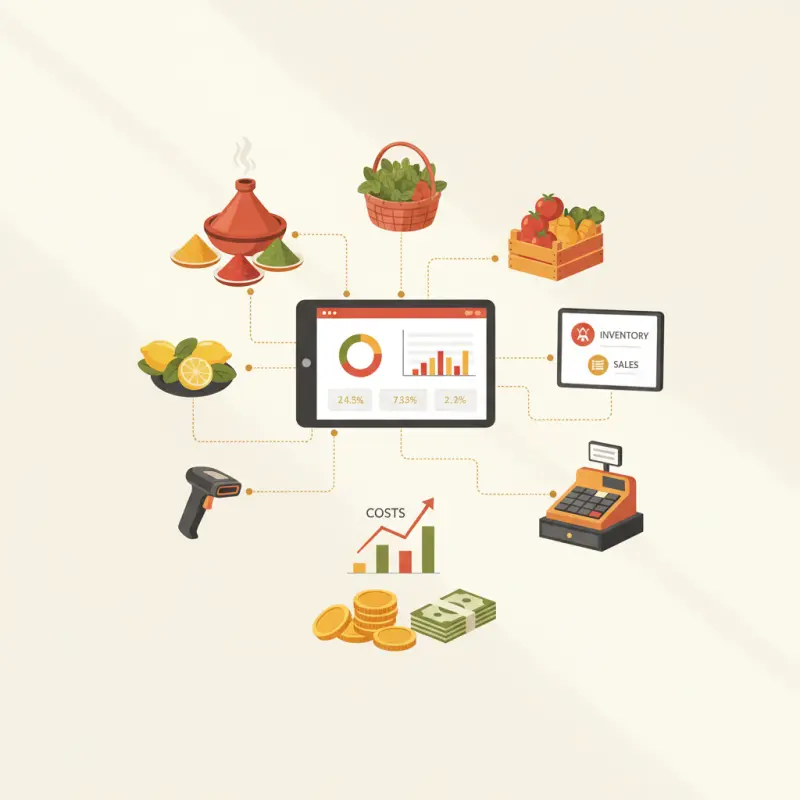
Manual restaurant stock control systems cost Moroccan restaurants an average of 180,000 MAD annually through food waste, overstocking, and staff inefficiency. A restaurant stock control system with gram-level tracking reduces food waste from 25% to 8% and cuts inventory time from eight hours to two hours weekly. Casablanca restaurants using spreadsheets report 20-25% food waste rates, while digital systems in Marrakech reduce over-ordering by 30%. Tomato prices in Morocco swing from 3 MAD to 12 MAD per kilogram seasonally, making real-time cost tracking essential. Manual portion control varies by 40% between cooks, destroying profit margins. Start by tracking your three highest-cost ingredients digitally — this captures 60% of potential savings with minimal setup time.
Table of Contents
The Real Cost of Manual Stock Management in Moroccan Restaurants
A restaurant in Casablanca throws away 15,000 MAD worth of food every month. That's not unusual — it's the industry average when you're tracking inventory on paper or spreadsheets.
Manual stock management costs more than spoiled tomatoes. It's the hours your chef spends counting bottles instead of creating new dishes. It's the cash tied up in excess inventory because no one knows what's actually on the shelves. It's the reputation hit when you run out of a popular dish during dinner rush.
The numbers tell the story. Moroccan restaurants using manual systems report 20-25% food waste rates. Staff spend eight hours weekly on inventory tasks — time that could serve 200 additional customers. Ordering mistakes happen twice per week on average, leading to stockouts or overstock. When you add it up, a mid-sized restaurant loses 180,000 MAD annually to poor stock control.
Why Spreadsheets Fail When Suppliers Change Prices Weekly
Tomato prices swing from 3 MAD to 12 MAD per kilogram between seasons. Your spreadsheet from last month shows outdated costs. Your actual food cost percentage? Nobody knows until month-end — and by then it's too late.
Manual tracking creates a 15-20% over-ordering pattern. You order extra "just in case" because you can't see real-time usage. Those safety buffers become waste. Meanwhile, supplier invoices pile up with different formats, making reconciliation a nightmare. One restaurant owner in Marrakech discovered his kitchen was ordering 30% more chicken than needed — simply because three different staff members were placing orders without coordination.
Stack audit
What do you currently use?
Tick what you have. We’ll show what OCHI replaces or connects to.
Recipe Costing That Actually Works: Gram-Level Tracking
Traditional portion control relies on chef intuition. "A handful of rice" varies by 40% between cooks. "A ladle of sauce" changes with each service. These variations destroy your margins.
Gram-level tracking changes everything. When you know exactly how much each ingredient costs per gram, you control your destiny. A tagine that seems profitable at menu price might actually lose money once you calculate the real portions used. Restaurant management starts with knowing your true costs.
The Harira Example: From 8 MAD Loss to 3 MAD Profit Per Bowl
Take Morocco's beloved harira soup. Most restaurants price it at 25-30 MAD, assuming a food cost around 8-10 MAD. But watch what happens with actual measurement:
| Ingredient | Traditional Portion | Actual Weight Used | Cost Difference |
|---|---|---|---|
| Lentils | "One handful" | 45-75g (varies) | +2.5 MAD variation |
| Tomato paste | "Two spoons" | 30-50g (varies) | +1.8 MAD variation |
| Meat | "Small pieces" | 80-120g (varies) | +6 MAD variation |
| Total cost range | Assumed: 10 MAD | Actual: 8-18 MAD | Up to 8 MAD loss per bowl |
With gram-level tracking, you standardize at exactly 45g lentils, 35g tomato paste, and 90g meat. Cost becomes predictable at 12 MAD. Price it right, control portions, and that 8 MAD loss becomes a 3 MAD profit — a 150% margin improvement per serving.
Why Most Restaurant Stock Management Software Fails in Morocco
International restaurant inventory management software assumes you're buying from sysco-style distributors with barcodes and digital invoices. In Morocco, you're buying from the local market, dealing with handwritten receipts, and negotiating prices in person.
These platforms charge 500-2000 MAD monthly, then add training fees, hardware requirements, and integration costs. They offer features built for American chain restaurants — not for the chef-owner in Agadir buying fresh fish from the port each morning. The language barrier compounds the problem. Your staff needs Arabic or French interfaces, not English-only systems designed in Silicon Valley.
The Subscription Trap: When "Affordable" Becomes Expensive
A restaurant inventory program advertised at "just 500 MAD/month" sounds reasonable. Add the reality: 3000 MAD setup fee, 2000 MAD for tablet hardware, 1500 MAD for staff training, plus transaction fees on every supplier payment. Your "affordable" solution now costs 8500 MAD before you track a single tomato.
The break-even timeline stretches to 8-12 months — assuming perfect adoption. Most restaurants abandon these systems within six months, eating the sunk costs. The problem isn't the technology. It's the mismatch between foreign restaurant software inventory systems and Moroccan market realities.
Building Your Stock Control System: Week-by-Week Implementation
Successful implementation follows a proven path. Skip steps and you'll join the 70% of restaurants that fail at digital transformation.
Week 1-2: Baseline Measurement and Supplier Audit
Start by measuring your current waste. Count everything thrown away for one week. The average Moroccan restaurant discovers 25-30% waste rates — higher than they imagined. Document which items spoil most often. Usually, it's produce ordered in wholesale quantities to get "better prices."
Map your suppliers. List delivery schedules, minimum orders, and payment terms. Calculate the true cost including transportation. That "cheap" supplier 30 kilometers away might cost more once you factor in delivery charges and spoilage during transport.
Week 3-4: Digital Transition and Staff Training
Set up your recipes with gram-level specifications. Every dish gets a precise ingredient list. Configure reorder points for high-turnover items — when olive oil drops below 10 liters, the system alerts you.
Train your kitchen staff on portion protocols. This isn't about restricting creativity. It's about consistency. When customers order their favorite dish, they expect the same experience every time. Proper restaurant stock management software makes this possible without turning chefs into robots.
OCHI's Approach: Zero-Commission Inventory Management
OCHI includes inventory management as part of the complete restaurant platform — not a costly add-on. Track ingredients by SKU, build recipes with exact measurements, and monitor branch-specific stock levels. The system alerts you before items run out, suggests reorder quantities based on sales patterns, and maintains a complete audit trail.
Integration matters. When a customer orders through your OCHI storefront, inventory updates automatically. No double data entry. No reconciliation headaches. Your restaurant stock control system works with your POS, online ordering, and kitchen display — one unified platform.
Real Results: Restaurant Atlas in Agadir
Restaurant Atlas implemented OCHI's inventory tracking three months ago. Food waste dropped from 28% to 21% in the first month as staff learned proper portioning. By month three, waste hit 19% — a 25% total reduction. The savings: 12,000 MAD monthly.
Automated purchase orders changed their supplier relationships. Instead of panic buying, they order based on next week's forecasted sales. Suppliers appreciate the predictability and offer better prices for consistent orders. The restaurant's branded ordering site at votrenom.ochi.ma drives direct orders — no commission fees eating into margins needed for quality ingredients.
The path from manual chaos to controlled operations takes work. But the payoff — in reduced waste, improved margins, and staff efficiency — transforms your business. See what OCHI can do for your restaurant.
Frequently Asked Questions
How much does manual stock control cost restaurants in Morocco?
Manual stock control costs mid-sized Moroccan restaurants approximately 180,000 MAD annually through food waste, overstocking, and staff time inefficiency.
What food waste percentage is normal for Moroccan restaurants?
Moroccan restaurants using manual inventory systems report 20-25% food waste rates. Digital stock control systems reduce this to 8-12%.
How much time does manual inventory management take?
Staff typically spend eight hours weekly on manual inventory tasks. Digital systems reduce this to two hours while improving accuracy.
Why do restaurant spreadsheets fail for inventory management?
Spreadsheets can't track real-time usage or price changes. Moroccan ingredient prices fluctuate significantly — tomatoes range from 3 MAD to 12 MAD per kilogram seasonally.
What's the biggest cause of restaurant inventory waste?
Over-ordering creates 15-20% excess inventory because staff order extra without seeing real-time usage data. Multiple staff placing uncoordinated orders amplifies this problem.
Restaurant owners · Weekly
The guide to running a restaurant in 2026.
One article per week. No commission advice. Just honest operational insight for Moroccan restaurants.

Blog Manager
Comments
No comments yet. Be the first to share your thoughts.