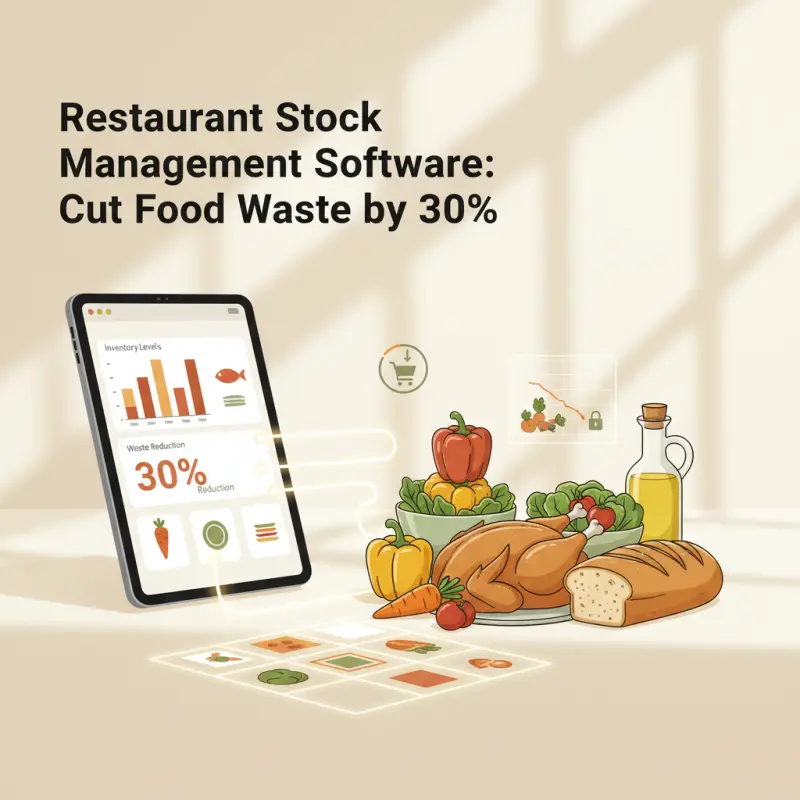
Why Most Restaurant Stock Management Software Fails Small Operations
The Enterprise Software Problem
Walk through any restaurant technology expo and you'll see the same pattern: massive restaurant inventory management software designed for McDonald's, priced for Marriott, and completely unsuitable for your neighborhood bistro. These platforms assume you have dedicated inventory managers, IT departments, and training budgets.
Enterprise restaurant inventory program costs destroy small restaurant economics. A typical "industry-leading" solution runs 3,000-5,000 MAD monthly, requires 40 hours of training, and needs constant technical support. For a restaurant making 150,000 MAD monthly revenue, that's 3% gone before you count a single tomato.
| Software Type |
Monthly Cost (MAD) |
Training Hours |
Best For |
| Enterprise Systems |
3,000-5,000 |
40+ |
10+ locations |
| Mid-Market Solutions |
1,500-2,500 |
20 |
3-9 locations |
| Integrated Platforms |
0-500 |
5 |
1-2 locations |
The Commission Double-Hit
Traditional platforms create a financial squeeze most owners never calculate upfront. They charge 15-30% commission on every delivery order, then add monthly fees for restaurant inventory control software. A restaurant doing 100,000 MAD in platform orders loses 20,000 MAD to commissions, plus another 2,000 MAD for inventory features.
This 22% total platform cost turns profitable restaurants into struggling ones. You're paying twice — once to get orders, again to track what you ordered. It's like hiring someone who charges you to work and charges again to tell you what they did.
What Actually Works: The Three Non-Negotiables for Restaurant Inventory Software
Real-Time Recipe Costing
Moroccan cuisine demands precision. A proper beef tagine uses 23 ingredients, from preserved lemons (12 MAD/100g) to ras el hanout (45 MAD/100g). When saffron prices jump 20% or local beef suppliers raise rates, your menu prices need immediate adjustment.
Effective restaurant stock management software tracks ingredients to 0.1g precision and automatically recalculates dish costs. When your tagine recipe calls for 3g of saffron at 2,000 MAD per 100g, the system shows exactly 60 MAD in saffron cost. Multiply across 23 ingredients and you know your true food cost instantly.
This granular tracking revealed shocking truths at Restaurant Palais in Rabat. Their famous lamb couscous showed a 45 MAD food cost on paper but actually cost 67 MAD after accounting for garnishes and sides. They'd been losing money on their signature dish for two years.
Automated Purchase Orders Based on Par Levels
Par levels prevent both stockouts and waste by maintaining optimal inventory. Set minimum and maximum quantities for each ingredient, and let the system generate orders when you dip below minimums.
Restaurant Kasbah in Agadir connects their restaurant inventory management software directly with three local suppliers. When onion stock drops below 15kg (their three-day par), the system automatically emails their vendor for a 30kg delivery. No midnight phone calls. No forgotten orders. No empty bins during Friday lunch rush.
Smart par levels adapt to seasons. Summer in Agadir means 40% more seafood orders, so the system adjusts fish pars automatically based on previous July data. This responsive ordering cut Kasbah's seafood waste from 25% to 8%.
Mobile-First Design for Kitchen Staff
Your prep cook won't log into a desktop during service. They need restaurant software inventory on their phone — fast, simple, works with wet hands. The best systems require 30 seconds to count and update any ingredient.
Look for visual interfaces showing ingredient photos, not just text lists. When your kitchen team can tap a tomato image and enter "12kg" faster than writing on paper, they'll actually use the system. Resistance drops when technology makes jobs easier, not harder.
The OCHI Approach: Zero Commission, Full Control
OCHI builds restaurant management differently. Instead of charging commissions on orders then adding inventory fees, everything lives in one platform at zero commission. Your branded site at yourname.ochi.ma includes complete stock tracking alongside ordering, POS, and kitchen management.
Restaurant Riad Atlas in Marrakech switched to OCHI's integrated inventory system in January. By April, they'd cut food waste from 28% to 18% through gram-level ingredient tracking and automated low-stock alerts. Their lamb supplier receives purchase orders automatically when stock drops below par. Kitchen staff update counts on mobile during prep. Management sees real-time food cost percentages on every dish.
The numbers tell the story: Riad Atlas saves 14,000 MAD monthly through waste reduction alone. They pay zero commission on the 300,000 MAD in monthly orders flowing through their OCHI storefront. The restaurant inventory control software that enables these savings comes included — no extra monthly fees eating into recovered profits.
Integration matters more than features. When your inventory system talks directly to your POS, every sale automatically deducts ingredients. Sell 20 tagines and the system removes 4kg of beef, 600g of vegetables, and 60g of spices from stock. No manual deduction. No human error. Just accurate counts that match reality.
Your 90-Day Implementation Plan
Month 1: Data Collection
Start by measuring current waste. Track every spoiled item for 30 days — the wilted mint, the sour milk, the forgotten fish. Most restaurants discover they waste 25-35% of purchases. Document your three most expensive ingredients by total monthly spend. Calculate staff hours spent on manual counting and multiply by hourly wages. This baseline data proves ROI later.
Create simple categories: proteins, vegetables, dairy, dry goods, beverages. Don't attempt to track 500 items immediately. Focus on your top 50 ingredients that represent 80% of food costs.
Month 2: Software Selection and Setup
Choose restaurant stock management software that fits your operation size, not your growth dreams. Train one kitchen manager thoroughly rather than everyone poorly. They become your champion who trains others.
Run parallel tracking for accuracy. Continue manual counts while the software learns your patterns. When both systems show matching numbers for two weeks straight, you're ready for full deployment. Set conservative par levels initially — better to order frequently than waste product while learning.
Month 3: Full Deployment
Stop manual counting completely. Trust the system. Measure waste reduction percentage against your Month 1 baseline. Most restaurants see 15-30% waste reduction within 90 days. Adjust par levels based on actual usage data — the software now knows your true needs better than estimates.
Review food cost percentages weekly. When costs creep above target, investigate immediately. The faster you spot problems, the smaller they stay.
Modern restaurant success requires systems that work as hard as you do. The right restaurant inventory program transforms midnight chaos into morning clarity. Ready to see gram-level tracking in action? Set up your branded restaurant platform at votrenom.ochi.ma — inventory management included, zero commission on orders.